By Gil Chan, Founder, CraftedStays · Prices checked October 2026 against each vendor's public pricing page
Most vacation rental websites never book anything. Hostaway asked 326 operators about this in 2026. Seven in ten had a direct booking site. Of those, 62% got less than a quarter of their bookings from it. The site is up, and the bookings still come through the platforms.
This guide is for operators who run a property management system (a PMS) and want the website to sell. If you manage five properties or five hundred, the steps are the same. I cover the five ways to build one and what each costs over a year. Then the steps in the right order, what breaks when you move off an old site, and a checklist for launch day.
I run CraftedStays, which is one of the five routes. I say where it fits and where it does not.
Yes, if you want guests to book you again without paying a platform for the introduction. For professionally managed US rentals, direct bookings were 39% of revenue in 2025, according to Key Data. That was 26% of reservations. Direct guests stay longer and pay more per booking.
The other side of that number: the three big booking platforms went from 53% of the market in 2019 to 71% in 2024 (Skift). They are not going away. A direct site does not replace Airbnb or Vrbo. It takes the guests who already know you, the ones who search your brand, and the ones who would rather not pay a service fee. It books them on your terms.
Two groups should wait. If you have one property and no repeat guests yet, the free booking page from your PMS is enough for now. If you have no photos worth showing, fix that first. A website cannot sell what it cannot show.
There are five routes. The right one depends on how many properties you run and who will maintain the site after launch.
| Route | Best for | Time to launch | Who maintains it |
|---|---|---|---|
| Your PMS's built-in site | One to ten properties, no brand yet | A day | The PMS vendor |
| All-in-one builder (Lodgify, Smoobu, Uplisting) | Small portfolios without a PMS | Hours to days | You |
| Platform paired with your PMS (CraftedStays) | Operators on Guesty, Hostaway, Hospitable, OwnerRez or Hostfully who want a storefront, not a brochure | Days to two weeks | The platform |
| WordPress build by an agency | Large portfolios with a marketing team and a project budget | 6 to 8 weeks | You, or the agency by the hour |
| Generic builder (Wix, Squarespace) or WordPress you build | One property and time to spare | Weeks | You |
Each has an honest case.
Your PMS's built-in site (Guesty Websites, Hostaway's booking website, Hospitable Direct, OwnerRez hosted sites, Hostfully's direct booking site) is the cheapest start. It syncs because it is the PMS. The limits show up as you grow: one template, little control over structure, and often a checkout that sends the guest to the vendor's domain.
All-in-one builders bundle the PMS and the site. (We compare fifteen of these and the other routes in our builder comparison.) Good if you have no PMS yet. If you already run one, you would be switching your whole operation to get a website.
A platform paired with your PMS keeps your PMS and adds a site that reads from it: listings, rates, availability, rules. Search, property pages and checkout sit on your own domain, so your analytics see the whole path from search to purchase, and the guest list feeds your own email tool. Pages are structured to be cited in AI answers by default, and the templates are designed for hospitality. This is what CraftedStays does. You give up some design freedom compared with a custom build. You get a site that keeps improving after launch without another project.
An agency build gets you anything you can describe. If you have twenty properties and a marketing person who likes WordPress, it can be the right call. I have seen it work. I have also seen the three-year-old version, which is a site frozen on launch day. An operator who came to us this year had a three-year-old agency WordPress site that cost $3,000. The PMS connection dropped, photos stopped updating, and "Book Now" on the property pages bounced back to the search page. Every fix was a ticket.
A generic builder is fine for one property with a booking plugin. Past three or four properties, the calendar sync and the search become the job.
Prices checked October 2026 against each vendor's public pricing page. Vendors without a public price are marked "quote".
| Route | Upfront | Monthly, 2 properties | Monthly, 30 properties | Fees on direct bookings | Who maintains it |
|---|---|---|---|---|---|
| Your PMS's built-in site | $0 | Bundled, or a small add-on (OwnerRez: $15) | Bundled | 0% to 4%, by PMS plan | The PMS vendor |
| All-in-one builder (Lodgify, Smoobu, Uplisting) | $0 | $26 to $51 | Quote | 0% (Uplisting pay-as-you-go: 3%) | You |
| Platform paired with your PMS (CraftedStays) | $0 self-serve. White Glove from $2,500, Growth from $7,500, Enterprise from $14,000 | $89.99, plus $8 per added property | $240 on the portfolio plan | 0% | The platform |
| WordPress build by an agency (Boostly, Hudson Creative, ICND) | $5,000 to $25,000 (quote) | $200 to $300 hosting and upkeep | Same | Depends on the plugin | You, or the agency by the hour |
| WordPress you build | $200 to $600 for the theme and plugins | $15 to $60 hosting | Same | Depends on the plugin | You |
| Generic builder plus a booking plugin (Wix, Squarespace) | $0 | $19 to $40, plus the plugin | Same | 0% to 2% store fee, plus the plugin's fee | You |
Three notes on the table.
The agency range is wide because the quotes are. Lodgify's own guide puts an agency build at $5,000 to $8,000 plus $200 to $300 a month. Agency directories list vacation rental projects up to $25,000. The operator above paid $3,000 three years ago and spent more than that on fixes.
The subscription is the small number. The hours are the big one. A WordPress site is six or seven moving parts: domain, hosting, theme, booking plugin, payment gateway, SSL, SEO plugin. Each one updates on its own schedule. When one breaks, it is usually the booking flow that stops.
Fees on direct bookings matter more than the subscription once you are booking. A 4% fee on $300,000 of direct revenue is $12,000 a year. That pays for a lot of subscription.
Start from the PMS, not the design. Your listings, rates, availability, booking rules and photos already live there. The site should read them, not copy them.
If you copy, you will have two calendars within a month. Someone will book a night you already sold. The only fix is one calendar that everything else reads from.
Which PMS you run decides which routes are open. Guesty, Hostaway, Hospitable, OwnerRez and Hostfully each have a built-in site, and each connects to outside platforms. Streamline and Track operators mostly use agencies today. If your PMS is not on a platform's list, ask before you sign anything. "We integrate with everything" usually means a calendar feed. A calendar feed is not live rates and rules.
A real connection does four things. It pulls every property with photos and amenities. It shows live availability and the price for the dates the guest picked. It applies your minimum stays, gaps and fees. And it pushes the booking back into the PMS so the OTA calendars close.
One market or ten, a portfolio site needs four kinds of pages. A search page with filters. A page per market. Collection pages for the ways guests ask: pet friendly, sleeps 12, on the water, near the slopes. And a page per property.
Guests do not ask for "a vacation rental". They ask for "a pet friendly cabin near Broken Bow that sleeps ten". AI assistants answer in those terms too. In our study of 1,407 AI answers across 10 US vacation-rental markets, October 2026, the managers the assistants named and linked most often had a page for each way guests ask. 75% of them had three or more kinds of landing page, against 38% of the managers who were never named. The town was in the page titles for 86% of the most-named managers and 32% of the never-named. This is a snapshot from October 2026. AI answers change week to week, so treat it as a read on the moment, not a permanent rule.
A storefront has a page for every question a guest asks. A brochure has a home page and a list.
Every property page needs the facts in the first hundred words: sleeps, bedrooms, baths, and the distance to the thing people come for. Then twenty or more photos, a map, the rules, and reviews.
Write the description for the guest who has three tabs open. Lead with what makes this one different. Put the hot tub in the second sentence, not the ninth paragraph. List amenities as a list, not a paragraph. Add drive times to the two or three places your guests go.
Reviews belong on the property page, pulled from your PMS so they stay current. If your platform can mark them up so search engines read the rating, turn that on.
Photos are the one thing no platform can fix. If yours are phone shots from 2019, the budget for a photographer comes before the budget for a website.
Show the direct price next to the Airbnb and Vrbo price for the same dates. Then keep the guest on your domain all the way through checkout.
The price comparison does the selling. A guest who sees $1,240 on your site and $1,410 on Airbnb for the same week does not need a banner that says "book direct and save".
Every redirect loses guests. Picture the path from your property page to a vendor's checkout page, with a different logo and a different web address. That jump is where a share of guests stop. They were not sure they trusted you yet. The new address confirmed the doubt. If your route sends checkout off your domain, know that going in.
Instant book or inquiry? For most operators, instant book with your PMS rules applied. Inquiry forms feel safer and convert worse.
Run payments through the processor your PMS already uses. One more processor is one more place money can get stuck.
Put the cancellation policy, the deposit and the house rules one click from the price. Guests who cannot find the policy assume it is bad. Say the fee structure plainly: nightly rate, cleaning fee, taxes, total. No surprises on the last screen.
A note on Hostfully: checkout runs on Hostfully's side regardless of the website in front of it. That is fine, as long as you know it before you compare routes.
Pages broken into many short sections, each answering one question, are the pages search engines and AI assistants can lift an answer from. A long page with one heading and a wall of text is not.
When I say an AI assistant "cites" a manager, I mean it said their name and sent people to their website with a link. That is the thing worth having.
Three habits do most of the work.
Put the place name in the titles and headings. "Cabins in Broken Bow that sleep 12", not "Our properties".
Build a page for each guest question, not one page for everything. See Step 2.
Add a short questions-and-answers block to the pages that matter: the market page, the big collection pages, the property pages. Real questions, two-sentence answers.
More on how AI assistants pick sources is on our AI search page. What did not matter in our study: llms.txt files, markdown copies of pages, and AI-specific robots rules made no measurable difference in who got cited. Spend that time on the pages.
One more number from the same study, for the skeptics. 70% of the AI answers we looked at cited a property manager's own website (967 of 1,377 answers from ChatGPT, Gemini, Perplexity and Google's AI Overview). The booking platforms appeared in 81%. Managers are not shut out of AI answers. The ones with the pages get in.
This is correlation, not cause, and a snapshot from October 2026. I would not promise anyone a spot in ChatGPT. I would build the pages.
Twelve checks before you point the domain.
Map every old web address to a new one before launch. Keep the property addresses if you can. Submit the new sitemap the day you switch. Done well, expect a four to eight week wobble, not a cliff.
This is the step every guide skips and the one operators fear most. Here is what is going on underneath.
Google has a list of your old pages. Each one has some standing: links from other sites, history, rankings. When a page disappears, that standing goes with it. When a page moves and you tell Google where it went (a 301 redirect), most of the standing follows.
So the work is a spreadsheet. Column A: every address on the old site. Pull it from the old sitemap and from Search Console's pages report. Column B: the new address for each. Property pages map to property pages. Market pages to market pages. Blog posts to blog posts. Pages with no new home map to the closest page, not the home page.
Then three things on launch day. Load the redirect map. Submit the new sitemap in Search Console. Ask Google to recrawl the ten pages that matter most.
Things that go wrong: the old site had 400 property pages and the new one has 380 because 20 left the program; map them anyway. Photos were hosted on the old domain and now show as broken. The old site had a blog nobody mentioned; move it or lose it. Someone turned off the old hosting the day before the redirects went live.
If an agency or platform tells you rankings will "transfer automatically", ask to see the redirect map. Nothing transfers on its own.
A PMS built-in site: a day. A platform paired with your PMS: a preview built from your own properties the same day. Launch takes days to two weeks, depending on how much you change. An all-in-one builder: a few days. A WordPress site you build: weeks of evenings (the step-by-step is here). An agency build: 6 to 8 weeks, and 3 to 4 months for a full transition off an old site, by the agencies' own numbers. ICND, which has built sites for hundreds of managers, publishes those figures itself.
Add the time to write. Whatever route you pick, the market pages and the collection pages need words a guest would read. Nobody else can write "why our guests come to Gulf Shores in October". Budget a day per market.
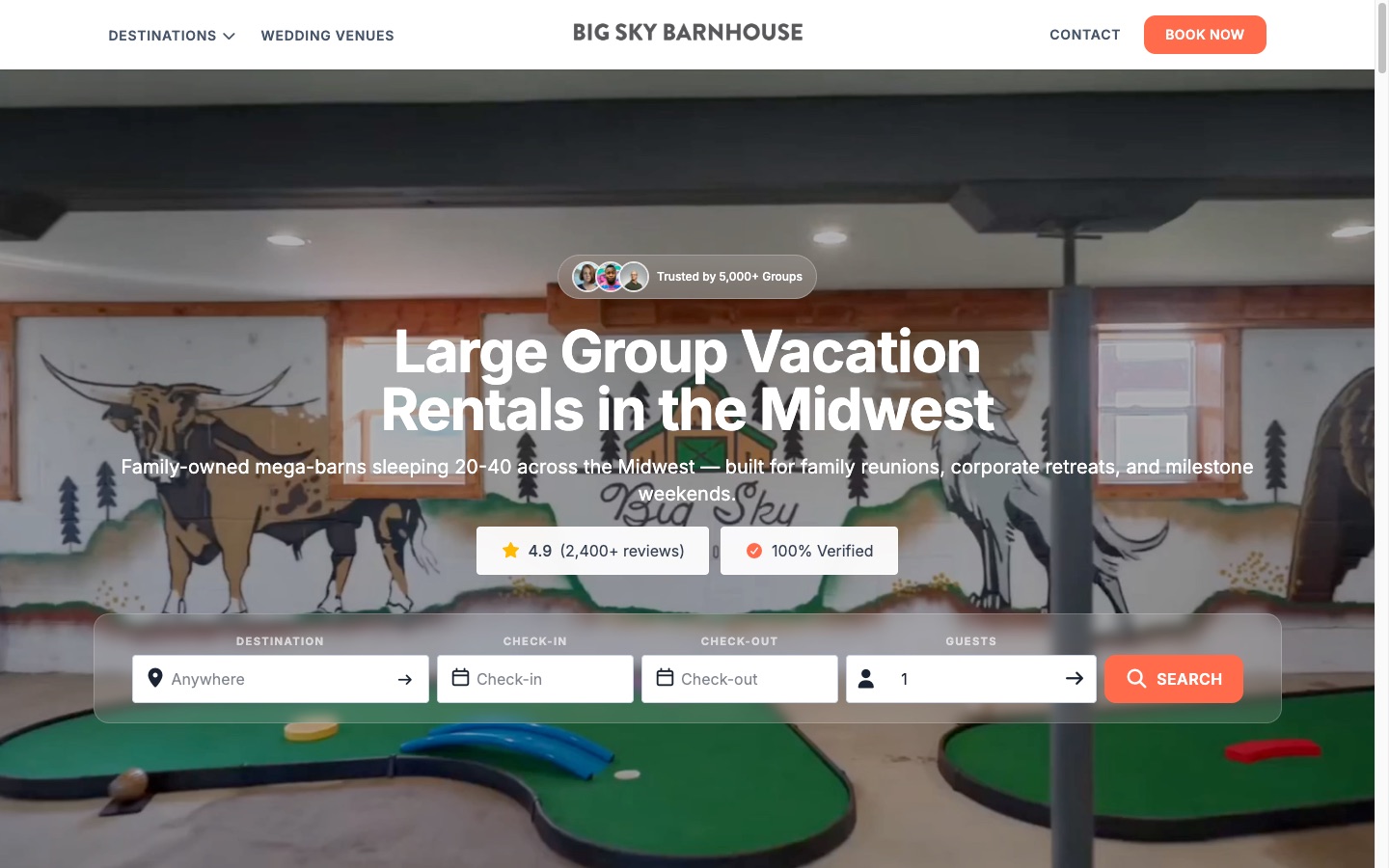
Big Sky Barnhouse runs fifteen mega-barns for groups of 20 to 40 across eight Midwest states, and every state has its own page. Property pages lead with the facts (20 guests, 5 bedrooms, 4 bathrooms), say "book direct and save 15%" above the calendar, and keep the booking on the domain. The site took $60,000 in direct bookings in its first seven days.
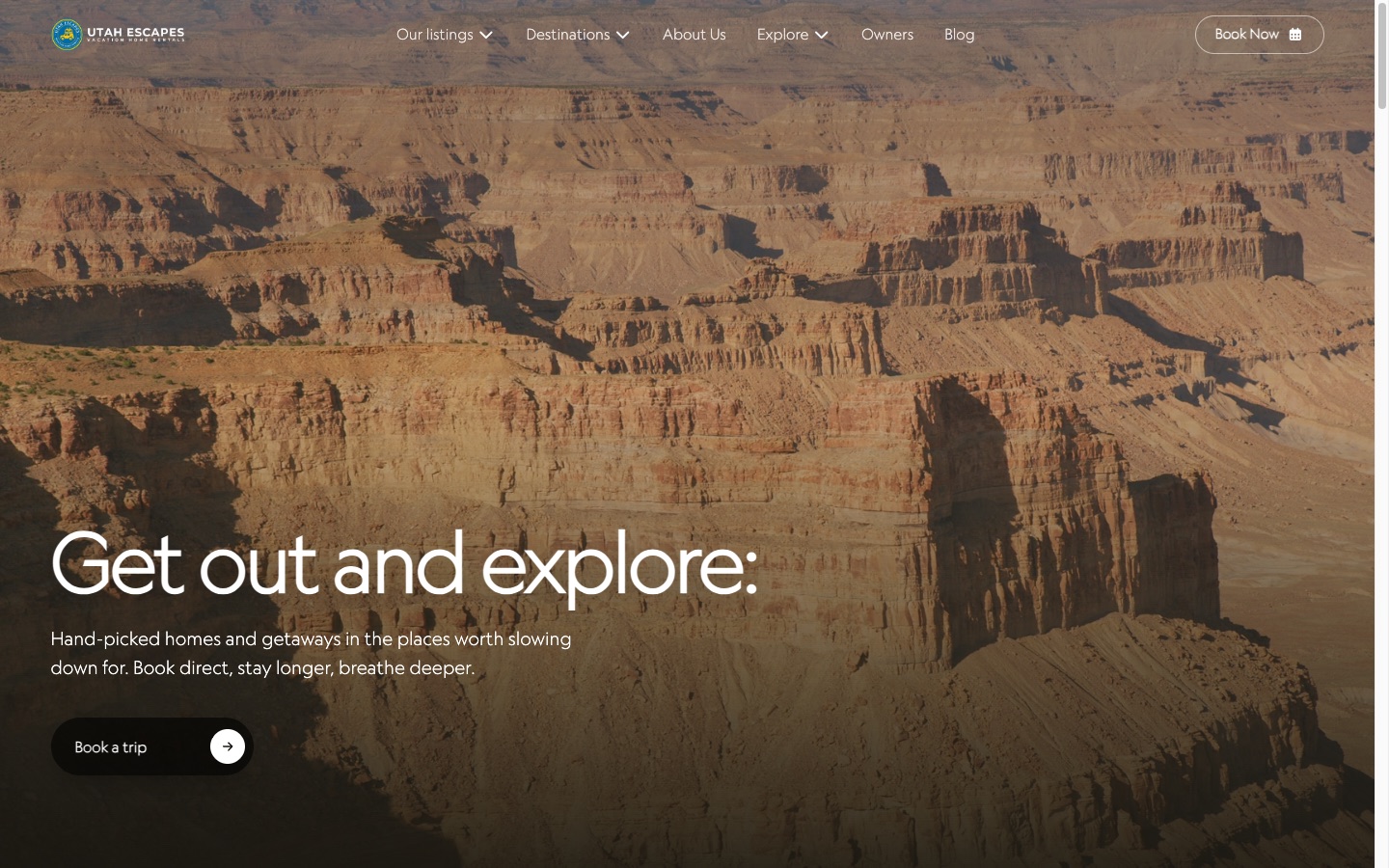
Utah Escapes puts 50-plus homes across Moab, Kanab, Park City, Greater Zion, the La Sals and the Salt Lake area under one search. The homepage says what the brand is for in one sentence and puts the search box under it. Guests book through the site's own checkout and deal with the operator, not a platform.
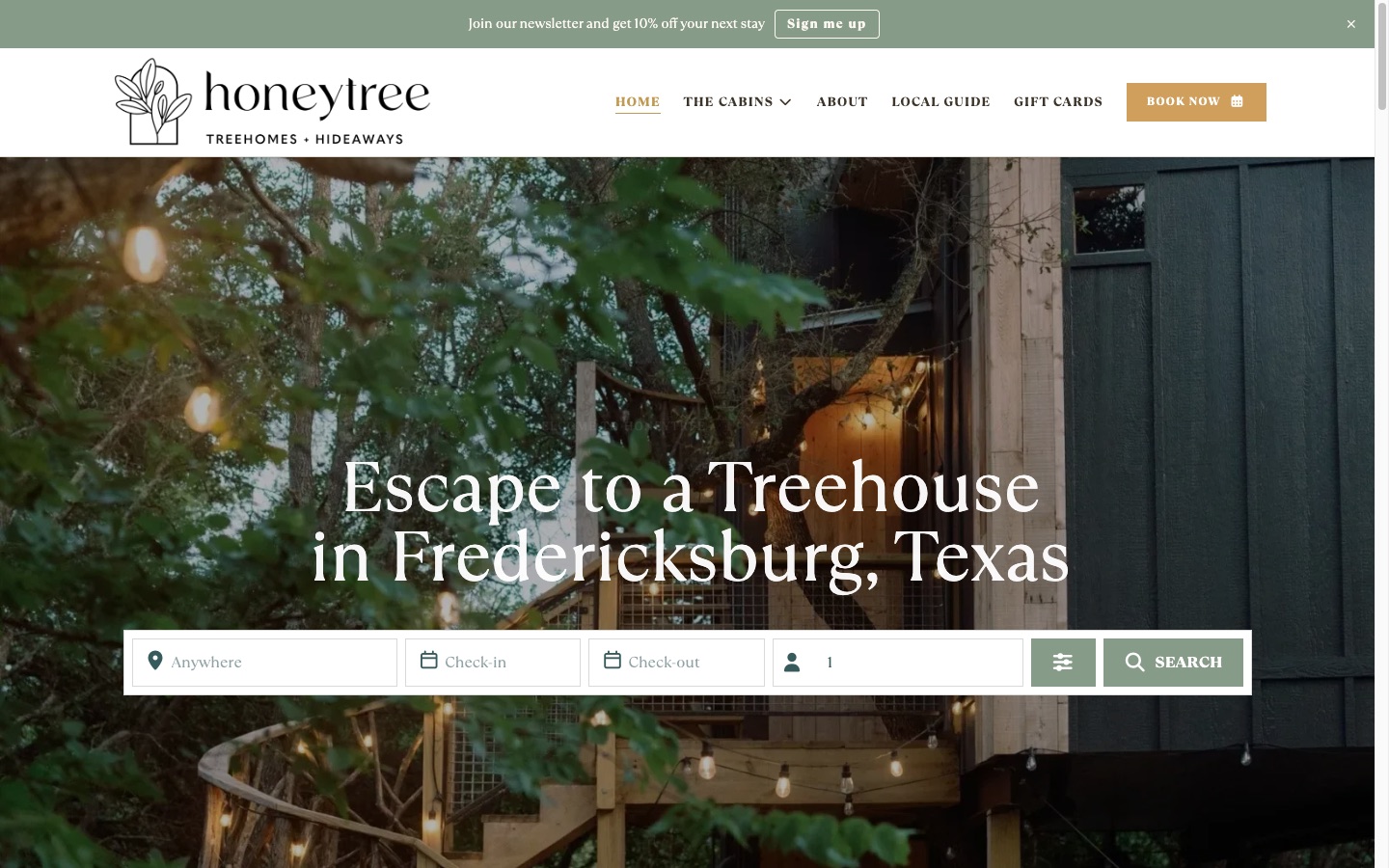
HoneyTree is seventeen treehouse cabins at two Fredericksburg, Texas locations. Each location has its own page, each cabin has its own, and a local guide and gift cards sit beside them. The brand carries the site and the booking engine sits behind it.
More examples are on the portfolio page. What the three have in common is boring: facts first on every page, one price, checkout on their own domain, and a page for each question guests ask.
Between nothing and $25,000 upfront, and $0 to $300 a month, depending on the route. The table above has the current numbers. The hidden cost is the hours to maintain a site you own every piece of.
No, for four of the five routes. A WordPress site you build yourself needs someone comfortable with plugins and hosting.
Yes. Most operators run both. The direct site books the guests who already know you and the ones who search by brand or by market. The platforms keep bringing new ones. Your PMS keeps the calendars in sync.
Professional US managers averaged 39% of revenue direct in 2025 (Key Data). Most operators are well under that. In Hostaway's 2026 survey, 62% of those with a site got less than a quarter of their bookings from it. The gap is the site and the follow-up, not the market.
If you run Guesty, Hostaway, Hospitable, OwnerRez or Hostfully, yes, through their own built-in site or through a platform that connects to them. Ask any vendor for the list of PMSs they sync rates and rules with, not just calendars.
Set the direct rate at or below the OTA rate after fees, and show both on your site. Many operators price direct at the OTA rate minus a share of the platform fee. The guest sees the saving without you going below what you net today.
No. One site with a page per property, grouped by market and by collection, is what guests and search engines both prefer. A single-property brand site makes sense when the property is the brand.
Repeat guests and brand searches start within weeks if you tell past guests the site exists. Search traffic takes months and depends on the pages you build. Nobody books a site they cannot find.
Gil Chan is the founder of CraftedStays, the direct booking platform for professional property managers. He spent 15 years building software, about seven of them in e-commerce, before starting CraftedStays. CraftedStays was named 2025 Direct Booking Website Builder of the Year by Travel & Hospitality Tech Outlook. Spotted an error on this page? Email gil@craftedstays.co and he will fix it.
If you run Guesty, Hostaway, Hospitable, OwnerRez or Hostfully, connect it to a platform and look at the preview built from your own properties before you pay anyone for a design. You will learn more from twenty minutes with your real listings on a real page than from any proposal. If the preview does not sell your properties better than your current site, close the tab. If it does, you have your answer.
14-day free trial · No credit card required
The platform behind high-performing direct booking websites for short-term rental operators.
