
🎙️ “Soft Stuff Is the Hard Stuff”
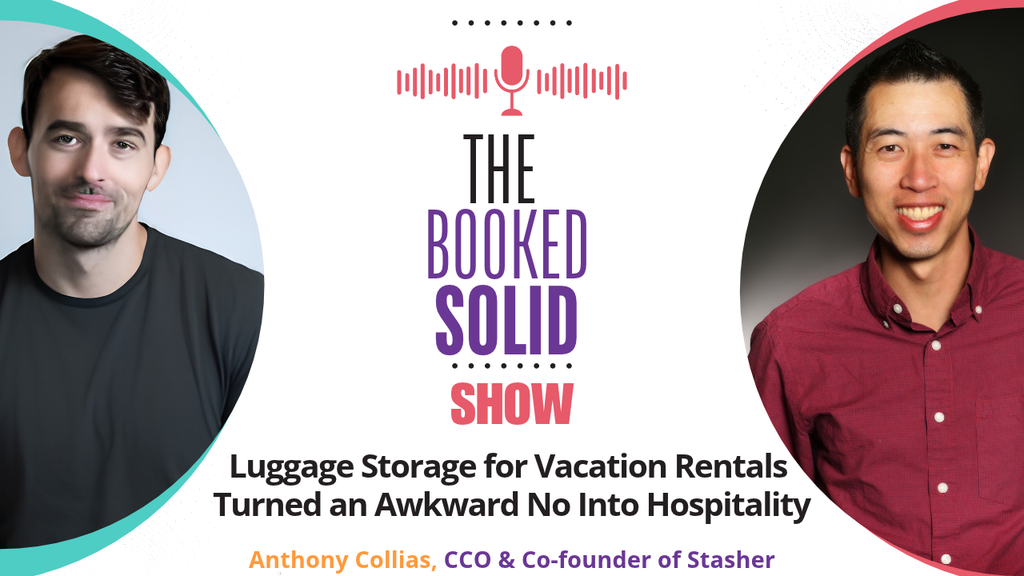
Every host knows this message: “Can I just drop my bags early?” On this episode of the Booked Solid Show, Gil Chan sits down with Anthony Collias, cofounder of Stasher, to talk about luggage storage for vacation rentals. It’s a small service, and it shows how guests decide whether you really care about their stay. You’ll hear why Stasher’s first storage spot failed and how small USPs now get picked up by AI search. Anthony also explains how to use AI without losing the human side, and gives one task you can finish this afternoon to grow repeat bookings.
👋 Meet Anthony Collias
Anthony “Ant” Collias is the cofounder and Chief Commercial Officer of Stasher. Stasher is a luggage storage network that lets travelers leave bags at hotels, local shops and smart lockers in more than 1,000 cities. He started it in 2015 with a friend from university, after guests and friends kept asking to leave bags at his London flat between Euston and King’s Cross.
Ant studied economics, politics and philosophy at Oxford and was named to Forbes 30 Under 30 Europe. Now based in Madrid, he focuses on how travel businesses find customers and make money. He believes STR operators should depend less on any single platform and use AI to grow without adding unnecessary costs.
🔑 Key Takeaways
- 🧳 A partner service gives guests a real answer instead of an awkward no.
- 🏪 Stasher’s first storage spot was Ant’s apartment, and it taught him that reliability beats enthusiasm.
- 🛡️ Direct bookers need reassurance upfront: clear policies, stated services and a professional site.
- 🔍 AI answers love small differentiators, so put them where search engines can read them.
- ✨ Low effort gestures can leave a lasting impression on guests.
- 🤖 Use AI to elevate service, and always tell guests when they’re talking to it.
- 📬 Collecting guest contact details is the simplest path to repeat stays.
🧳 From a Joke to a Global Network
Ant was an Airbnb host in one of the busiest luggage storage areas in the world. His London flat sat between two major train stations, and guests and friends were always asking to leave their bags. He joked that he should start charging them, and the idea stuck.
He and his cofounder built a simple website where people could book a spot to leave their things, including Ant’s own guests. That small experiment grew into Stasher. Today it works with hotels, independent shops and smart lockers, and it’s rolling out its own dedicated luggage lockers.
For hosts, the value is easy to see. When a guest arrives at noon and check in is at 4 PM, your cleaner is inside and there’s no concierge to help. As Ant puts it, Stasher offers “the nicest way possible to say no.” The guest gets a convenient place for their bags, often at a discount, and the host can earn a referral fee.
🏪 Why Apartments Failed and Shops Worked
The early days involved Ant racing home in the middle of the day to store a single bag for about $2. It didn’t take long to see the problems. People aren’t home on a reliable schedule, few travelers book storage far ahead, and nobody wants strangers in their home for a tiny commission.
Businesses solved all three problems at once. They keep fixed hours and are easy to find, and travelers can judge for themselves whether they trust them. Because the shop is open anyway, with staff and space already in place, the economics work for everyone.
There’s a lesson for operators here. The idea that sounds exciting isn’t always the one that scales. Building around what customers can count on usually wins.
🛡️ Trust Is Built Before the Booking
Ant sees a direct parallel between what Stasher had to prove and what every direct booking site needs to prove. Guests have to believe they’re just as safe booking with you as they would be on a big platform.
Part of that is explicit. How do your cancellation, refund and damage policies compare? Part of it is practical. If a guest is worried about an awkward arrival time, seeing “24 hour lockbox access” or “luggage storage nearby” upfront can be the deciding factor. Our guide to building trust on your direct booking site covers more ways to remove those doubts, and so does our piece on the trust factor in guest confidence.
Then there are the soft signals. “If your website looks like it’s from the ’90s,” Ant says, guests start wondering whether you’re legitimate. A clean, professional site is part of your hospitality, even before a guest arrives. The same thinking applies to clear pet policies, FAQs and every other detail that answers a question before it’s asked.
🔍 Small USPs Now Win in AI Search
Ant has noticed something about AI search. When someone asks an AI chatbot for a recommendation, it usually returns a list and explains how each option differs. Small details that used to sit halfway down a page are now the ones AI picks out to tell options apart.
Gil sees the same opportunity for hosts. Vacation rental schema tells search engines about your property, including its amenities. Property-level FAQs can answer questions like “Can I store my bags before check in?” with a specific yes and a nearby location.
If you want to go deeper, read about how ChatGPT picks vacation rental sources and why long tail SEO matters for niche searches. Our AI search optimization guide walks through the basics. A small USP costs you almost nothing when a partner provides it, and it can decide who gets recommended.
✨ Little Touches Guests Remember
Ant points to Unreasonable Hospitality, the book by the former head of Eleven Madison Park. His takeaway is that many standout gestures aren’t hard at all. He describes a sign in WeWork’s bathrooms offering a toothbrush or floss to anyone who forgot theirs. Hardly anyone asks, but everyone notices.
Gil shared his own version. His welcome messages tell early arrivals about the grocery store nearby and the pantry space at that specific property. Guests start their stay stocked and settled, and they feel looked after from the first hour.
You don’t need dozens of these. Two or three well chosen touches across the guest journey can change how a whole stay is remembered. That idea runs through Dave Goodfellow’s mid stay phone calls and our post on guest experience marketing. Tailoring helps too: suggest kid friendly activities for families and nightlife for groups. “They actually wrote this just for me” is a feeling guests remember.
🤖 AI That Elevates Instead of Replaces
Both Gil and Ant are excited about AI and hospitality coming together. Ant also gives a warning, using Klarna’s experience: the company cut support staff in favor of a chatbot, then hired people back when the bot fell short.
His advice is to use AI for what you couldn’t do before. Answer simple questions instantly, personalize at scale, and free your team for the harder work. Be upfront that guests are talking to AI, and make it easy to reach a human. Gil sees the same thing at CraftedStays, where AI helps the team triage support faster so the people can focus on harder problems.
Sabrina Mulligan made a similar case for building a human brand with AI guest communication. We also wrote about what happens when your AI support tool isn’t actually supporting your customers.
📬 The Afternoon Task That Builds Repeat Bookings
Ant’s tactical advice is simple. First, if you don’t have a well managed direct booking website, get one. Second, sit down this afternoon and check whether you’re actually capturing guest contact details.
A friendly “if you’re ever coming back, let me know” message to a mailing list is still the simplest source of repeat bookings. Partner services can help here, the same way restaurants offer WiFi in exchange for an email. Arthur Colker explained how guest data collection through StayFi turns WiFi logins into revenue, and our complete guide to collecting guest emails covers how to do it in a compliant way.
⚡ Rapid Fire with Anthony
📚 Book recommendation: The Old Man and the Sea by Ernest Hemingway. Ant reads it as a story about perseverance. Even when an effort seems to end in nothing, the lesson is still worth having. He also mentioned Unreasonable Hospitality by Will Guidara.
🧠 Mindset advice: Expect to look a little silly at the start. Growth is slow and quiet before it’s visible, so keep going through that stage. Also learn the difference between perseverance and stubbornness, which Ant says is more art than science.
🛠️ One thing to do this afternoon: Check whether you’re collecting guest contact details, and start building your list.
🤝 Connect with Anthony Collias
- LinkedIn: Anthony Collias
- Website: stasher.com
- Partner program for hosts: partners.stasher.com
- Partnership enquiries: partnerships@stasher.com
🎧 Listen, Learn, and Build Direct
Listen to the full conversation with Anthony on the Booked Solid Show for the complete story behind Stasher and more on guest experience. When you’re ready to turn those small touches into bookings, visit CraftedStays.co and start booking direct.

Anthony: At WeWork, they have signs in the bathroom that say, “Did you forget any essentials? Just ask the team and we’ll get it for you.” Toothbrush, mouthwash, floss, whatever you need, they’ll get it for you. Putting that sign up takes no effort at all. Very few people are ever going to ask them to fulfill it.
But the impression it gives you is, wow, okay, that’s pretty cool. They really do think about you. Likewise, there are a lot of things that aren’t actually that big of an effort for you, but the impression they give is really, really strong.
The classic cases are little things like gift hampers, particularly if they’re little local things, or a handwritten note. That’s all been done a lot now. But still, the average vacation rental doesn’t do it.
It doesn’t take that much effort, and it radically changes the impression people have of you and of their stay.
Gil: Before we bring on our guest, I wanted to talk a little bit about something I’ve been hearing a lot from hosts. I keep hearing the same thing: “I know my website isn’t converting, but I can’t afford $8,000 on an agency to rebuild it.” Here’s the thing. You’re learning all these marketing strategies, you’re driving traffic, and you’re putting it all to work, but if your site isn’t built to convert, you’re basically lighting your energy and money on fire.
And even if you could afford an agency build, every time you want to test something or make a change, you have to pay them again. You can’t iterate, you can’t test, and you really can’t improve. You don’t need a custom $10,000 website to get the conversion rates that matter. You just need the right platform.
That’s why I built CraftedStays. It’s purpose built for short term rentals and designed from the ground up to help you drive more direct bookings. You can finally turn that traffic into bookings, and you can keep testing and improving as you learn. You can make changes right on the platform. You don’t need to learn something new.
So if you need some help or you want to get started, go to craftedstays.co and start your free trial. Now let’s bring on our guest and dive deep into hospitality and marketing.
Hey, folks. Welcome back to the Booked Solid Show, the show where we bring in top operators to discuss hospitality, operations, and direct booking.
On today’s show, we have Anthony from Stasher. Today, he shares how he elevates the guest experience through the small things, and how he’s built one of the largest networks solving a real guest pain point: holding bags before the rental is ready. We had a great discussion on why he started this in the first place and how it makes a big difference when thinking about driving repeat bookings.
So without further ado, let’s bring him in.
Gil: Anthony, welcome to the show.
Anthony: Hey, thank you for having me.
Gil: We had a little bit of a chance to catch up, and admittedly, I hadn’t come across you before, but it was really interesting to hear you describe what you’ve been building over the last decade.
To kick us off, Anthony, give folks a brief introduction on who you are and what you’ve been cooking on.
Anthony: Sure. Quite simply, we run a platform for short term storage, particularly for vacation rental guests. So your guests are turning up, you have your check in time, maybe 2:00, 3:00, 4:00 PM, whatever that is. And I’m sure everyone listening to this has had tons of customers messaging, kind of sheepish, saying, “Hey, do you mind if I stop by?”
And you’re like, “I’m sorry, the cleaner’s there.” And they’re like, “Well, I don’t mind if the cleaner’s there. Can I just leave my bags?” Basically, we help resolve that problem. Same at checkout. You kick people out, and they say, “Hey, my flight’s not until later, can I leave my stuff?” For many of your listeners who run their own properties, there’s no concierge, there’s no communal area, and there isn’t necessarily constant access.
And like I say, you want your cleaner to come in, and you don’t want the confusion of people traipsing around with their bags or messing stuff up. It’s just so much easier to say no. So we give you the nicest way possible to say no to that, while actually giving the customer a discount on that typical service and letting them leave their stuff somewhere more convenient.
And in many cases, we also give you ancillary revenue, a referral fee for every customer who uses it.
Gil: That’s very interesting. I remember traveling to Japan with all this luggage, and we explicitly had to call the hotel in advance to see if we could leave our luggage there, because we were going overseas and weren’t landing at an ideal time.
We were landing right in the middle of the day, when our check in wasn’t ready yet. So I can totally empathize with what you’re building. But if you rewind to when you first started the company, what sparked the inspiration to go down this path?
Anthony: Well, this is probably completely unoriginal to all of your listeners, but I was an Airbnb host. I was living in London, between Euston and King’s Cross. I’m based in Madrid now, but back then I was living between Euston and King’s Cross with my brother.
We were doing Airbnb, and between Airbnb guests and friends, people were always asking to leave stuff at our apartment. It happens that, in terms of luggage storage, that’s probably one of the highest value square miles in the world, because there are two major stations.
If you play Monopoly, the British version, I don’t know if there’s a different American version, I think they still keep the English names, right? You have Mayfair as the blue one.
Gil: I think the blue one is Boardwalk on our side.
Anthony: The stations are King’s Cross and Euston, which are about a mile apart in London, and they’re two of the busiest train stations probably in the world. They must be some of the busiest in Europe. And we were right in the middle.
So people were always asking to leave stuff, and my cofounder was a friend from uni. I’d studied economics, politics, and philosophy at Oxford. He did economics and management. We knew we wanted to start a business. He was doing a master’s at UCL, and they had a startup program.
And we were like, “People seem to want to do this. They want somewhere to leave stuff, so let’s just make a website where they can book and leave their stuff,” including our own guests who were staying with us. And it just rolled from there. The one thing I should say, just so the story isn’t confusing, is that my apartment was the first place, but we very quickly realized apartments didn’t work.
Businesses make way more sense. So now we work with over 10,000 partner locations, a mix of local shops, hotels, and smart lockers. Not Amazon themselves, but lockers like Amazon’s, where you can rent a door. And increasingly, we’re also rolling out our own smart lockers, dedicated luggage storage lockers.
So we do that in about 1,000 towns and cities, with over 10,000 partners, and that’s growing quickly.
Gil: What was it that didn’t work out in the apartment days? It’s probably like almost every startup. You try something out and you’re like, “Oh, that was a bad idea. Let’s pivot.” What was the breaking point with the apartment?
Anthony: For us, we were excited about it. We were racing home in the middle of the day to let people in and store a bag to make, like, $2. And pretty soon we realized two or three things. One, most people were not going to do that. People are not home all the time.
They don’t know when they’ll be home. They don’t have reliable hours when they’re accessible. And most people aren’t booking their luggage storage way ahead. Secondly, for someone to let a stranger into their home, we’d have to take such a small commission for people to consider it worth it.
What we realized with businesses is that they have fixed hours. It’s very clear what they are and where they are, and people can make a judgment about how comfortable they are with that business. And because the business is open anyway, they have the space anyway, and it brings footfall into the business, the commissions make a lot more sense.
It wasn’t a case where you need to give them most of the money because they have to bother opening up. They’re there anyway. The staff is there anyway. The space is there anyway.
Gil: That’s so interesting. It makes a lot of sense as you say it now, but it probably wasn’t quite as obvious that first time, when you’re like, “Okay, let’s open up this apartment and see how it goes.” And I’m guessing location matters too.
Perhaps someone wants to drop something off when they leave the airport, and they want something close to their route rather than something they have to double back toward. And shops are usually in populated areas where you’d want to spend a little time anyway.
So that makes a ton more sense.
Anthony: Yeah, exactly. Exactly.
Gil: It makes me wonder, as you think about what’s made you successful and some of the things you have to balance, my guess is one of the big things you have to focus on is building trust, where people feel they can leave you their bags, because a lot of very personal belongings and some valuables are in there.
There’s also the network side, making sure you have density of places, but also density of demand. And third, really figuring out the operations for all of that. I’m sure there’s a lot more to it, but does that resonate with you as the most important parts of the business you’ve had to nurture over time?
Or are there hidden ones that are particular to your business?
Anthony: I’d say matching supply and demand density is surprisingly easier than in other marketplaces, because for us, supply is many to one. You find a hotel that has space for 100 bags, and you can store 100 bags. That many people can store there. And the areas where people want to store tend to be very centralized around major transit points and major tourist areas.
More coverage is obviously good, and it gets you more visibility on search engines, for example. The other thing with supply is that it’s easier to be supply led, because supply has no cost to be on there, and the supply is open anyway.
So it’s not like an Uber or Airbnb, where for the people who listen to your show, if you set up your vacation rental, put it live, and don’t get any bookings, it’s a pretty short matter of time before you’re like, “Ah, I’ve made a mistake. I need to go for a long term rental or sell this.”
For us, these businesses are open anyway, so it’s much easier to lead with supply and let demand catch up, which was very helpful for us. That was one of the points. Remind me of the other two?
Gil: Trust and operations.
Anthony: Trust and operations, yep, super important. This is really where platforms stand in the middle.
And for your listeners, as someone thinking about promoting direct bookings, it’s one of the key reasons you need to think, “How do I reassure people that they’re just as safe, or reasonably safe, booking through me?”
Part of that is explicit: what are my actual policies, and how do they compare with booking on Airbnb? How does my cancellation policy compare? How does my refund policy compare? Part of it is practical: what extra services am I offering, or what can I reassure customers I can offer?
Which actually reminds me, you said you were in Japan and had to call your hotel. In some cases, saying this stuff upfront is important, because knowing which services exist will be critical to whether or not someone books. I’ve definitely had it where I’m looking at accommodation, on or off platform, and I know I’m arriving at an awkward time, or I don’t know my arrival time and it might be awkward.
So seeing upfront “24 hour access with a key lockbox” is immediately a qualifier for me. Or if I know I’ll have an awkward departure time, knowing these people provide luggage storage, and obviously I’m biased, can be a determiner. First, it tells me these people are thinking about taking care of me holistically as a guest.
And second, it means one of the doubts I had about booking this place has been resolved, because they communicated it clearly upfront. So that’s definitely part of building trust. For us, a lot of it is the normal platform approach: make sure you’re communicating your USPs clearly.
Make sure you build policies that put your money where your mouth is. You’re saying to customers, “Look, I’m guaranteeing your stuff will be safe up to this cash limit.” I know there isn’t a perfect equivalent in the world of short term rentals, but for you that might be something around your refund, cancellation, or damage policies.
For you, it’s about showing that you’re taking a large share of the risk. In our case, the customer is the one taking the risk with their belongings, so it’s a little backwards, but you understand what I mean. And then part of it is also the soft stuff.
That applies to our platform and also to specific locations on it. People read soft signals very deeply. For example, if your website looks like it’s from the ’90s, people will assume you’re a rinky dink operation.
If I were running a scam, I’d make a low effort website, right? So literally just having your stuff look good and look professional matters. Likewise for us, we’ll tell owners, “Make sure you take a nice picture. Keep the storefront nice and clean.”
And some of it you just can’t control. If it’s a recognized brand, like a Hilton, or a Premier Inn for your UK listeners, people just trust them more. So that’s definitely something we need to work on. And remind me, sorry, the third one?
Gil: The third one’s operations, making sure this is well oiled. I think you can leverage technology quite a bit to put standards and procedures in place, so you’re not the runner who has to deliver things, but you’re making sure standards are upheld. As you mentioned, you may be working with many different drop off points.
I don’t know what your official name is for them.
Anthony: StashPoints. Like a cash point, but for stashing.
Gil: Okay, your StashPoints. You may have many different StashPoints, and from what I picked up, there’s a standard you expect a StashPoint to meet, and if it doesn’t meet that standard, it may get removed. Whether bags are being stored properly, whether guests can find staff.
I’m guessing there are things like that you want to measure against. I’m not sure you do this, but my guess is you have some sort of rating of how the whole experience went and whether that StashPoint met the standard, so you can monitor it and figure out, okay, do we have an issue with this specific partner that we need to address?
Anthony: Yeah. This is one of those things AI has been great for. I’m sure most of your listeners, whether through your product or things they’ve built themselves, have found there’s a lot of bitty stuff that would previously have been hard to automate and is now a lot easier.
Communications is a really obvious one. It was hard to build templated communications before. Now it can be a lot more flexible and actually inexpensive, so it’s more feasible. The other thing for us, which won’t necessarily be relatable to your listeners, is the initial checking.
It’s much easier to build systems that, even across different countries, can validate that this is a real business. Here are the documents proving it’s a real business operating at this real address. Here’s proof that the person we’re talking to lines up with the actual details.
It’s easier than ever to check that automatically, check photos, and validate the information they’re giving us. And like you say, yes, we do have systems for that. With any kind of customer interaction, it’s very easy to compile it, and you can run an agent daily or weekly that says, “Look, these are the hosts who are starting to look like there might be issues,” based not just on review scores, which was easy before, but on a bunch of different signals put together. It might say, “This host looks like they might be a problem host.
Consider removing them from the platform, or consider nudging them in this way to improve.” That sort of thing. It’s all stuff technology basically helps you do better at scale.
Gil: That makes a ton of sense. You mentioned something interesting earlier about a guest going through their buying decision and figuring out where to stay. We’ve been doing a lot of research at CraftedStays on making sure our property managers are found when someone searches for things to do in an area or where to stay in a specific area.
We’ve done a lot of optimizations, and as you mentioned it, I was thinking about helping property managers who use your service get that populated onto their website, structured in a way that lets LLMs and AI chat engines pick it up. If you’re looking on ChatGPT for a place to stay where you can leave your bags, how do we make that show up?
I don’t know if you’ve done any research on this or invested in this area to help your property managers get these places found.
Anthony: We haven’t yet, but it’s obviously the kind of thing we’re super interested in. The difficulty is that for a lot of people, it’s a surface area they don’t necessarily control. So you’d need to look at integrations with direct booking platforms, things like that.
But I’m sure we’ll have a follow up chat now that it’s clicked.
Gil: For instance, when we optimize our websites, we have something on the property pages called vacation rental schema. It basically tells Google where the property is, the description, how many people it can sleep, and the nightly rate.
We also include a list of amenities, and I need to check whether luggage storage is a standard amenity or can be added as a custom amenity. But that’s something that perks up in my mind as we help property managers get found in AI search.
It would be wonderful if a property manager using CraftedStays had some sort of toggle on the back end saying they’re part of this type of service, and we automatically signal to the different AI engines crawling the website that this property qualifies.
So if someone’s searching for a place to stay that allows a 24 hour bag drop, this property shows up. That’s what goes through my mind. I’m constantly thinking about discoverability and conversion.
Anthony: No, it’s true. It’s something we find ourselves. Smaller USPs used to be harder to communicate, but so far my finding is that when you ask an LLM, “Hey, I want this,” it normally wants to give you a list and explain why each option is different.
And suddenly these smaller USPs are often the differentiators it uses to pull things apart in a list. So increasingly, we find smaller things that used to be a line halfway down the landing page are suddenly being pulled into LLM responses as what makes someone different.
So that makes sense to me. It sounds small, but it could matter quite a lot to visibility.
Gil: I don’t know if any of our listeners do this, but we have the capability on our platform for property specific FAQs, and it’s one thing I’d encourage folks to use if they can. If you’re on one of the PMS site builders, you don’t really have that capability.
But if you have a bespoke website or you’re on our platform, you can have property specific FAQs. One FAQ I think should be in there is, “Do you allow early bag drops?” or “Can you store my bags?” And the answer is, yes, we partner with this many locations nearby.
On our platform, you could even programmatically cite the nearest locations within a certain range, do a sweep, and update all your property descriptions or property FAQs at once. So I’m thinking through how to optimize for that visibility. If someone offers this type of service and someone else is searching for it, how do we marry the two so they’re found together?
Anthony: That makes a ton of sense. I think people should be doing that. Differentiating with small USPs like this, which effectively cost you nothing if you’re working with a partner, is a great way to stand out.
Gil: Talk to me a little about some of the wins you’ve seen with your clients, or some of the big successes as you’ve grown. You have a pretty big network now, and it can be anecdotal. You don’t need to name any specific person or organization.
How has this been received? How has it impacted the guest experience or the property manager benefiting from it?
Anthony: It’s interesting. We call the entire function where we work with property managers and similar businesses “partnerships.” That doesn’t sound that novel, but the question is, why don’t we call them affiliates?
In some sense, they function like affiliates. They refer customers, they get some money back, and they also give their users a discount. But the number one piece of feedback or benefit we hear from property managers is operational time saved and operational hassle saved.
They have an easy answer to the question customers are always asking, one that doesn’t require coordinating door access while the cleaner is around. You say “yes,” and suddenly there’s a bunch of messages, awkward timing, and back and forth.
It’s easier to point people elsewhere. And for some people, the answer to avoiding all that is to just say, “Really sorry, no.” But these touches obviously help, particularly when you’re doing direct bookings and trying to build a relationship with a customer.
It gives the impression, “I’m thinking about your experience. I’m building an overall hospitality experience for you, not just yield maxing an apartment by doing this instead of a long term rental.” And it’s a relatively low effort way to do that, because instead of saying no to a request, you’re saying, “Hey, I’ve thought about this, and here’s an answer for you, even though I don’t have a reception or concierge.”
So the most common responses are, “This saves me a ton of time and effort, and it makes my customers happier.” Usually the third response is about ancillary revenue: “This can meaningfully contribute to my bottom line, because it’s all profit.”
In some cases, partners will actually say, “I want to give a bigger discount because I just want customers to be happy, so I’ll give up my share of the revenue.” And they find customers mention it: “I stayed at this place, and they even helped me sort out this problem afterwards, which was kind of them.”
Gil: We touched on this very early, but you mentioned the use case of being in a metro area where someone wants to drop off their bags, and you have to juggle the dance of whether to do it while the cleaners are there. Our cleaning crew explicitly says, “We don’t want someone dropping off their bags.
We don’t want to be liable for someone’s bags, especially while we’re cleaning. We don’t want to move them around.” So oftentimes you want to take care of the guest and open up your place, but from a security standpoint, there are liabilities when you take that on, especially when someone hasn’t checked in yet.
Our rental agreement doesn’t cover that, though that can be changed. Overall, it’s an area where we want to offer something, but there’s no reliable way to do it, plus having to adjust the door codes to activate earlier. So it makes a lot of sense: if I want to elevate the hospitality experience and make sure I’m taking care of guests, is there a way I can do it sustainably?
As a property manager, that’s actually more important to me than the ancillary revenue. Getting a cut of a few dollars, yes, even in volume, can make a difference. But the bigger difference is whether we can really take care of that guest so they feel they had a stellar experience.
And it’s not just this particular case. It’s your check in process, how you treat them, how fast you answer. All these things add up to, “Wow, I actually had a really good experience,” and maybe the next time they’re thinking about coming back, that’s the differentiator that makes people want to return.
I think that’s the bigger value than the ancillary revenue.
Anthony: Yeah, probably.
Gil: So talk to me about that. I know a lot of our listeners dial in, and one of the biggest things is: how do we improve hospitality? How do we drive more direct bookings?
What’s your take? Given that you obsess over one leg of it, how does that extrapolate to how property managers show up?
Anthony: Part of it is obviously what we’re saying here: you provide a great experience and give people a reason to come back. But I think the biggest answer is probably a bunch of practical things around your distribution stack. There’s still a shocking number of people who make the effort of running a vacation rental and just list it on one platform.
When you consider the array of technology that exists to have your own website, connect to many different booking platforms, and coordinate it seamlessly in one place, there’s no real excuse. I presume everyone listening is already far enough along that they’ve done that, otherwise they probably wouldn’t be listening.
So maybe I’m preaching to the choir, but the bread and butter is: make yourself visible and bookable in as many places as possible. And then we’ve touched on some of the key stuff already. You have to make your experience stand out.
That’s clear. And particularly with direct bookings, think about the little niche ways you can do something different that bigger platforms can’t. We talked about that: “Can I put in more niche USPs?”
I’m only one listing, but there are a number of niche searches where people say, “I need this, and I have these specific needs,” and suddenly you have a better chance of showing up. That matters. And again, bread and butter, make sure your website is technically set up well for both SEO and GEO.
There are loads of tools you can work with now to help with that. I think those are the key points. Is there another direction or level of depth you were expecting?
Gil: I wanted your point of view because you work with so many property managers, and I’m guessing the hosts who come to you tend to care quite a bit about the hospitality experience. Otherwise they wouldn’t care about this.
And to your point about niche use cases that differentiate you, I think we’ve gotten to a point where so much is being standardized. There’s a certain level of expectation, and with all the changes at Airbnb, they’re even setting expectations for what you can and can’t do, or should and shouldn’t do.
So I think the property managers who start to pull away and deliver that experience are the ones operating at the fringe. They’re thinking beyond, “How do I create a great place to stay with all the amenities guests expect?”
The property managers who think a little outside the box, about the entire experience from before check in to after checkout, are the ones who elevate things to where guests say, “Oh, that’s something I did not expect.”
And that “did not expect” is what drives more repeat business.
Anthony: Yep. And there’s a great book about this. If people are fans of The Bear, I think the author has a low key guest appearance, and the book is mentioned in it. It’s Unreasonable Hospitality, by one of the people who ran Eleven Madison Park, and it’s about really going above and beyond.
One of the things I took from it, and I can’t recall if it was the point he was making, is that some of these things aren’t that difficult, but the impression they make is huge. To give a funny example, WeWork. At WeWork, they have signs in the bathroom that say, “Did you forget any essentials?
Just ask the team and we’ll get it for you.” Toothbrush, mouthwash, floss, whatever you need. Putting that sign up takes no effort at all. Very few people are going to ask them to fulfill it. But the impression it gives you is, wow, that’s pretty cool.
They really do think about you. And likewise, there are a lot of things that aren’t that big of an effort for you, but the impression they give is really, really strong. The classic cases are little things like gift hampers,
particularly little local things, or a handwritten note. That’s all been done a lot now, but the average vacation rental still doesn’t do it. It doesn’t take that much effort, and it radically changes the impression people have of you and of their stay.
Gil: And I don’t think you even need to pepper it all over the place. Just two or three unique touches make a huge difference to the impression of the entire stay. When we went back to Japan, they had small things they’d actually thought through.
The culture there is very methodical about these things. But when we left that stay, my wife said, “I want to go back there.” It was a very delightful stay. So it doesn’t take reinventing everything. It’s thinking through the guest journey and all the different touchpoints.
I’d add: think through the problems guests go through, identify them, and find ways to solve them. And to your point, you don’t need to solve them in the most complex way. Just saying, “Hey, if you need help with X, Y, or Z, I’m here for you,” goes a long way.
A lot of the time, it can be very simple things. For instance, in our welcome messages, if you arrive early, we mention there’s a grocery store very close to the property. It shows we know the local area and our properties really well.
We know guests will be shopping, so we tell them there’s plenty of pantry space at those particular properties. We have very tailored messages for specific properties, because we know that if we elevate the experience just a little, they’ll have a better stay.
They go into the stay with their groceries, we’ve taken care of them, and they have what they need. They start their stay in the best way possible. It’s about sprinkling this throughout the entire stay, both pre and post.
Anthony: Yep. And it’s easier than ever to do that in a tailored way. You can have some information about who guests are and tailor to it. You know they’re coming early. Likewise, if you know it’s a family with a young kid, you can suggest kid friendly activities. If you know it’s a bachelor party,
and I don’t know how many of your listeners host bachelor parties, you can tell them where they can go out nearby. Even if they don’t take the advice, the fact that they think, “Oh, they actually wrote this just for me,” says something.
Gil: And this is where I’m excited about AI starting to cross paths with hospitality. You already mentioned AI helping you validate whether a business is of quality and legitimate enough to trust on your platform.
On the flip side, property managers are starting to play with AI tools, and many are now answering guest messages. When you combine hospitality with a very personalized experience at scale, that’s a very special place. AI could read every booking and know who’s staying at the property, how many kids they have, and whether to change the messaging based on that.
Are there certain things we suggest based on that? Maybe in their first message they tell us why they’re staying. If we can notify the cleaning crew and they can pinpoint that, imagine the experiences we can start to roll out over the next few years
as all these pieces start to come together. I think that’s one of the best parts of where we’re headed.
Anthony: I do think the one thing to be careful of is this. You definitely want to do the things you’re describing, but you don’t want to do, for lack of a better example, the Klarna thing. Klarna said, “We’re getting rid of all our support people because this AI chatbot can handle it.”
And now they’re hiring back their support people, because the chatbot is going to fail sometimes. It’s important to remember you use AI to enable experiences you couldn’t reasonably have offered before. You use it to fix easy things quickly. And being realistic, maybe it helps you manage your headcount a bit.
But what you should really be doing is empowering people to do the more difficult, more complicated things, and to work on the process rather than in it. Too many people jump to using it purely for cost savings. Don’t get me wrong, there’s a space for that.
There’s a space for pure yield maxing, where you don’t care so much about providing great hospitality. But the people listening to this probably fit less into that category. You probably sit somewhere in the middle and understand that good hospitality is not only rewarding in itself, but also a good profit maximization strategy in the mid to long term.
Gil: If I relate that back to CraftedStays, we try to hire support staff ahead of demand. When demand picks up, we try to hire two or three months in advance so we still have dedicated time. But what I can’t do is offer 24 hour support for some of the smaller questions, like “How do I do X, Y, or Z?”
We’ve used a lot of tools, and we’re using industry tools. We’re not creating our own Claude agents and so on. We’re using tools run by some pretty large SaaS companies to see how we can elevate the experience. What that allows us to do is get back to people even when we might not be there.
So if you have a question about how to add or manage reviews, that’s where we’re leveraging it more. Over time, it’s also creating capacity for our CSM staff to figure out how to use their time more effectively, now that we have tools that help us triage issues and get back to customers.
On the customer service side, it takes a lot of time and energy to figure out: a customer asked us about this, so which PMS are they using? How are they set up? Which integrations do they have? Where could it be breaking? How can we help them?
With AI, we can go through those questions a lot quicker. It actually elevates the experience. That’s how we think about it. It’s less about squeezing so we don’t have to hire another rep. It’s quite the inverse.
It’s about how we deliver a better experience and focus on that as the thing we optimize for. And if we save some time, how can we reuse it to do more meaningful work for our customers? That’s how I think about it. Maybe it’s because both of us are a breed of property manager with hospitality in our bones.
Otherwise we wouldn’t have gone into the business in the first place. And we’re also running this business while trying to figure out how to optimize for taking care of our customers, not yield maxing for how much we save by not hiring.
Anthony: Exactly. Exactly. Some of the best experiences I’ve seen make it clear upfront that you’re talking to an AI, and they don’t make it hard to move from AI to human support once you’ve made at least a brief effort with the AI. If you have a simple question, it just answers it.
As a customer, I’ve also found that talking to an AI can be great if I have a simple question. It answers quickly, and I don’t need to wait around to talk to a person and then explain my context. So it sounds like we’re pretty aligned. The way you’re doing it is roughly how I think people should think about doing it.
Gil: I’ve seen tech companies that leverage AI without telling customers AI is the one responding. The customer has this lengthy back and forth, and then it starts to escalate, and the AI agent says, “Do you want me to route you to a human?”
And they’re like, “Wait a minute, I wasn’t talking to a human this entire time?” They feel a bit tricked. So I totally agree. If you’re going to use AI, say so upfront and don’t try to mask it. Anthony, we usually end the show with three questions.
I think this is a good opportunity to ask you those. First question: what’s a book that has inspired your life or your career?
Anthony: I feel obliged to say a work book now. I mentioned Unreasonable Hospitality, but I haven’t read that in a very long time, so I don’t want to say that. Am I permitted to say a fiction book?
Gil: Sure.
Anthony: You know what, I’m a big fan of The Old Man and the Sea.
I think it’s an interesting book. For anyone who hasn’t read it, it’s very simple and very short. It says something about learning to do things for their own sake. It’s the story of a man who catches a fish that drags him out to sea. You get this conflicting feeling where his pride means he won’t let go of the fish that’s dragging him out, and it ends up being…
Spoilers, guys, but it’s a very old book. He ends up bringing the fish back, but it basically gets eaten by sharks on the way. So in a way it seems futile, but you realize he still achieved something. It becomes a sort of parable.
It’s quite a satisfying read. I could probably articulate myself better, but it’s a little late where I am, and I’ve had a big few days.
Gil: No problem.
Anthony: It teaches you something about perseverance. Even when it seems to be for nothing, you respect the guy for having held onto that fish.
Even if you build your business and it fails and you get nothing from it, thinking you got nothing from it is taking the wrong lesson.
Gil: That’s quite interesting. I’m honestly more of a nonfiction reader. My wife is a pure fiction reader. She won’t read anything that’s nonfiction. So our sections of the bookshelf are dramatically different.
Anthony: There’s a line in the middle you don’t cross.
Gil: Yeah, definitely. Her books are hefty. They’re really thick books.
And sometimes I feel like I need to read because I’m trying to learn, but what you’re saying reminds me there’s also learning in storytelling, which I probably discount a little too much. It’s been a while since I picked up a fiction book.
You’re inspiring me to.
Anthony: It’s a short one, very easy. And the older I get, the more I appreciate the soft stuff. I see that in business and in life. I used to be very much, “The hard stuff is all that matters,” the math, the physics, the right answer.
And then you realize most of the most difficult problems come down to soft stuff. Managing people, communicating well, understanding what you really want from your business or from yourself. Soft stuff is the hard stuff.
Gil: I hear you. That’s a good segue into my second question: what’s one piece of mindset advice you’d give someone starting something completely new?
Anthony: One is that you’ll probably look dumb. Maybe this is more of a European thing than an American thing, but let’s talk about Instagram followers. Say you want to be a content creator. From zero to 10, it’s like, “Oh, okay, they’re going to be a content creator.”
From 10 to 100, it’s, “Oh, look at them trying to do their little thing.” From 100 to 1,000, it’s, “Okay, they’re trying to do this thing.” Then at 10,000 to 100,000, people are like, “Oh yeah, you’re killing it.” You looked dumb for the first part, and you need to be okay with persevering while it’s difficult or dumb, because we all see the news of people who raise a ton of money
and do amazingly in a year or two. The reality is that’s not the modal story. It’s not even the median story. It’s a complete outlier story. You’re probably going to look dumb, and it’s going to be hard for a while, so you need to be okay with that.
The flip side, and balancing these two things is more art than science, is that you also need to know when it’s the right time to accept that the thing you’re doing isn’t working. There’s a balance between perseverance and stubbornness that you need to work out for yourself.
I can’t give you a simple heuristic that answers that perfectly. It’s art, not science.
Gil: It’s having the energy, drive, and grit to push forward, but balancing that with the humility to know when to check yourself. That seems like the real story. Last question. We talked a lot about hospitality
and what it means for your bottom line and how it can drive more direct bookings. For listeners looking to amplify their direct bookings or just getting started, what’s one thing they can do in an afternoon?
Something tactical.
Anthony: It might sound biased, but the easiest thing would be to sign up to a platform like yours. If you don’t already have a well managed direct booking website, sign up for one. Obviously CraftedStays is a great product for that. Honestly, that’s a big part.
Second, I’d sit down this afternoon and ask, “Am I currently getting contact details from my guests?” Because the simplest way people generate direct bookings is sending a text or an email saying, “Hey, if you’re ever thinking of coming back, let me know.”
Stick them on a mailing list. Very simple. Even if you don’t have a strategy yet, just making sure you have access to those details in a legally compliant way is probably your biggest source of direct and repeat bookings.
Gil: That’s a very timely tip.
Anthony: Obviously Airbnb is now trying to cut that out, right?
Gil: They’ve always told us, “Don’t try to market to our guests,” especially not inside the home. But I’m guessing what you’re describing is, if someone signs up for your service, you get their email address.
That’s a very legitimate way. You’re offering a service, and capturing their email is legitimate. And if you have an opt in that you respect, where someone says, “Okay, I want to keep in touch with this property manager,” that sounds to me like
a legitimate way to grow your email list while really serving the guest where they are.
Anthony: Yeah, exactly. Third party services can be a way into that. A lot of businesses, restaurants for example, do this through their WiFi. They’ll say, “You can have free WiFi, but you need to provide your email.”
It’s the same with partner services. That could be your new way to capture those details. And before those doors close with existing platforms, just try to set up the easy ways. That’s the one you can do in an afternoon.
Gil: Awesome. Well, Anthony, it was a pleasure having you on the show and hearing about the journey since you started this about a decade ago, how it’s evolved, the lessons from running StashPoints out of homes, and the tactical tips on hospitality and getting more direct bookings.
Overall, Anthony, it was a pleasure meeting you and having you share your story.
Anthony: Likewise, mate. Thank you very much. I enjoyed it.
Gil: And if folks want to stay in touch with you, where can they find you?
Anthony: You can always email me. It’s a bit risky, but I guess you can find it anywhere anyway. You can reach me at anthony@stasher.com. You can always find me on LinkedIn: search Anthony Collias Stasher and you’ll find me. And of course, if you’re thinking, “My business should sign up for this,” there’s a partners area on our website.
I think it’s partners.stasher.com, where you can sign up. But you can also just chat to me if you’re interested.
Gil: Sounds good. Thank you, Anthony.
Anthony: Yes, mate. Cheers, mate.