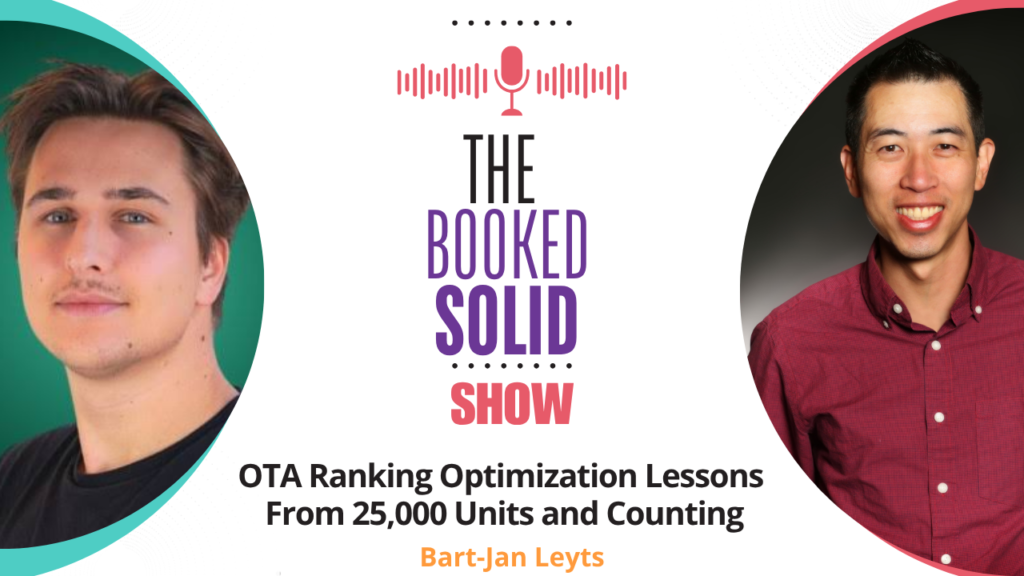
OTA Ranking Optimization Lessons From 25,000 Units and Counting with Bart-Jan Leyts
“Anyone could be ranked number one. Just slash your prices.” That line from Bart-Jan Leyts sums up a trap many hosts fall into. Ranking first on Airbnb or Booking.com means nothing if your revenue goes backward. This episode of the Booked Solid Show is a little different. We usually talk about building your direct channel. This time, Gil sits across from someone who studies the other side of the table. Bart-Jan is the founder and CEO of Otamiser, an AI native revenue management service that handles OTA ranking optimization for over 25,000 units. You’ll hear how Airbnb’s algorithm thinks differently from Booking.com and Expedia. Bart-Jan explains why a fully booked calendar can quietly hurt your ranking, and why owner stays and split calendars carry hidden costs. He also shares what conversational search means for your listings, and a simple fix for guests who copy your Airbnb title into Google and find nothing. Whether you run one cabin or a full portfolio, this one will change how you look at your listings. 🎧 Podcast and Summary Highlights 👤 About Bart-Jan Leyts Bart-Jan Leyts is a 26 year old founder from Belgium and the CEO of Otamiser. He studied finance at Ghent University, and right after graduation he and his cofounders began doing hotel revenue management for family hotels and small chains across the Benelux region. They noticed something early. A property’s dynamic pricing only worked as well as its position in search. That insight turned a small rate management side project into a company that now optimizes rankings and rates across Booking.com, Expedia, Airbnb, and Vrbo. Bart-Jan later brought the same thinking to short term rentals, starting with Casiola in Orlando and then launching a self serve tool called AutoRank. Today Otamiser blends software, AI agents, and hands on revenue managers into one service. 💡 Key Takeaways 🔁 Bookings, reviews, and consistency drive OTA rankings. Titles and photos help, but mainly as conversion accelerators. 📅 Booking pace matters more than most hosts think. Selling out all at once can stall your visibility. 🏡 Owner stays and calendars split across channels limit the inventory each OTA sees. ⭐ How you respond to a bad review can matter as much as the review itself. 🤖 Conversational search is coming to the OTAs, and listing accuracy will decide who gets shown. 🔍 If a guest pastes your Airbnb title into Google and can’t find you, you have an SEO problem. 🎯 Visibility Is Buying Bookings Bart-Jan’s first experiment was simple. On Booking.com, his team joined the Preferred Partner program, which carries a higher commission. Then they raised rates to offset it. The result was net positive. His takeaway? Guests don’t scroll far. They type one search with all their filters and book from the top. Expedia once told his team that roughly 75% of bookings go to the first 15 listings shown. More eyeballs really do buy more bookings. That doesn’t mean chasing the top spot at any cost. As Bart-Jan points out, anyone can rank first by charging $10 a night. Ranking and revenue are not the same goal, which is why Otamiser ended up tying its ranking software directly to pricing. If you’ve been thinking about pricing as a standalone task, Mridul Bansal’s breakdown of the three signals behind dynamic pricing pairs nicely with this part of the conversation. 🧭 Two Kinds of OTAs, Two Different Games Bart-Jan splits the OTA world in two. Booking.com and Expedia were built for hotels. Their algorithms favor the listings that will make the platform the most money, and paying more commission can move you up. Airbnb and Vrbo are content OTAs. Their algorithm leans toward the listing that best matches the guest and is most likely to earn a strong review. That means your photos, descriptions, and settings carry more weight there. Vrbo sits somewhere in the middle. He also notices the platforms drifting toward each other. Discounts that used to be a Booking.com specialty now show up on Airbnb and Vrbo too. For more on what’s shifting inside Airbnb specifically, Dan Rivers covered why Guest Favorite now outweighs Superhost in an earlier episode. 📅 The Hidden Cost of a Full Calendar This was one of the most surprising parts of the episode. Bart-Jan ranks the top three factors as bookings, reviews, and consistency. Booking pace is the one he calls most underrated. Some property managers sell out a listing’s whole calendar and celebrate. But once nothing is open, the platform stops indexing it. When dates open again, the listing practically starts over. Owner stays work the same way. A month long owner block can hurt Airbnb rankings. And a listing split evenly between Airbnb and Vrbo shows each platform only half its availability. Bart-Jan doesn’t recommend going all in on one OTA though. A single suspension could take down the whole business. The answer is balance, which is also the heart of building a scalable direct booking strategy that doesn’t depend on any one channel. ⭐ Your Response Matters as Much as the Review Every host gets a bad review eventually. Bart-Jan says what happens next is what counts. If guests complained about construction noise, updating your listing to say the work is finished helps Airbnb feel confident showing you again. He also shares an honest observation about smaller hosts. They often rank higher, and many are exclusive to Airbnb. But Gil and Bart-Jan agree it’s more correlation than cause. Small hosts tend to describe every detail, down to the shampoo brand and the coffee maker. That care shows up in reviews. Vee Venski talked about a similar habit of tracking daily rank changes after every photo or title tweak. 🤖 Conversational Search Is Coming to the OTAs Bart-Jan believes every OTA will move toward conversational search. Instead of filters, a guest might simply type, “I want a two bedroom home in Orlando.” From tests run alongside people at Booking.com and Airbnb, one factor keeps rising to the top: listing accuracy. If your