

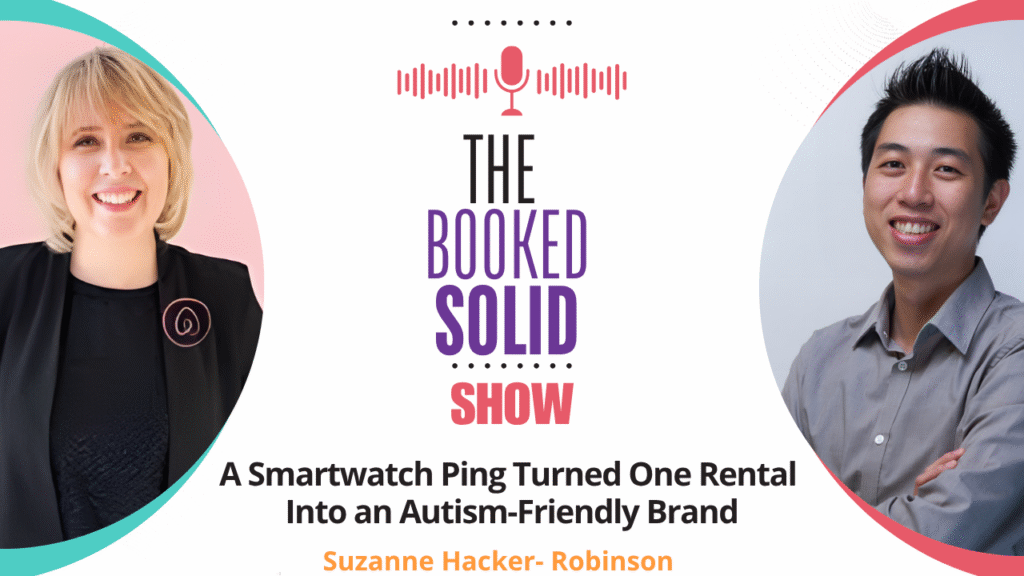
“Don’t give up. People give up too early — and it usually doesn’t make sense to.” — Suzanne Hacker Robinson 🌴
What if the quiet, unsexy part of hosting — the checklists, the naming, the tiny intentional touches — is actually what separates a one-and-done guest from one who books direct every year? In this episode of the Booked Solid Show, Gil sits down with Suzanne Hacker Robinson, founder of Welcoming Wow and a former 25-year banking executive who now manages 25 vacation rental properties in Florida. Suzanne shares why operations quietly runs the whole show, how a single ping on her smartwatch reshaped her entire hosting philosophy, and the simple direct booking moves any host can start this week — no agency build required. 🏡✨
This one’s for anyone who keeps waiting for their portfolio to be “big enough” before starting to invest in direct bookings. Suzanne makes a humble, grounded case for just starting — and keeping it simple.
Summary and Highlights
👋 Meet Suzanne Hacker Robinson
As the founder of Welcoming Wow, Suzanne helps hosts and investors create vacation rentals that not only look beautiful but run beautifully. Her 25-year banking background — where she led 17 locations and managed teams across lending, marketing, and operations — gives clients the tools to grow their revenue while designing spaces that reflect warmth, inclusivity, and intention.
Suzanne believes every successful vacation rental home starts with clarity: a clear guest experience, clear systems, and a clear vision of what makes your property special. That’s why she brings a mix of business strategy, marketing know-how, and design insight to every project — helping owners launch faster and perform better.
At the heart of her work is a simple philosophy: hospitality isn’t just about pretty spaces or perfect reviews — it’s about connection, understanding, and creative experiences that make people feel like they belong. 💚
🧠 Operations Is the Quiet Engine Behind Every Great Stay
Suzanne is wired for systems. She jokes that her banking brain is probably why she can’t function without symmetry — right down to how the pillows and towels are staged on turnover day. But there’s a deeper point in there for anyone scaling past their first property: the invisible stuff is what guests actually notice.
They rarely tell you when the toilet paper is stocked. They absolutely tell you when it’s not.
This is where so many hosts under-invest. Licensing. Tax filings. Inspection requirements. The Wisconsin state inspector who literally trained Suzanne on how to make a bed. Gil admitted he learned the operations lesson the hard way — buying a second property a year later and realizing he hadn’t documented a single step from the first launch. Eight steps across permits, fire marshals, and health inspectors. Gone from memory.
The fix is boring and powerful: write it all down. Screenshots. Direct links to PMS reports. Tax deadlines by market. The kind of documentation that makes adding your next property feel like a workflow, not a panic. For operators thinking past one or two doors, this is exactly the kind of infrastructure explored in scaling a short-term rental business starts with systems, not more properties.
🌐 Start With the URL — Even If the Website Isn’t “Ready”
When Gil asked Suzanne where she’d tell a host to start with direct bookings, her answer was refreshingly simple: claim your domain.
Your own URL does more than make you look legit. It builds site authority over time. It works with your Google Business Profile. It lives on your QR codes, business cards, Instagram bio, and welcome book — all pointing to one place that actually belongs to you. Even if your first site is basic, the domain is the foundation everything else compounds on.
Suzanne’s property runs on www.privacyinthepalms.com. She picked that domain before the site was beautiful, and she’s been able to build everything else around it.
Gil added a small but easily-missed warning: don’t anchor your brand to a service URL you don’t control. Printed business cards with a QR code that routes to a subdomain you’ll eventually leave? A Linktree you don’t own? Those become dead ends the moment you switch tools.
🏷️ The Naming Move Most Hosts Get Wrong
Suzanne named her Florida property Privacy in the Palms — a name that actually matches the experience and, crucially, doesn’t overlap with anyone else.
Gil shared his own lesson the other way around. His first cabin in Gatlinburg was called Cozy Creek Cabin. Great vibe, terrible for search. Three other Cozy Creek Cabins already existed in the same market. Anyone trying to find his property on Google was walking into noise.
The fix: before you commit to a name, search it. Across Google. Across Instagram. Across Airbnb. If someone remembers your name after their stay, you want them to land on your listing, not someone else’s. This is the kind of foundational work that makes later SEO and AI search actually pay off — a principle explored more in how to optimize your short-term rental SEO for Google, ChatGPT, and AI search.
📧 The Email List You Already Have (And the One You’re Not Using)
Suzanne’s been capturing guest emails through StayFi for four years. The list is modest — around 170 guests, largely because her stays run three nights to three months. But here’s the honest part: she hasn’t been nurturing it.
That came up in the conversation, and Gil walked through how he thinks about marketing emails — not as spam, but as a long slow conversation.
A few principles worth borrowing:
- Lead with value, not with a booking pitch. A curated local guide earns trust faster than a discount code.
- Drip roughly once a month for the first year.
- For the first nine emails, don’t mention your properties at all. Just deliver value.
- Time your nurture sequence around your booking window. If guests tend to book three months out, that’s where your first gentle promotion should land.
Most importantly: repeat guests aren’t always the same-season travelers. A family visiting in summer probably isn’t coming back for winter. Your nurture cadence should match their real-life rhythm, not your calendar. For hosts still building the mechanics underneath this, the complete guide to collecting guest emails for short-term rentals is a good companion read.
🎟️ Give Them Something to Take Home
Suzanne keeps branded takeaways in every property — a business-card-sized piece with the property photo on one side and the URL on the other, plus a postcard version guests can throw on the fridge.
Gil’s version? Cheap branded coasters on every surface a guest might set a drink. No “please take one” messaging needed. They disappear into suitcases, land on coffee tables back home, and quietly reintroduce the brand every morning.
It’s a small, humble tactic. But when you think about what most properties leave behind (nothing), even a $0.75 coaster is a rebooking engine. Combined with a well-named domain, it’s the kind of brand presence that slowly builds what’s explored in purpose-driven vacation rentals and the quiet advantage behind direct bookings.
💚 A Niche Born From a Single Ping
The most moving part of the episode started with a smartwatch notification.
Early in hosting her Florida property, Suzanne noticed rapid lock-unlock pings coming through her app. A child was playing with the front door. And because a close friend’s four-year-old with autism had once slipped out of the house unnoticed — and children on the spectrum are often drawn to water — Suzanne had an immediate, uncomfortable realization: her home wasn’t safe enough.
That moment became a mission. Privacy in the Palms is now autism-friendly. Extra locks. Thoughtful sensory considerations. Colors and lighting chosen with care. One family now returns annually because it’s the one place their son feels safe on vacation.
Here’s what’s worth noticing for any host listening: Suzanne didn’t pivot to autism-friendly hosting because it was a clever marketing angle. She did it because it mattered. And the marketing results followed naturally — inquiries from parents, repeat bookings, and a clarity of audience that most hosts spend years searching for. Her free “12 Steps to an Autism-Friendly Vacation Rental” guide is available through her Linktree.
Niching down isn’t a trend. It’s what happens when a host decides to serve someone specifically and well.
⚡ Rapid Fire With Suzanne
📚 A book that inspired you? Safely Home by Randy Alcorn — a quiet, life-shaping read she keeps coming back to. Plus the newest Hospitable Host: STR Sisterhood Edition, where Suzanne is a contributing author. (Gil’s currently reading the Couples Edition.)
🧠 One piece of mindset advice for someone starting something new? Don’t give up. When Suzanne told her mom about her business idea, her mom’s advice was direct: it might take three to five years before the profit shows up. Most people quit too early — including vacation rental owners who panic in year one. Stay in the game.
🚀 One tactical move for hosts wanting to grow direct bookings? Just do it. Use what your PMS gives you if you have to. Get your own URL. Link the widget. Talk to someone who’s done it. Don’t wait for the portfolio to be “big enough” — the earlier you start, the faster your engine compounds.
🔗 Connect With Suzanne
- 🌐 Website: www.welcomingwow.com
- 📸 Instagram: @welcomingwow
- 🔗 Linktree (free resources, including 12 Steps to an Autism-Friendly Rental): linktr.ee/SuzRobinson
- 📧 Suzanne@welcomingwow.com
🎧 Ready to Build Your Own Direct Booking Engine?
Suzanne’s biggest piece of advice — just start — is the same thing we hear from nearly every successful host on the show. The engine takes time to warm up. The hosts who start early are the ones pulling ahead two years from now.
CraftedStays is purpose-built for short-term rental operators who are done waiting. Connect your PMS, customize a mobile-first template, and launch a direct booking website in minutes — no agency bill, no plugin stack, no maintenance drag. Start your free trial at CraftedStays.co and build the site your brand actually deserves. 🏡
And if you want more conversations like this one, join the Booked Solid community — where independent hosts, property managers, and direct booking operators swap the tactics that actually move the needle. 🌟
Transcription
Gil: Before we bring on my guest, I wanted to talk just a little bit about something that I’ve been hearing a lot from hosts. I keep on hearing the same thing: “I know my website isn’t converting, but I can’t afford $8,000 on an agency to rebuild it.”
Here’s the thing — you’re putting all these marketing strategies to work. You’re driving traffic. But if your site isn’t built to convert, you’re basically lighting your energy and money on fire. And even if you could afford an agency build, every time you want to test something or make a change, you’re having to pay them again. You can’t iterate. You can’t test. You can’t really improve on things.
You don’t need a custom $10,000 website to get the conversion rates that really matter. You just need the right platform. That’s why I built CraftedStays. It’s purpose-built for short-term rentals and designed from the ground up to help you drive more direct bookings. You can finally turn that traffic into bookings, and you can keep on testing and improving. As you learn, you can make changes all on the platform. You don’t need to learn something new.
So if you need some help or you want to get started, head over to CraftedStays.co and start your free trial. Now let’s bring on our guest and dive deep into hospitality and marketing.
Gil: Hey folks, welcome back to the Booked Solid Show — the show where we bring in top operators to discuss operations, hospitality, and direct bookings.
On today’s show, I have Suzanne Hacker Robinson. She’s a short-term rental host and the founder of Welcoming Wow, a short-term rental coaching service. On today’s show, we talk about operations and how even simple things should be documented. We talk about how not to overcomplicate your direct booking engine, and some of the simple things that you should be putting into practice today to get started in direct booking.
So without further ado, let’s bring her in.
Gil: Suzanne, welcome to the show.
Suzanne: Thank you, Gil. Thank you for having me on. It’s a pleasure.
Gil: As we’re recording, there’s a lot of activity and a lot of conferences happening abroad, but we’re both still in the states. I’m having a little bit of FOMO on all the activities happening there, but I have a lot of work to do, so I can’t really escape away.
Suzanne: Right. Can’t go to all of them either. Just not practical.
Gil: There are a lot of conferences, especially if you start thinking globally, and they all condense around the same time. You have your spring conferences and then your fall conferences, and they get pretty packed. Is there one that you love going to every single year?
Suzanne: No, actually — I don’t like going back to the same ones every year. This year I’m going back to FAVR, the Florida Alliance for Vacation Rentals, which makes sense for me to repeat since it’s specific to Florida. But I’ve been to several, and I don’t go back the immediate year after. I don’t know if it’s because I’m waiting for fresh content or what it is, but I have yet to go back to the same one.
Gil: Are you happy that you invested that time and energy into it afterward?
Suzanne: Absolutely.
Gil: I just wanted to make sure you weren’t feeling like —
Suzanne: No, there’s maybe only been one where I was like, “Okay, the best thing I got was a t-shirt.” But no, definitely. I’m always glad that I’ve invested the time, the energy, the money, all that good stuff.
Gil: I’d second the energy piece. The time and money is one thing, but after the conferences, your body is drained. You’ve been traveling, you’ve been going nonstop for two or three days. You definitely get pumped, but it does take a toll.
Suzanne: Yeah. I think VR Nation’s going to be my new favorite, but we’ll see.
Meet Suzanne
Gil: Suzanne, we dove a little bit into it, but do you mind giving folks an introduction on who you are?
Suzanne: Absolutely. So, Suzanne Hacker Robinson — and I use “Hacker” in there partly to set myself apart from another author named Suzanne Robinson, who’s nothing like me.
My business is called Welcoming Wow. I originally started thinking I was going to do virtual design for vacation rentals, and my thought behind the name was that we want to welcome our guests with a “wow.” But when I actually started to work with clients, it always went back to business because I have a banking background — 25 years, where I was an executive overseeing 17 locations, lending, and a lot of different things.
When I started working with clients, I found myself going back to studying the numbers, the algorithms — what’s actually going to get a property booked. It’s not just the design. There’s so much that goes into it. So I stuck with the name because we still want to welcome guests with a wow — not just with the design. There are so many different ways we can do that.
Gil: It sounds like you’re very operations-focused, and that’s one of your cores. When I think about the association of operations with the promise of “welcoming wow,” it’s really about putting the right operations in place so you can have consistency with every guest at scale. Is that how you position yourself and how that relates back to the brand?
Suzanne: Totally true. When I was in banking, I don’t think I spent as much time learning about myself. Then you become an entrepreneur and you’re doing your own thing, and you learn a lot more about yourself. I realized one of the reasons I was successful in my banking career is because of the way my brain works. It’s totally operations, systems, processes.
I don’t work well without sameness. Like with my cleaners — I have great cleaners, they clean the properties really well. But I have not yet found somebody who cleans and also stages the property the way I want it to be. I’ll go in there with them and I’m talking about the symmetry, even just the pillows and the towels. Those little touches can make a big difference to guests. Making sure there’s toilet paper, paper towels — all those things. They’re kind of boring, but if they’re not there or if we didn’t do it right, those are the things we hear about.
I always felt with the bank operations piece that we rarely heard when the customers had a good experience. You hear more when something’s missing or when that operation piece doesn’t go quite right. It’s a thankless job sometimes.
The Shift to Entrepreneurship
Gil: I empathize with you about the growth piece. Prior to starting CraftedStays, I’d been a W2 product director for 15 years, building for others, learning product management, learning how to work with teams. But there’s something different when you’re driving the entire train. You start to feel like, “Oh, I did this really well, but I’m not paying attention to this side of the business.” You start to learn what you love and don’t love.
In year two and year three, I started to understand: “I don’t love this. I don’t know if I ever will love this part of the business. I need to start hiring out or getting professional help on those things.” That’s the next tier of entrepreneurship — can you build a sustainable business? And then, can you scale it and create a lifestyle where you get to do what you love, surrounded by people who help you meet your goals? That’s the second phase I’m trying to get through right now.
Suzanne: Totally. With my banking background, I thought, “Well, I’ve got the bookkeeping side down.” No — that was one of the first things I offloaded. I hired a bookkeeping firm because I just didn’t want to do it. I know myself with receipts, tracking expenses, all that. I gave it away pretty quick. I’d have spent way more time on it than it was worth.
You have to value your time. I looked at the cost of hiring a bookkeeping firm and thought, “That’s totally worth it.” Same with accountants, cleaners — whatever. Totally worth it.
Scaling the Portfolio
Gil: You have a pretty sizable portfolio. How many properties do you manage now?
Suzanne: I don’t look at it as sizable. When I see some of these people with 400, 500 properties — it has grown, and I’m at 25 at the moment. A couple years ago, I never would’ve thought I’d even be here. It’s at a good size right now. But I’m also learning that the more I hire and the more help I get, the more you can help other people.
Gil: Do you see a sweet spot? I hear quite often that folks will scale to 100 and then scale back down to a comfortable number. They’ll start to fire properties they don’t want to manage anymore and bring in others to fill those spots. They try to hover toward a sweet spot. Did you have a number in mind of where you want to get to and stay?
Suzanne: I don’t, partly because it’s about the right properties — and understanding what my niche is. I did learn pretty quickly that you don’t want to just take everything that comes your way. That’s when you have to start firing.
I fired a couple of them partly because the owner and I didn’t see eye to eye. It wasn’t important to them to get air conditioning fixed immediately — little things like that. And this is Florida. So if we’re not lining up on what I feel is important for the guest experience, then it’s probably not the right fit. It’s more important that I work well with my clients and that their properties fit into my portfolio. But I also like having different ones.
Gil: I have no doubt that a year from now, you’ll be at more than 25. You ramped up pretty quickly, and there’s momentum on your side. I’m interested in seeing how your thinking has evolved over time as you manage more — whether or not you want to keep reaching for the stars, or you’re like, “Actually, I’m good here.”
Suzanne: Property management or vacation rental management wasn’t something I thought I was going to be doing. When I started my business, I thought it was going to be design. I really got into it to coach people — to help them get their rentals launched. I helped a lot of people around the country.
What happened was, it was like setting birds free. “Here, I’ve taught you everything you need to know, you’ve got this.” And then they’d come back: “I don’t really want to do this myself. Can you just do it?” That’s how I first started co-hosting or managing — my previous coaching clients would come back. So I started doing that, and it grew when I wasn’t really trying to get more properties.
Then you get referrals. A local realtor finds out and refers people. There’s one realtor who keeps sending people to me, and I’ve never even met him. They’re like, “Yeah, Ronnie sent us to you.” And I’m like, “Great. I don’t know who he is, but thanks Ronnie.”
That momentum keeps building, and then it’s on me to figure out: is that a good property for me or not? I’m already at that point where I know that’s not the type of property I want in my portfolio. So we turn it down.
Why Coaching Clients Come to Suzanne
Gil: On the coaching side — why do people come to you? What problem are they trying to solve?
Suzanne: Really, it’s more the newbies I work with. They don’t know what to do, and they get a little scared. They don’t know about licensing and all that government stuff that we all really need to do but don’t really like to do.
I think I help them simplify. I have checklists I’ve used from the beginning because I’m a checklist kind of person — so you don’t forget stuff. The majority of my coaching clients come to me because they’re looking to launch and they just don’t know what to do. They’re in the design phase, or they just bought the property, or they want to transition it from their primary residence to a rental.
Gil: Are these clients more local, or are you taking clients outside your region?
Suzanne: A lot of my coaching clients have been around the country. Coaching you can do more virtually. Co-hosting or vacation rental management — you don’t have to be local, but I do feel it sometimes works better when you are. Maybe that’s the control freak in me that needs to keep an eye on the properties and make sure the cleaners are doing what they should be doing.
Gil: I was curious because you mentioned licensing, and I wondered if you were the go-to expert in your region, and that’s why people come to you. Then they seek help and you’re like, “Oh, you do coaching too?”
Suzanne: No, people just found me — whether through social media, Google, LinkedIn. They just found me, and maybe they liked some of the things they heard me say.
The Painful Reality of Licensing and Taxes
Gil: The licensing and taxes — one of the least fun parts of hosting. I remember when I had to go through that process with our first property. I was not as astute as you are on operations. I didn’t write down the process for it. Come the following year, I bought another property in the same market, and I was like, “What was that thing I need to do?” There are eight different steps. You had to get the fire department, the permit. In one market, we had to get a health inspector. It’s not a fun process.
Suzanne: When I first launched in Wisconsin, the state actually sent out an inspector who also trained the owner in the details of how they felt you should make a bed.
Gil: Oh wow.
Suzanne: I’ve never experienced that in any other market. Never heard of anybody else doing that. But they did — they wanted to train us how to do this. So I still make the beds the way they trained me.
Gil: I learned since then to document much more. Pretty much anytime I have to do anything that requires a tax or process or submission, I document it. Now — some taxes are due monthly, some quarterly — and remembering each one across the different markets we’re in, it’s not fun. It changes too. In Tennessee, they moved us from annual to quarterly. We had to be on top of it.
Operations is one of those things folks need to get good at, especially if you’re scaling and operating more than a handful of properties. If you have the right SOPs, you almost don’t have to think about it. I have screenshots of everything.
Suzanne: Copies, screenshots, everything. Yep.
Gil: Direct links to everything. Whenever I need to do a tax report, I have a direct link into my PMS that pulls the specific report for the specific property. It makes it so much easier and less painful. Because it can be painful when you’re like, “Oh man, I don’t want to add another unit because I hate doing this.”
Suzanne: Even when that deadline approaches — the 15th or the 20th, whether you’re supposed to file monthly or quarterly — I’m just like, “I don’t want to do this. Let’s leave it till the last minute. That’s always easier.”
Why Direct Bookings Matter
Gil: Talk to me a little bit about direct bookings. Right before the show, we talked about why you invested into it and some of the things you’re doing there. What are some of your investments, and why did you decide to invest in direct bookings?
Suzanne: Well, for one — you don’t have to give away quite as much of your profit to those OTAs or the larger platforms (we’ll keep them nameless). You’re just not giving away as much of your profit. To me, that’s probably the most important reason. I don’t want to give away money to anybody. If you can keep it, let’s keep it. We’re not large corporations with extra money just sitting around. At least I’m not.
So I do have a direct booking website. But I also feel it’s important, if you can, to have your own URL. That gives you so much more ability. Even if the website you first create isn’t wonderful — mine’s not that wonderful yet, but it’s a start. And you always have it. So naming your property, branding it, and then having your own URL — to me, that’s important. Because even if guests find your property through an OTA, the second they walk in the door, you better be leaving something for them to take with them so they can book their next stay direct.
Why Your Own Domain Matters
Gil: I want to double-click on the URL side of things. There are many ways to get a website up and running — even if you’re vibe coding, you can get a website spun up. But one thing you need to do, like you mentioned, is actually register your own domain.
Even if the PMS provides you with a website — something like explore-dayday.blankpms.com — most allow you to do custom domains where you can register your own. When you do that, you start to build your own site authority. It signals to Google that this is a business.
If you were to register your subdomain URL with Google My Business and try to get reviews on it, or put it on your Instagram, it’s not going to rank as highly as if you had your own domain. That domain becomes your address. No matter where you are — your emails, your website, your guidebooks, the QR codes you’re placing in the properties — they all link back to the same place. It’s really important to establish your URL early on.
Little tip: if you’re ever switching services, or if you have a QR code with a custom link, make sure whatever you’re using has the ability to redirect. I’ve seen folks print business cards with a QR code and then find out they can’t keep that same URL when they switch services. You just shot yourself in the foot. Or you end up with a Linktree you don’t have access to anymore. That is really hurtful, because then you have a bunch of cards in the wild that no longer link back to you. Make sure you have that good structure in place so you can route traffic back to your website.
Suzanne: Yeah, that’s a great point.
The Power of Naming Your Property
Gil: Talk to me a little bit about the naming side of it. Why is naming so important for you?
Suzanne: For me, I just feel like it’s the first thing a guest will remember. I try to have the name kind of match the decor. Mine is called Privacy in the Palms. A few different reasons for that. I’m in Florida, but I didn’t want my property to be the same white and blue coastal that everyone has. So it’s green and yellow instead. I like to be different.
I just think it’s important because it gives people something to hold onto, to remember. So when they leave your property, hopefully they remember it. I have business cards. I also have book-direct cards that are there for them. The welcome book is branded as much as I can — I’m going to brand things. I don’t go overboard. I’m not someone who goes so far out that I have branded coasters or branded blankets. My property is a regular home. It’s not a luxury high-end brand. And it’s just one property at this time. But I think it’s important to be memorable.
Gil: One thing I learned is that you chose a good name — one where there wasn’t a lot of conflict. You chose a phrase that encapsulates the essence of what you want to bring, but you’re also not competing against other folks using the same phrase. I’m actually surprised no one else has used that phrase in other areas or niches.
When we launched our first property, we had a cabin called Cozy Creek Cabin. It was a dark, moody cabin. We put moody lights in there, had a wooden fireplace. It felt really cozy. Alongside the front was this little creek that flowed almost all year round. When we designed it, we had that vibe in mind.
When we started investing in direct bookings, we realized we were not the only Cozy Creek Cabin in Gatlinburg. There were three others.
Suzanne: You’re kidding.
Gil: So it was really hard. From then on, we got really methodical about naming. We’d do a search to see whether anything like it existed already. Because what you don’t want, when you’re starting small with a couple of cabins — you want to make sure that if someone visits your cabin, they remember the name. Maybe they saw it on Airbnb and they’re trying to see if it’s elsewhere. You want them to be able to pick it up. It’s really hard if you have a generic name. My advice: try to uniquely name your cabin. Every property since then, we’ve learned the hard way to look for uniqueness.
Suzanne: I love that you brought that up about how, if they find your property on an OTA and you’ve done a good job in your description using that name several times, then it may be easy for them to just do a Google search. It definitely happens. I’ve had it happen. One of the companies I’ve helped with for a while — it’s a growing luxury brand of vacation rentals. We name the property, and then we use it several times in the description.
I’ve had it a couple of times where — you’ve got to be a little careful — guests will send a message through an OTA and ask, “Well, is there any way to book direct?” You have to say, “Well, here at such-and-such, it’s not something we can do for you.” But not too long later, there they are coming through as a direct booking. So you’ve got to be careful. But there are definitely ways, if you use that name enough, that they can pick up on it these days.
Gil: Hopefully all of our listeners know that when someone asks you on an OTA, “Do you have the ability to book direct?” — you bet you, the platform is listening in on that conversation. They’ll be triggered if you send anything. Even if you don’t put “www” or “.com” — they’ll know.
Suzanne: And nobody wants to be flagged or taken off the platform.
Gil: It would get easily picked up. I’d heard of guests who inadvertently had hosts redirecting them. Definitely be on the more cautious side. I’d much rather have someone book on the OTAs than me being even a little hint-y and trying to bring them over. It’s not worth it. The goal is to diversify. You don’t want to sever your leg while you’re doing that transition.
Suzanne: Yeah, that was one of the things we talked about earlier. My goal is — I don’t expect to ever be 100% direct booking anyway. My goal is just to keep watching that needle move so direct bookings increase. I don’t even necessarily set a goal. Maybe I should set a goal for what percentage of my revenue I want to come from direct bookings. But I don’t currently. Maybe I should think about that.
Gil: I’ve seen a pretty big wave recently — I don’t know if it’s because of guest behaviors, or that my clients are more proactive at getting direct bookings. But there’s been almost two or three times the growth for a lot of my clients who started with us a year ago. Now their websites are seasoned, they’re getting more SEO traffic. I’m starting to see a lot of momentum pick up. It could also be that, given this economy, people are a little more price-conscious. They’re looking for ways to travel when there’s a lot of uncertainty around us.
Suzanne: I’m going to have to start setting a goal on that.
Investing in Email Marketing
Gil: What are some things you want to invest into or spend more time on to help you reach those targets?
Suzanne: I want to spend more time writing good emails that actually convert. That’s probably my first thing. Because I already capture the email addresses when they stay at the property. But I’m not doing a very good job writing emails that actually get them to come back. That would be my first thing — I need to spend more time on that.
Gil: I’m guessing you’re using some system to capture emails. What are you using?
Suzanne: StayFi. When they come in and want to get on the internet, they have to enter their name and email address. I’ve been using StayFi since the beginning — about four years now.
Gil: Has that email list grown to a sizable amount after four years?
Suzanne: Probably not as much as you’d think. Partly because I get week-long stays. I get snowbirds who stay for three months. So if I have longer-staying guests, there aren’t as many names on the list. I don’t do one-night stays, and typically mine are three to five nights.
Gil: I’m using StayFi as well. I’ve been using them about four years too. In contrast to you, we don’t have snowbirds. I just today got a nine-night stay during the summer, and that’s considered extremely long for us.
Suzanne: Long booking for you. I’ve got people in my place right now staying 10 nights. Not uncommon sometimes.
Gil: Most of our stays are weekends. A lot of three-night stays.
Suzanne: Like a Friday-Saturday, two-night.
Gil: Yeah — Friday, Saturday, leave on Monday.
Suzanne: Sure. If I had to guess, I probably have 170 maybe in my email list. I need to do a better job of sending regular emails and giving reasons to come back.
Gil: Do you send nurture emails when they enter?
Suzanne: I don’t right now.
Gil: That’s one thing I would probably —
Suzanne: I should.
Gil: There are basically two different types of emails. There’s what we call a nurture email. When you get on an email list, you’re very likely going to get a series of emails over some period of time. They’re usually sequenced in a way to evoke emotion or build a brand relationship. They’re there to nurture and make sure you’re top of mind forever — whenever they’re thinking about doing that one thing you’re trying to get them to do.
Suzanne: Can I tell you something, though? Maybe other people feel the same way. I hate getting spammed with emails all the time. So I feel like, “Well, I don’t want to do that to my guests.” So then I don’t do it to them. Because I don’t feel like I want it done to me. The whole “do unto others” — okay, don’t send me too many emails.
Gil: I think that’s probably a common mistake. The way I think about marketing: where are the areas where people are asking for help, and how can you help them along the way? On our websites, when I’m trying to capture an email, you usually have to give something up to get an email. You can do a discount, a coupon, enter-for-a-free-stay. But I tend to like: “Here’s the best way to enjoy Florida.” A guidebook that’s very curated. When they see it, they’re more than happy to exchange their email. Because you’re starting to build goodwill from the beginning. It doesn’t feel like you’re doing marketing.
Then when you get them on your email list, you’re sending things of value to them. All the great spots in the area, things they could have visited, local attractions — things they’d get excited to see.
Typically I recommend setting up a drip — at least once a month. Two times in the first month, then once a month for the first 12 months. For the first nine emails, you don’t mention your properties at all. You don’t mention the amenities, you don’t mention any of that stuff. Because then it feels like marketing. It feels like you’re selling to them.
What you’re trying to do is deliver value. You’re trying to tell them: “I’m here to serve you.” For us, we have about a three-month booking window. That’s when people typically think about staying. So at 12 minus 3 — nine months — we start to tell them: “If you’re looking to travel again, here’s a coupon code.” We have our future property that they can go to.
We find that if people are doing annual visits, they’ll come every summer. We don’t get people who come during the summer and then come again during the winter. We cater to families, so they have certain schedules — summer break, spring break. Given that, we try to be the destination: “You had a great stay, you want a stress-free vacation, you had a good time last time. Come visit again. Here’s a little coupon code for you.”
That’s how we think about marketing. Yes, I get spam all the time, and I want to hit that unsubscribe button faster than anyone else. But there are also a lot of emails I leave in because I get nuggets of information. Maybe not every email is a great hit, but I get nuggets.
For instance, at CraftedStays, every single week we send a newsletter. Our unsubscribe rate is extremely low. Many weeks, over hundreds — thousands — of emails we send out, we don’t get a single unsubscribe. Usually because people who subscribe to our email list are folks interested in direct bookings or learning what’s happening in the industry. The content we provide is all value-added. We talk about what’s happening in the industry, we talk about direct bookings, we go deep into a blog post about one specific thing, we highlight the podcast. It’s value, value, value, value, value.
Then on the footer, it’s just a call to action. If you haven’t started your direct booking journey and you want help, there’s a link to sign up. But we bury that on the very bottom. Our goal is to earn trust over time. That’s how I think about marketing. It’s not aggressive. It’s very value-driven. But you end up having the most loyal people who want to hear from you.
Suzanne: I like it. Thank you.
Leaving Something Behind
Gil: Outside of — so you mentioned the URL, making sure you have that registered, naming it properly, and really capitalizing on all the emails you’ve collected — any other tips and advice you would give our listeners?
Suzanne: The only thing you didn’t mention is I like to have something in the property that guests can take with them. I don’t put QR codes on them. I actually just have the website on there — www.privacyinthepalms.com. Two different things I like. One is just a business-card size. Real simple. Picture of the property on one side, info on the other. Then I have a bigger postcard size. That one might have a QR code, now that I think about it. So they can take that with them.
Maybe it goes in the trash. But it also has a chance of ending up on their fridge. Then they know where to book next time. That’s the only other thing I do — I like to have something they can take with them.
Gil: I like that. We have this coaster in our cabins. I like coasters because — I used to have wooden coasters scattered around, but the wooden ones are so cheap. Less than a dollar apiece. They have our branding. I get to put them everywhere. We have them on the dining table, the coffee table, bedside tables. Anywhere a guest may want to bring a drink, we have one. And I expect them to walk away.
Suzanne: I was going to say — do you mention in your messaging, “Please take a coaster”?
Gil: I don’t. We replenish quite often, so I don’t think I need to.
Suzanne: Nice. You don’t have to tell people. Nice.
Gil: It’s a great way to market. If they take it home and set it on their coffee table, they’ll see it every single day. It’s a great way to get your URL, your brand, out there in front of people in their everyday life.
Suzanne: Do you do a logo for each property?
Gil: I used to. I don’t anymore. Because as your portfolio grows, it’s less about individual properties and more about the portfolio and your hospitality and how you focus on your guest. Things have evolved quite a bit. When it was just one property, I’d spend so much energy on the logo, the branding for that particular property. Over time, I realized I get more benefit from telling our story — why we furnish properties the way we do, what’s the idea behind it. So no, not anymore.
Suzanne: I was curious if we were on the same page with that.
Niching Down: The Autism-Friendly Mission
Gil: Before we get to the final question — during the show, we talked about really understanding your niche. We walked through your website, and you mentioned you had a phrase about autism that your website was gearing toward. Can you talk to us about what inspired you to put that on your webpage, and what difference that has made for anyone with autism when they visit your site?
Suzanne: Yeah. For one, I have a really good girlfriend with a couple of children on the autism spectrum. One of them in particular, when she was four, was nonverbal. She slipped out of the house in the evening while they were watching a movie. They didn’t know. She was tiny — four years old.
Unfortunately, with a lot of children on the autism spectrum, they’re also drawn to water. They often escape out of their homes, and they’re drawn to bodies of water. So it can be quite dangerous. Her husband actually called me when they realized she was missing: “Can you come help look for her?” That was one of those moments that stuck with me.
So when I launched my vacation rental here in Florida — at the time, I was getting pings on my watch when the lock would be locked or unlocked, because of the app. All of a sudden, with one of the first families staying there, I kept getting pings. Real quick: lock, unlock, lock, unlock.
For whatever reason, it literally smacked me in the face. I was like, “Oh my gosh. That’s probably a kid playing with the lock. And if that child is on the autism spectrum — oh my gosh, my house is not safe enough if they’re autistic.” Because that was the only lock on the front door. If they had slipped out without mom or dad knowing…
Imagine being a parent of a child on the spectrum who can’t even tell people what their name is. Kids are quick. You’ve got kids — you know. I know a lot of hosts just want to say, “Well, parents should be watching their children.” And it’s like, no — us as hosts, I believe it’s our responsibility to provide safety measures in our homes.
There are little things we can do just to make it safer and more comfortable for families traveling when they have children who are autistic. That was why. I told my girlfriend — the one with the child I was mentioning — when I told her this was a path I was going down, she cried. She was turning their home into a vacation rental. She said, “Suzanne, I didn’t know how I was going to explain all these extra locks and alarms.” She didn’t know what to say but was extremely grateful.
That alone was like, “All right. I’m on the right path. We’re doing this.”
Gil: I bet that has attracted the right set of folks who really appreciate it.
Suzanne: There are some. One family just wants to keep coming back every year because that’s where their son feels safe. That means so much to me — that they have a place they can come and vacation every year and everyone feels comfortable.
Even people who see it in a listing, whether on an OTA or my direct booking website, they’ll reach out: “Okay, this is what it says. What do you have in your property?” Then they’re like, “Oh my gosh, thank you so much.” It’s important to me. Partly because if I could even save one child from going and drowning in a nearby body of water, it’s worth it. I’ll keep talking about it.
Gil: If you don’t already have a dedicated page on that, I’d encourage you to have one — specifically on that, and how you think about it, and maybe the story behind it. It’s really powerful on multiple angles. Telling that story, empathizing with who you’re trying to attract, and also on their side — having the comfort to know, “Okay, if I have a child on the spectrum, I can trust this home is going to be good for me.” Rather than going back on Airbnb and trying to find something, because I don’t think there are checkboxes or ways to filter for that.
Suzanne: If you say your property is family-friendly, then — for me, I’m just like, put a few more things in there to make it even more family-friendly. Things that can also be comfortable and safe if they happen to have someone on the spectrum. It’s not much.
Gil: It’s not much, but it does take some intentionality. Because when I think of family-friendly, I’m thinking: does it have board games? A high chair? Those types of things. It’s a bit different when you’re hosting someone with autism.
I’m surprised — I don’t hear about it until afterward, but every so often I’ll get a comment from a guest: “We actually really loved your home. My son has autism and he really enjoyed it.” In some of our pool properties — we have one with an indoor pool — we take a lot of precaution so that a child can’t get in on their own. And if they do, we have the pool alarm. It gives a lot of comfort to families staying with us.
We don’t outwardly market autism. I’m thinking now whether we should consider at least taking some extra precautions first. Not just marketing it, but making sure — do we know enough about how to protect our families? And if we are close, signal to others: “If you have a child with autism, these are some of the precautions we take.”
Suzanne: Every child with autism is different, and they all have different needs. I may say my property is autism-friendly, but it may not be autism-friendly for this child. I’ve done a lot to put things in there, but every child is different. I know what to stay away from — there are certain colors, certain lighting that are real triggers for children on the spectrum. But I don’t have everything in my property that a child on the spectrum could use.
Rapid Fire
Gil: Awesome. That leads me to the last question. Given all that we talked about — niching down with autism, understanding your guest avatar, setting yourself up so people can find you, having the right URLs, placing business cards or something people can take back with them, collecting emails — what’s one tactical piece of advice you’d give to our listeners today who are either trying to get started in direct bookings or amplify their direct bookings?
Suzanne: Part of me is just like — just do it.
You are an expert in this, and you know the best ways to do it. But part of it is also: just start. Just do something to offer that. What is it going to hurt? That would be my first thing. Now, that’s not very tactical.
Gil: I think for some, it could just be going into their PMS.
Suzanne: It’s like, just do it. Exactly. Most owners use some form of PMS. They use something. A lot of them have an option. Is it always the best option? No. I do believe getting your own URL is absolute. But there are ways you can get your own URL and just use their widgets, or link them in, so people can book through your site.
I’d probably still stick with: just do it. Find a way. Talk to an expert — talk to somebody who knows something. People might be surprised that it doesn’t cost as much as they think. Sometimes we make assumptions: “Oh, I can’t afford to do it.” Yeah, but you don’t know, because you haven’t researched.
Gil: That was one of the motivations for starting the business. I felt like folks thought they had to reach some volume of properties before they started investing in direct bookings. That was certainly the mindset I had. I was like, “I don’t have $6,000 to spend on a new website.”
When we built our platform, we tried to make it very economical. We even subsidized the first year to lower that barrier so people could start their direct booking engine as early as possible.
Because the one thing I’ve come to realize, both as a host and as the founder of CraftedStays — the earlier you start your direct booking journey, the further along you’ll get. It takes time to build that engine. It takes time to gain momentum.
I’ve seen great success from folks who are just in the start of their second year. They’re hitting really healthy double digits, and now they’re going to the 60%, 70%, 80% target the following year because they built off good momentum. But if you wait one year because you feel your portfolio isn’t big enough, that’s just a huge gap. If your target is going from 20% to 60%, that’s a huge gap you could be losing out on.
I highly encourage folks to — I empathize with you — get started as early as possible. Even if you use the direct booking website from your PMS. Do something to get you started.
Suzanne: I like it. All right. Well, thank you so much. It was so nice to talk with you. I appreciate it.
Rapid Fire Questions
Gil: We usually wrap the show with three questions. First question: what’s a book that has inspired you?
Suzanne: I have two — I can never follow all the rules. There’s a book that has always stuck with me. It’s called Safely Home by Randy Alcorn. It just hit me. It made me think a lot about life and the journey we each have.
My second favorite book is the newest Hospitable Host: STR Sisterhood Edition, which I was a contributing author of. I’m reading through the other authors and — man, they are inspiring. I’ll read one and come away with things.
Gil: I’m on the Couples Edition right now.
Suzanne: Oh, the one that just came out in February. Nice.
Gil: It’s right behind me.
Suzanne: I have that one here too.
Gil: I find the Couples Edition super inspiring too — hearing other people’s stories. I like seeing the different lenses of how couples interact. Sometimes it’s two folks really diving in deep. In other cases, it’s a balance — one person with ambitions of great success in real estate, another really focused on family. It’s interesting because across all the different series, everybody has a very unique story in how they’re approaching things.
Suzanne: Yeah, I like it.
Gil: Second question: what’s one piece of mindset advice you’d give someone starting something completely new?
Suzanne: Don’t give up.
When I started my business, I was telling my mom about my idea. This was before I even launched it. My mom has always been fully supportive of me and what I want to do in life, which is fabulous to have.
But her parents had their own business for quite a number of years before they were able to sell it and retire. My mom helped me understand: on the one hand, she believed in me. “You can do this.” But she said, “Suzanne, it’s going to take some time.” She took it back to her own business. She said, “It might take three to five years before you really start to see that profit you’re looking for.”
She was encouraging me, even in the beginning, to set those expectations. It could take a little while. But just keep going and don’t give up. One thing that happens is people give up too early. I even see that with vacation rental ownership. They’re not getting the numbers in the first year they want to see, and they’re like, “Okay, well, I’m selling it.” And I’m like — but what? To me, it doesn’t make sense to give up too quickly.
So — don’t give up.
Where to Find Suzanne
Gil: Where can folks learn about you, follow you, and get in touch if they’re interested in working with you or having you manage properties for them?
Suzanne: The best place is my website: www.welcomingwow.com. In there are all sorts of links. You can book a call, find properties I manage. I’m on Instagram. I’m on Facebook. I’m not on TikTok much — I haven’t gotten there. But social media — the main one would be Instagram.
Gil: Awesome. Suzanne, it was a huge pleasure to have you on, have you share your stories and some of the investments and simple things people can start to put into practice today. I appreciate that.
Suzanne: Thanks, Gil.
Gil: All right. Bye.
Suzanne: Bye.
This episode of the Booked Solid Show features Suzanne Hacker Robinson, founder of Welcoming Wow. Connect with Suzanne at www.welcomingwow.com, on Instagram @welcomingwow, or through her Linktree at linktr.ee/SuzRobinson.
Ready to build your own direct booking engine? Start your free trial at CraftedStays.co.
