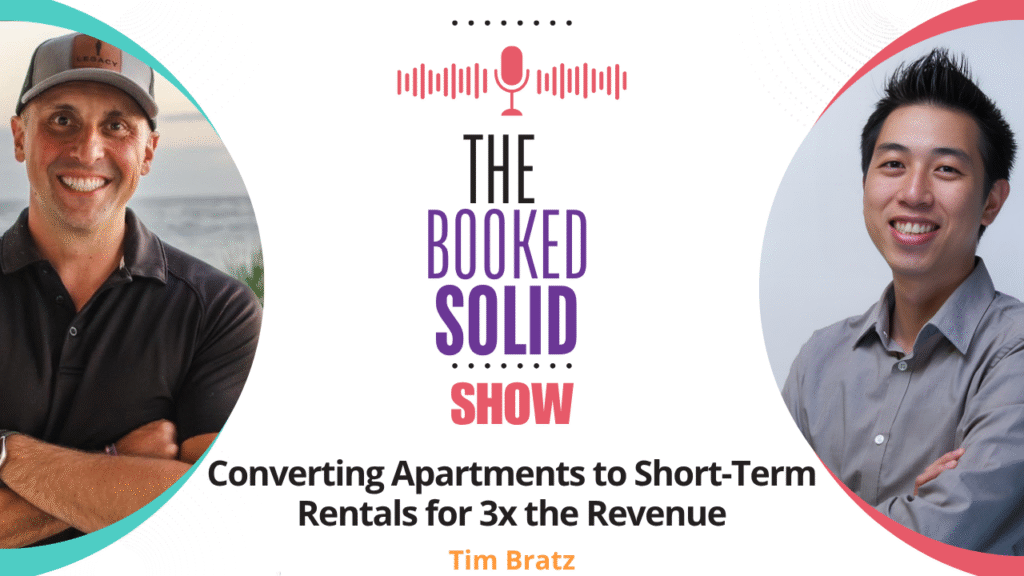
Converting Apartments to Short-Term Rentals for 3x the Revenue with Tim Bratz
“Resourcefulness is the ultimate resource.” — Tim Bratz What happens when a commercial real estate operator with 2,800+ apartment units starts converting a slice of that portfolio into short-term rentals — and generating two to three times the revenue on those units? In this episode of the Booked Solid Show, Gil sits down with Tim Bratz, founder of Legacy Wealth Holdings and Smart Management. Tim walks through how he went from a 23-year-old with a maxed-out credit card buying his first $14,000 house, to building and shrinking a portfolio that’s peaked at nearly 5,000 doors and is valued at over $350 million today. But the real story here is what’s happening right now: multifamily operators like Tim are quietly carving off a small percentage of their apartment units, furnishing them, and putting them on Airbnb and VRBO — and it’s opening up a massive opportunity for short-term rental operators to partner directly with commercial real estate owners who are sitting on stressed portfolios and need help generating revenue without taking on debt. If you’ve ever wondered how the STR world looks from the other side of the real estate spectrum — or you’re looking for your next growth opportunity beyond just buying more doors — this conversation will change how you think about where direct booking expertise can go next. Summary and Highlights 👤 About Tim Bratz Tim Bratz is the Founder and CEO of Legacy Wealth Holdings, a commercial real estate investment firm headquartered in Charleston, South Carolina, with a portfolio of roughly 2,800 rental units valued at over $350 million. He’s transacted on more than 6,000 doors across his career, scaling from single-family flips to a multifamily portfolio that once peaked near 5,000 units before Tim intentionally trimmed it down for quality over size. Tim is also the founder of Smart Management, an all-in-one AI-enabled property management platform built to unify leasing, accounting, communication, maintenance, and reporting — for residential, commercial, and short-term rental portfolios — into a single system. He also runs the Legacy Family Mastermind, coaching entrepreneurs on scaling into multifamily real estate, and hosts his own show, The Legacy Podcast. Originally from Cleveland, Ohio, Tim got his start as a real estate broker in New York City before relocating to Charleston in 2008 — right as the housing market collapsed. With no lender willing to bet on an unproven 23-year-old, he financed his first property with a credit card balance transfer check. That resourcefulness became the throughline of everything he’s built since. 🏢 From Broker to 6,000 Doors: The Long Game Tim’s path into real estate started as a commercial broker in New York, closing leases for landlords who were pocketing millions off deals he’d spend hours negotiating on their behalf. That imbalance is what pushed him to the ownership side. After moving to Charleston in the middle of the 2008 crash, he found his first deal — a $25,000 listing he negotiated down to $14,000, funded with a $15,000 credit limit increase on a Mastercard. He renovated it himself, sold it 100 days later, and netted $13,000. He just kept repeating that formula. By 2012, Tim moved into multifamily, drawn to the efficiency of managing one roof and one utility bill instead of eight. Partnerships, flips, and a turnkey rental business followed, before he made a deliberate pivot in 2017: stop flipping single-family houses entirely and go all-in on acquiring apartments. That decision compounded into thousands of units acquired across 2018–2021, before rates, insurance costs, and labor expenses forced a multi-year period of defense — trimming the portfolio down to today’s roughly 2,800 units, still worth over $350 million. For a related look at what disciplined, intentional scaling looks like on the STR side, check out how Fouad Bazzi and Jacinda Neustel built an 82-property portfolio across six markets using the same “growth isn’t just more doors” philosophy Tim describes. 📉 Why Commercial Real Estate Is Taking Arrows Right Now Tim doesn’t sugarcoat the last few years. Multifamily is valued on the income approach — income minus expenses equals net operating income — and while rents stayed largely flat from 2022 through 2026, expenses climbed dramatically: property taxes up over 25%, insurance premiums doubling or tripling in coastal markets, materials up over 40%, energy up 50%. Add in variable-rate loans hitting the steepest Fed rate hikes in history, and a lot of operators found themselves squeezed with no exit strategy — unable to sell, unable to refinance, forced to just hold on and cash flow. Tim’s advice for anyone navigating instability, whether in commercial real estate or short-term rentals: control the controllables. He restructured investor returns, negotiated seller financing, and avoided cementing losses on properties that were still cash-flow neutral, even when they weren’t performing like they used to. The parallel to STR revenue management is direct — operators focused on amenity and property-level upgrades that move revenue are applying the same discipline: control what you can influence, hold steady through what you can’t. 🏠 The Multifamily-to-STR Conversion Play This is the heart of the episode, and it’s a strategy most short-term rental operators have never considered from this angle. At Legacy Wealth’s apartment complexes, Tim typically converts about 5% of units at any given property into furnished, short-term-licensed rentals — the ceiling most lenders will allow before it creates financing complications from over-concentrating revenue in a single stream. The tiered approach looks like this: For multifamily owners feeling squeezed by flat rents and rising expenses, this is a direct lever to boost net operating income without adding debt or units. And here’s where it gets interesting for STR operators specifically: Tim sees this as a wide-open door for short-term rental experts to partner directly with apartment owners who don’t have the team, bandwidth, or hospitality background to run this themselves. That can look like a rental arbitrage lease on 5–10% of a building’s units, a revenue-share or equity-stake arrangement, or simply offering furnishing and management services in exchange for a cut of