CraftedStays Blog Posts

Purpose-Driven Vacation Rental: The Quiet Advantage Behind Direct Bookings

There’s a version of short-term rental success that gets talked about constantly — better photos, sharper pricing, faster replies, more amenities. And all of it works, to a point. But spend enough time around operators who’ve quietly built loyal, high-conversion, direct-booking-heavy businesses, and a different pattern starts to emerge. They’re not just running rentals. They’re running a purpose-driven vacation rental — one where the “why” behind the business shapes almost every decision that follows. 🎯 This isn’t soft branding. It’s a structural advantage. And it’s one of the few things a property can build that an OTA listing page can’t reproduce, strip out, or outrank. The “Why” Is a Decision-Making Engine, Not a Slogan Most operators assume mission work belongs on an “About” page. The ones who get the most out of it treat it differently — as an internal compass for business decisions. When the “why” is clear, purchasing choices get easier. So do property design trade-offs. So do hard judgment calls when something goes sideways. Instead of defaulting to whatever maximizes short-term revenue, operators with a defined purpose can ask a better question: does this move us closer to what we said this business was for? That single filter removes hours of low-value deliberation and produces a more consistent brand by accident. A well-articulated “why” also survives the moments that wreck most small businesses. When bookings dip, when a renovation goes over budget, when a difficult guest leaves a harsh review, there’s something steady to return to — a reason this was worth starting that has nothing to do with this month’s cash flow. Purpose Doesn’t Replace Revenue — It Depends on It Here’s the nuance most people miss. Purpose-driven doesn’t mean profit-indifferent. The opposite is true. Operators who commit to giving back — whether that’s a percentage of every booking, in-kind donations, or hosting families in need — quickly learn that the mission can only keep growing if the business keeps growing. Revenue becomes fuel, not the goal. A strong month doesn’t mean more lifestyle spending. It means more capacity to fund what the business actually stands for. This reframing changes how operators think about conversion rates, occupancy, and direct bookings. Every percentage point of improvement is now tied to something tangible beyond the P&L. That’s a powerful motivator — and one that generic “grow the business” framing rarely provides. Mission Pre-Qualifies Guests Before They Ever Book A clearly communicated purpose doesn’t attract everyone. That’s the whole point. When a property’s values are visible on the website, in the booking flow, in post-stay emails, and on social channels, it filters traffic in both directions. Guests who share the values lean in. Guests who don’t quietly self-select out. What arrives on check-in day is a higher concentration of the kind of guest who understands the brand — which translates directly into fewer conflicts, easier communication, and better reviews. There’s a specific dynamic worth naming: mission creates guest grace. When something inevitably goes wrong — a hot tub that won’t heat, an appliance that breaks, a late-arriving delivery — guests who feel connected to the brand extend far more patience than guests who booked purely on price. Upfront communication about values builds a buffer that pays out exactly when it’s needed most. 🤝 The Ripple Effect: Family, Suppliers, Guests, Community A purpose-driven vacation rental rarely stays contained to the property. It tends to expand in circles. It often starts with family — partners, kids, close collaborators who get pulled into the work not as cheap labor but as participants in something meaningful. Renovation weekends become shared projects. Welcome basket prep becomes a teaching moment. Business decisions get discussed openly around the dinner table in ways that quietly pass along real-world financial and operational literacy to the next generation. From there, it spreads to suppliers. Operators who adopt a mission-first posture start negotiating differently with vendors, often asking suppliers to participate in the giving model — sponsorship discounts, donated products, shared community initiatives. Many suppliers say yes. The rental becomes a small hub of connected, values-aligned partnerships. Then it reaches guests. Inviting guests to choose which charity their booking supports transforms the transaction into a shared decision. What looks like a tiny interactive moment in the booking flow is actually a guest experience milestone — turning a one-time booking into the start of a relationship. And finally, it reaches the broader community and industry. Once the model is working, operators naturally pull other hosts into the conversation. This is the same long-game pattern behind building systems, branding, and the right team for direct booking growth. Purpose is what makes those systems worth building in the first place. ✨ Why Purpose and Direct Bookings Reinforce Each Other Here’s the part most operators underestimate. Purpose-driven positioning and direct booking infrastructure aren’t separate strategies — they’re the same strategy, layered. OTAs optimize for sameness. Listings get reduced to beds, baths, amenities, price. The mission gets filtered out because there’s nowhere for it to live. A direct booking website is the only place the full brand can actually be told — the “why,” the giving model, the community work, the behind-the-scenes story of how the business came to be. Guests who are drawn to that story are precisely the guests who will book direct when they return, because the story lives on the site, not on the marketplace. This is also where operational infrastructure earns its keep. A purpose-driven operator who capture guest emails through guest Wi-Fi, automate a thoughtful pre-arrival sequence that introduces the giving model, send a post-stay message, and re-engage months later, compound every mission-driven booking into a repeat relationship. The tech stack isn’t decorative. It’s how the mission scales. That’s exactly the logic behind turning one-time guests into loyal repeat customers through email. 📧 Start Small. Pick One Thing. Let It Compound. The operators who do this well almost never started with a fully formed mission. They started with a small act — a percentage donation, a local partnership,

CraftedStays Blog Posts

Amenity Upgrades That Move Revenue: A Practical Case for Investing in Your Vacation Rental

The operators growing fastest aren’t always the ones buying more properties — they’re the ones squeezing more revenue out of the ones they already manage. There’s a pattern that keeps surfacing in conversations with vacation rental operators who’ve scaled their portfolios quickly. The breakthrough rarely comes from doing more of the same. It comes from rethinking what a property is actually worth — and what it takes to raise the ceiling on that number. Amenity upgrades on a vacation rental, when chosen well, can be the single highest-leverage investment an operator makes in a given year. 🎯 Most hosts underestimate this. They treat the property as a fixed asset and assume revenue is determined by market, seasonality, and nightly rate. But markets are full of comparable homes earning wildly different numbers. The difference is almost never square footage. It’s what the guest gets to experience once they walk through the door. The Real Economics of a Strategic Upgrade Consider the math behind a well-placed upgrade. A backyard addition — a jacuzzi, a game room, a fire pit, a dedicated outdoor lounge — might cost a few thousand dollars to install. If that addition allows the property to raise its nightly rate even modestly and increase occupancy on shoulder nights, the compounding effect across a calendar year is substantial. It’s not uncommon for a single upgrade to lift monthly revenue by several thousand dollars, and for annual revenue on a property to jump from the mid-tens of thousands into the low hundreds of thousands. 💰 The investment pays back in weeks, not years. And once it’s paid back, the upgrade becomes pure margin on every future booking. The operators who understand this stop thinking about upgrades as expenses. They start thinking about them as capital allocation decisions. Every dollar deployed into the property is evaluated against its expected return — the same way a business owner would evaluate any other growth investment. Choosing the Right Upgrade Not every amenity moves the needle equally. The upgrades that convert well share a few characteristics. They’re visible in photos. They’re searchable as filters on booking platforms. They solve a real problem for the guest type a property is already attracting. And they create stories guests tell each other, which drives repeat interest and direct referrals. A hot tub in a cold-weather market is a different investment than a hot tub in a beach market. Outdoor games on a family property earn their keep in ways they wouldn’t on a corporate rental. The right upgrade isn’t a generic upgrade — it’s the one that deepens the match between the property and the guest who’s already looking for it. The mistake most operators make is spreading investment thinly across minor cosmetic improvements. Repainting a room doesn’t change the listing’s economics. Adding a feature that shows up in search filters and photo galleries does. 📸 Where Direct Bookings Fit In Here’s the piece that often gets missed. A property with strong amenities performs better on OTAs — but it performs dramatically better on a direct booking website. The reason is simple: on an OTA, the property competes against thousands of similar listings, and amenities are quickly commoditized by filter options. On a direct booking site, those same amenities become the centerpiece of a story the operator controls entirely. A direct booking page can show the jacuzzi at sunset, the fire pit mid-conversation, the game room packed with family — not as bullet points, but as the atmosphere that defines the stay. Guests who arrive on that page aren’t comparison shopping. They’re imagining themselves there. Conversion rates reflect that difference. This is why operators who invest in upgrades and operators who invest in direct booking infrastructure tend to be the same people. They’ve realized that the upgrade increases the property’s value — and the direct channel is where that value actually gets captured. 🏡 The Compounding Effect There’s a quieter benefit to all of this. When an operator proves that strategic upgrades move revenue, the relationship with property owners changes. Owners who see their property’s performance jump start asking what else is possible. They agree to larger improvements. They refer other owners. The portfolio grows — not because the operator is chasing more doors, but because trust and track record are doing the work. That’s the version of scale that lasts. Not more properties for their own sake, but better-performing properties that attract the right owners, the right guests, and the right revenue. What This Looks Like in Practice The operators who apply this thinking share a few habits: They treat every property as a revenue-generation system, not a passive asset. They track which upgrades produced measurable lift and which didn’t. They reinvest a portion of that lift back into the next upgrade. And they build a direct booking presence that can showcase those upgrades in the way OTAs never will. The short version: the property is the product. Keep improving the product, and the revenue follows. ✨ Ready to turn your property upgrades into higher-converting direct bookings? CraftedStays builds fast, mobile-optimized direct booking websites designed specifically for short-term rental operators who want to capture the full value of what they’ve built. Visit CraftedStays.co and start your free trial today.

CraftedStays Blog Posts

Social Media Content Strategy That Drives Direct Bookings for Vacation Rentals

The vacation rental operators who consistently drive 80% or more of their bookings through direct channels aren’t relying on luck, discounts, or a single viral post. They’ve built something more deliberate: a content strategy that treats social media as a full acquisition channel, not an afterthought. The difference between operators who dabble in social media and those who actually convert through it comes down to how intentionally they approach content — what they create, who they partner with, and how they follow up once someone shows interest. Shareability Is a Design Decision Before any content strategy can work, the property itself needs to give guests a reason to pull out their phones. This isn’t about having a luxury property — it’s about having something worth sharing. A massive lazy river in a backyard compound, a tree deck with a hot tub tucked into a hillside, a view that hits differently at sunrise. These features are decisions, not accidents. If your current inventory leans more toward well-amenitized but otherwise standard homes, the question to ask is: what can we add or highlight that would stop someone mid-scroll? That answer shapes everything downstream — from the kind of content you can produce to the caliber of creators who will want to collaborate with you. Properties with inherent visual appeal convert social traffic at a fundamentally higher rate because the guest’s buying decision is already emotionally made before they ever reach the booking page. Why Your Content Needs a Story, Not Just a Shot List One of the most common mistakes operators make is treating social content like a property brochure — polished walk-throughs, slow cinematic pans, hero shots of the kitchen. That content has its place, but on its own, it performs like an ad. And people pay money specifically to avoid ads. What actually drives engagement is tension and resolution. A walk-up to the property that builds anticipation before revealing a view. A renovation journey that shows the real struggle before the finished result. Even a simple reel structured around movement — entering a space, discovering something unexpected — creates the kind of narrative pull that keeps someone watching and, eventually, booking. This principle applies whether you’re building in public before a property even opens or repurposing existing footage into more compelling sequences. The goal isn’t production value. It’s emotional investment. Raw, UGC-style content often outperforms expensive shoots precisely because it feels genuine rather than promotional. The Right Influencer Beats the Biggest Influencer Influencer partnerships are a real driver of direct bookings for unique stay operators, but the strategy most people imagine — find someone with a big following, offer a free stay — rarely delivers meaningful results. A TV personality with millions of followers but no travel authority can generate zero bookings. A local creator with 15,000 highly engaged followers who trust their recommendations can generate thousands in reservations from a single post. The metric that matters isn’t follower count — it’s engagement rate and topical authority. Travel and food creators tend to convert well because their audiences are actively looking for recommendations. The best ones are selective about what they promote, which is exactly what makes their endorsements valuable. When a creator turns down properties that don’t meet their standard, the ones they do feature carry real weight with their audience. For operators willing to pay for top-tier local creators — typically in the $1,500 to $3,500 range per collaboration — the return on well-matched partnerships can reach seven to ten times the investment in direct bookings. Micro-influencer comp stays, meanwhile, continue to build content libraries and follower growth at minimal cost. The longer-term play is even more compelling: once you’ve built a substantial content library and a strong following in your key market, the dependency on ongoing influencer activations naturally decreases. Email Is the Channel You Actually Own Social media grows an audience. Email is how you convert and retain one. Operators who reach high direct booking rates treat email capture as a deliberate part of the direct booking website experience — not something bolted on after the fact. A well-timed pop-up on a direct booking site, positioned at the right moment in the browsing journey, can add hundreds to thousands of new contacts to a list every week. From there, a consistent newsletter — covering local events, new property openings, seasonal offers — keeps the property top of mind for the exact people who have already shown interest. The guests acquired through social media tend to be less price-sensitive than OTA guests because their decision is emotional rather than comparative. They aren’t shopping across a grid of options; they saw something that made them feel something. A warm email list full of those same people becomes one of the most cost-effective direct booking channels an operator can have. For a deeper look at building that email foundation, the CraftedStays guide to email collection for short-term rentals is worth reading alongside this strategy. The Tracking Problem No One Has Fully Solved One area where honest operators acknowledge real frustration is attribution. When a guest sees a reel, follows an account, visits a direct booking site weeks later, and then completes a reservation — connecting those dots cleanly is still genuinely hard. Most booking engines weren’t built with the same tracking infrastructure as e-commerce platforms. Boosted posts and paid social can amplify reach, but measuring actual revenue from those investments often comes down to traffic estimates and conversion rate assumptions rather than clean data. Cross-domain tracking between a property website and a PMS booking flow adds another layer of complexity that even sophisticated operators are still working through. The practical response isn’t to avoid paid amplification — it’s to go in with realistic expectations about attribution and lean harder on the channels where the feedback loop is cleaner, like email click-throughs and direct booking traffic trends. This is part of why the infrastructure behind a direct booking site matters so much. Platforms built specifically for direct bookings —

CraftedStays Blog Posts

Why Every Vacation Rental Host Needs SEO Landing Pages (And How to Build Them)

There’s a search happening right now for “pet-friendly vacation rentals in [your area].” And your direct booking website probably isn’t showing up for it. Not because your properties aren’t great. Not because your website is slow or poorly designed. But because you don’t have a page for it. That’s the gap. And it’s one of the biggest missed opportunities in vacation rental marketing. The problem with a single-page approach Most direct booking websites list all their properties in one place — a homepage or a generic “properties” page. It works for guests who already know your brand. But it doesn’t work for search. Search engines — and increasingly AI assistants like ChatGPT, Gemini, and Perplexity — rank pages, not websites. If nobody is linking to or landing on a page about your pet-friendly properties specifically, search engines have no reason to surface your site for that query. Our research on which pages AI engines cite is collected in the property manager’s guide to AI search for vacation rentals. Meanwhile, Airbnb has a page for every imaginable filter combination. Vrbo does too. They rank for thousands of long-tail searches because they have thousands of focused pages. You don’t need thousands. But you do need more than one. What an SEO landing page actually looks like An effective landing page for a property category isn’t just a filtered list of homes. It’s a standalone page with: The math behind it Let’s say you manage 20 properties across a beach destination. Without landing pages, you have one main page competing for every search term. Now imagine you create landing pages for pet-friendly stays, beachfront properties, family vacation rentals, large group accommodations, properties with pools, and luxury rentals. That’s six new pages, each targeting a different set of search terms. Each with its own URL, its own content, its own chance to rank. You’ve gone from one entry point to dozens — all without adding a single new property. Why this matters more in 2026 1. AI search is real. ChatGPT, Google AI Overviews, Perplexity, and Claude are answering travel queries directly. They favor structured, specific content. 2. Long-tail search is growing. Guests are searching for “vacation rental with pool near downtown Nashville that allows dogs.” The more specific your pages, the more of these queries you can capture. 3. Google rewards topical depth. Sites that demonstrate expertise through multiple related pages and internal linking consistently outperform sites with thin, isolated pages. Getting started Start with the one category that gets the most questions from guests. Build the page. Add your properties. Write a few FAQs. Optimize the meta tags. Link to it from your homepage and navigation. Then watch what happens in the search console over the next 30-60 days. The bottom line OTAs will always outspend you on marketing. But they can’t out-focus you. A page about “pet-friendly cabin rentals in Gatlinburg” written by someone who actually manages those cabins will always be more authentic, more detailed, and more helpful than an OTA filter page. Search engines and AI assistants are getting better at recognizing that. The question is whether your site gives them something to find. Your direct booking website should work as hard as you do. With CraftedStays, you get a purpose-built platform with SEO baked in — plus the flexibility to fine-tune every meta title, description, and image across your portfolio. See what CraftedStays can do for your properties →

CraftedStays Blog Posts

The Hidden Cost of Broken Links on Your Vacation Rental Website

There’s a link to your vacation rental website sitting in someone’s inbox right now. Maybe it’s from a newsletter you sent last summer. Maybe it’s a QR code on a brochure at the local visitor center. Maybe it’s in a guest’s bookmarks from when they stayed with you two years ago and have been meaning to come back. They click it. And they get a 404 error. They don’t try again. They don’t hunt around your site for the right page. They close the tab and move on — probably to an OTA. This happens more often than most hosts realize. And it’s entirely preventable. Every website breaks links over time It’s not a matter of if — it’s when. Links break because of perfectly normal things: You renamed a page to better reflect what it offers You reorganized your site structure as you added more properties You moved a blog post to a new category or URL format You redesigned your site and the URL paths changed You created seasonal landing pages that have since moved None of these is a mistake. They’re signs of a growing, evolving business. The problem isn’t that URLs change — it’s what happens when the old ones stop working. What broken links actually cost you Lost visitors — A guest who hits a 404 page is almost certainly gone. Dead-end pages have near-zero recovery rates. Lost SEO equity — Every link pointing to your site carries value. When the destination returns a 404, that value evaporates. Rankings drop. Crawl frequency decreases. Lost repeat bookings — Past guests are your best marketing channel. If the link they saved goes nowhere, you’ve made it harder for a warm lead to convert. The fix is simpler than you think A 301 redirect is a permanent instruction that says, “This page has moved — send everyone to the new address instead.” It works at the server level, invisible to the visitor. They click the old link and land on the right page. More importantly, 301 redirects transfer SEO equity. The link from that travel blog? Still counts. The bookmark in your guest’s browser? Still works. When to set up a redirect Any time you change a URL that someone might have saved, linked to, or bookmarked: Renamed a page: /about-us → /our-story Reorganized properties: /property/beach-house-1 → /property/oceanfront-retreat Moved a blog post: /blog/pet-friendly-tips → /guides/traveling-with-pets Seasonal promo expired: /summer-special → /specials Restructured the site: /listings → /vacation-rentals Best practices Point to the final destination. If you redirect A → B and later move B → C, update the first redirect to A → C. Use exact paths. /vacation-rentals/old-page is different from /vacation-rentals/old-page/. Be precise. Don’t redirect everything to the homepage. Redirect each old page to its most relevant replacement. Check your redirects periodically. A quick audit every few months keeps things clean. The bigger picture Broken links are a symptom of something deeper: most vacation rental websites are set up once and rarely maintained from an SEO perspective. 301 redirects quietly protect the SEO foundation you’re building every time you publish a page, write a blog post, or share a link. The best time to set up a redirect is the moment you change a URL. The second-best time is now. Your direct booking website should work as hard as you do. With CraftedStays, you get a purpose-built platform with SEO baked in — plus the flexibility to fine-tune every meta title, description, and image across your portfolio. See what CraftedStays can do for your properties →

CraftedStays Blog Posts

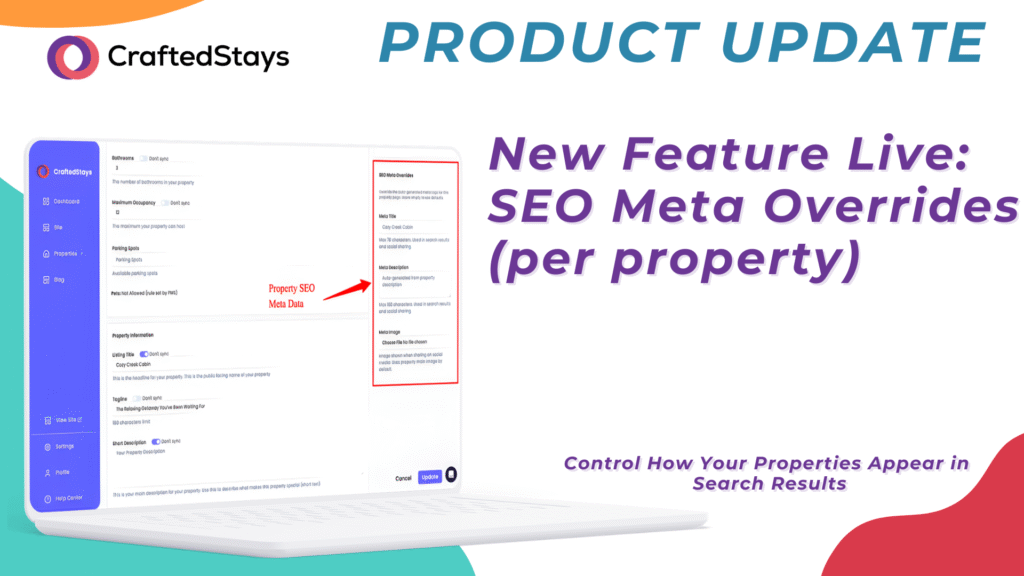
New Feature Live: SEO Meta Overrides (per property)

When someone Googles “cabin near Gatlinburg with hot tub,” what shows up in the search results matters. The title and description beneath your link are often the first — and only — impression you get before a guest decides to click or scroll past. Until now, CraftedStays auto-generated those meta tags based on your property details. That works well for most hosts. But if you want full control over how each property appears in Google, social media shares, and AI-powered search tools like ChatGPT — you now have it. What’s New: SEO Meta Overrides You can now customize the meta title, meta description, and social sharing image for each individual property on your CraftedStays site. These are the fields that control: How to Set Custom Meta Tags All fields are optional. If you leave them empty, CraftedStays continues auto-generating your meta tags from your property details — exactly like before. Nothing breaks. Why This Matters Stand Out in Search Results Your auto-generated meta description might say “3 bedroom cabin in Pigeon Forge.” A custom one could say, “Family-friendly mountain cabin with private hot tub, game room, and panoramic Smoky Mountain views — book direct and save.” Which one gets the click? Control Your Social Shares When a past guest shares your property link on Facebook or texts it to a friend, the title, description, and image that appear are pulled from your meta tags. Custom overrides let you choose exactly what shows up — instead of leaving it to whatever the platform auto-scrapes. Get Found by AI Search AI-powered tools are increasingly how travelers discover places to stay. These tools pull from structured metadata to build their recommendations. Better meta descriptions give AI more context about your property, which means better visibility when someone asks ChatGPT, “Where should I stay near Asheville?” Best Practices for Writing Meta Tags Meta Title (50–60 characters): Example: “Luxury Lakefront Cabin | Hot Tub & Dock | Lake Tahoe” Meta Description (120–155 characters): Example: “Wake up to lake views from every room. Private dock, hot tub, and 5 minutes to downtown. Book direct for the best rate.” Social Sharing Image: Pro Strategy: Prioritize Your Top Properties First You don’t need to customize meta tags for every property on day one. Start with the properties that get the most traffic or the ones you’re actively marketing. Those are the listings where a compelling meta description can make the biggest difference in click-through rates. For a detailed walkthrough, check out our help article: How to Set Custom SEO Meta Tags for Your Properties Your properties deserve to stand out — in search results, social shares, and AI recommendations. CraftedStays gives you the tools to control exactly how the world sees your brand. → Get Started with CraftedStays

CraftedStays Blog Posts

Customize Fonts in the Refined 2.1 Template

Your brand is more than a logo and color palette. The fonts on your direct booking site shape how guests perceive your property before they ever scroll to your listings. Why Typography Matters for Direct Bookings Before diving into the how-to, understand this: typography is one of the fastest ways to elevate your site from “template” to “brand.” The right font pairing creates visual hierarchy, builds trust, and guides guests toward your Book Now button. Generic fonts signal a generic experience. Custom typography signals intention. The Result: A site that feels like yours — not a cookie-cutter listing page. How to Customize Fonts in Refined 2.1 Step 1: Open the Typography Panel All global text styles are managed here, so changes apply across your entire site without editing each page individually. Step 2: Understand the Default Font System Refined 2.1 ships with a curated set of font families designed for clarity and hierarchy: All font sizes are based on a 16px root size with rem-based scaling, so your typography stays consistent and responsive across every device. Step 3: Know What Each Text Style Controls Here’s what you can customize and where each style appears on your site: Headings: Body and UI Elements: Pro Strategy: You don’t need to change everything. Start with your headings and body text. Those two alone account for 90% of what guests read on your site. Recommended Font Structures by Page Type Blog Posts Landing and Campaign Pages Best Practices When Changing Fonts When you adjust typography, keep these guidelines in mind: Tips for Hosts Note: Typography controls are currently available for websites using our Refined 2.1 template, with rollout to all templates coming soon. Your brand deserves more than default fonts. CraftedStays gives you full control over typography, colors, and every detail of your direct booking site — no code, no agencies. → Get Started with CraftedStays

Scroll to Top