

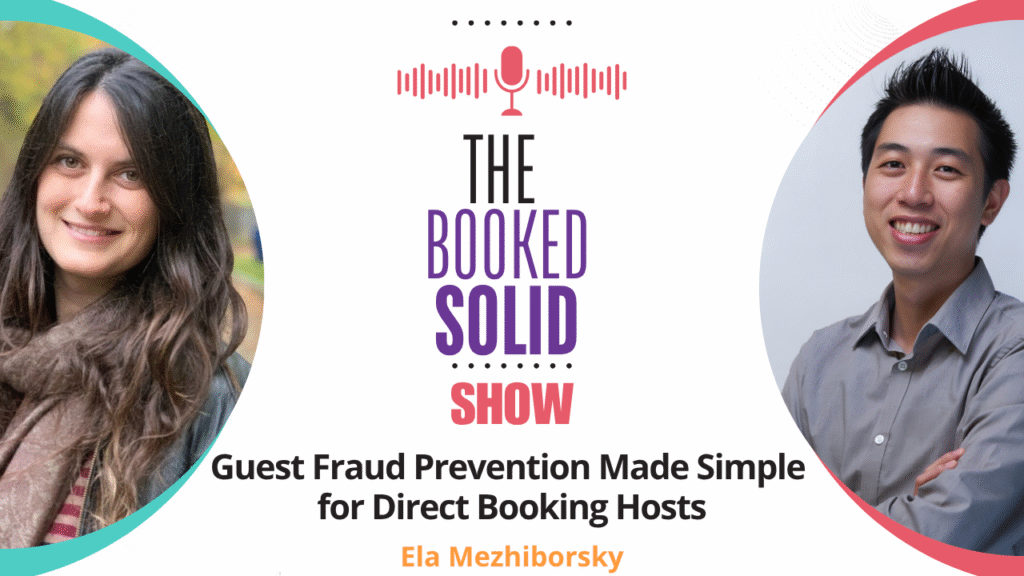
“Real fraud that’s aware of your loopholes will not come in looking sketchy.”
That’s the moment this episode shifts from guest screening 101 into something a lot more unsettling — and a lot more useful. On this episode of the Booked Solid Show, Gil sits down with Ela Mezhiborsky, Co-Founder and President of Autohost, to talk about guest fraud prevention in an age where AI can fabricate a convincing, sympathetic, entirely fake guest from scratch. Ela walks through how fraud has evolved from fake IDs to synthetic identities, why “gut feeling” is a liability instead of a filter, and why screening guests properly is what actually lets you say yes to direct bookings with confidence instead of fear.
Whether you’re just getting your first direct booking site off the ground or you’re managing a growing portfolio, this conversation reframes guest screening as the thing that protects your hospitality — not the thing that gets in its way.
Summary and Highlights
👤 Meet Ela Mezhiborsky
Ela Mezhiborsky is an industry advocate and public speaker focused on trust and safety as AI reshapes hospitality. A former short term rental operator and Cofounder & President of Autohost, she speaks on “bad AI,” guest verification, fraud risk, bias, and why yesterday’s solutions can’t solve today’s problems. Ela started as an operator running Quickstay, a property management company in Toronto with just over a hundred units, before cofounding Autohost with her childhood friend Roy Firestein, who brought a cybersecurity background to the hospitality problem she was living every day.
🚨 Why an Operator Became a Fraud Fighter
Ela didn’t set out to build a guest fraud prevention company. She set out to run a property management business. Somewhere along the way, scale exposed a harder truth: guests could also be the problem.
What started as an internal decision tree for her support team, flagging one night local bookings, flagging last minute reservations, flagging certain platforms, eventually collided with something much darker. Escort services. Money laundering. Weapons posted on Instagram from inside a rented unit. That escalation is what pushed Quickstay’s internal spreadsheet into becoming Autohost, a platform now integrated across many major PMS providers, including the ones covered in our Hospitable PMS guide.
🎭 The Guest Who Looks Perfect Might Be the Problem
For years, fraud had a look. Fake IDs. Stolen credit card numbers. Sketchy behavior an experienced host could spot.
That era is ending. Ela explained how AI now allows bad actors to build synthetic identities from scratch: a convincing photo, a plausible online footprint, a warm story about visiting a daughter at university. These personas don’t look sketchy. They’re built specifically not to.
“We’re starting to doubt what we’re seeing,” Ela said, describing a strange new instinct where a guest profile that looks too polished can be more concerning than one that looks rough around the edges. Voice cloning has made it worse. A fraudulent “guest” can now pass a phone call, stay in character under pressure, and even lean on emotional appeals faster than a host can catch them.
📊 Objective Data Beats Gut Feeling Every Time
Here’s the part every host needs to hear: intuition is not a screening system. It feels like one, but it isn’t.
Ela was blunt about why. “Sketchy” is subjective, and subjective judgment opens the door to real bias, while giving sophisticated fraud an easy way to slip through by simply not looking sketchy at all. Autohost instead builds its guest fraud prevention approach around objective signals: device fingerprinting, whether a credit card was recently flagged, whether an email address was created hours before the booking, whether a listed location matches the device’s actual location.
None of this replaces hospitality. It removes the guesswork so a host’s team can stay focused on the guest experience rather than quietly playing detective, a theme that echoes what Abby Grous from Hospitable shared about payment side fraud screening on an earlier episode.
💳 The Chargeback Problem Nobody Budgets For
Chargebacks came up as one of the quieter costs of direct bookings, and one of the reasons some hosts hesitate to leave OTAs at all.
Ela drew a clear line between two very different problems: real fraud, where a card was genuinely stolen, and “friendly fraud,” where a guest disputes a legitimate charge after the fact. Both hit the same merchant account. The difference is that proper guest verification gives an operator something to fight back with: a timestamp, an electronic signature, a verified ID on file, instead of a guessing game with the payment processor.
🔓 Screening Is an Enabler, Not a Barrier
This might be the most important reframe in the episode. Ela argued that treating direct bookings as inherently risky, and responding with blanket rules like “no one night stays” or “no local bookings,” isn’t caution. It’s a financial mistake dressed up as prudence.
“Better safe than sorry” sounds responsible. It isn’t strategic. Restrictive policies quietly choke off the direct booking revenue an operator worked hard to build, without actually solving the underlying risk. The fix isn’t more rules, it’s proper screening, paired with a brand guests already trust, the same trust building work covered in building trust on your direct booking site.
🧰 What Guest Screening Actually Costs to Run
One thing likely to surprise newer hosts: guest fraud prevention isn’t reserved for large operators anymore. Ela was once restricted to onboarding only larger portfolios at Autohost and got pushback from small hosts who wanted access and couldn’t get it. That gap has closed.
Cost typically runs from cents to a few dollars per reservation, scaling with how much verification a jurisdiction or contract requires. Compared against the cost of one bad chargeback, or worse, a property used for something it was never intended for, the math isn’t close. Whatever platform a host uses, a PMS, a direct booking site, or a standalone tool, the point is simply to build a verification step into the guest journey, the same way brand trust and OTA to direct conversion get built into the rest of a host’s systems.
📚 Book Recommendation
Ela’s pick was Atomic Habits by James Clear, not for the first time on this podcast, but for a reason worth repeating. She keeps returning to its central idea: small, consistent progress beats the overwhelm of trying to change everything at once, whether that’s in fitness, parenting, or running a company.
⚡ Rapid Fire Round
Book that made an impact: Atomic Habits by James Clear, for the reminder that habits, not motivation, drive results.
Mindset advice for starting something new: “Done is better than perfect.” Ela admits she’s a natural planner who has had to train herself to launch before she feels ready.
One tactical takeaway for direct bookings: Don’t half ass it. Invest in your brand, bring your authenticity, and screen your guests properly instead of leaning on blanket restrictions that quietly cost you bookings.
🤝 Connect with Ela Mezhiborsky
Ela is most active on LinkedIn, where she shares insights on guest fraud prevention, identity verification, and the occasional parenting story.
🎧 Listen to the Full Episode
This recap only scratches the surface. Ela’s stories from her operator days, including the gang fraud ring caught through device fingerprinting alone and the guest support horror stories that led to Autohost’s founding, are worth hearing in full. Listen to the complete episode of the Booked Solid Show on Spotify or YouTube.
And if you’re building or rebuilding your direct booking strategy and want a website that’s actually built to convert traffic into confirmed, verified guests, visit CraftedStays.co to start your free trial. You don’t need an $8,000 agency build to get this right. You need the right platform.

Transcription
Ela: But we can all kind of agree that a one-night stay by a local under 25 booking a four-bedroom condo but saying it’s for his anniversary is lying, and it’s a party risk. That’s your intuition playing. But then once we get into more data points, like, you know, actually checking their device fingerprint in real fraud situations, are, are they trying to mask their identity online?
Are they using a credit card that was reported stolen or trying to stuff 18 credit cards and the 19th one goes through? So yes, it goes way beyond just decision tree, but now we collect data points. And the important part there is that we really pride ourselves in collecting objective data points because gut feeling is where you’re getting into the whole, “I don’t feel comfortable with the guest,” or they feel sketchy, and sketchy is not a filtering criteria, and sometimes sketchy can get very deep into ethical discrimination.
But also sketchy can be a loophole because real fraud will exploit that. Real fraud that is aware of your loopholes will not come in looking sketchy. So we really came and said, what are the objective data points that we can look at from both the information they give us, the information we know from the reservation, other information we can collect about their device, their system, their location, combine all of that together and give you, like, the best estimate analysis we can, which is 100X better than any human judgment to say, do we see any flags or risks with this reservation?
Gil: Before we bring on our guest, I wanted to talk just a little bit about something that I’ve been hearing a lot from hosts. I keep on hearing the same thing: “I know my website isn’t converting, but I can’t afford $8,000 on an agency to rebuild it.” Here’s the thing, you’re learning all these marketing strategies, you’re driving traffic, and you’re putting it all to work, but if your site isn’t really built to convert, you’re basically lighting your energy and money on fire.
And even if you could afford an agency build, every time you want to test something or make a change, you’re having to pay them again. You can’t iterate, you can’t test, and you really can’t improve on things. You don’t need a custom $10,000 website to get the conversion rates that really matter. You just need the right platform.
That’s why I built CraftedStays. It’s purpose-built for short-term rentals and designed from the ground up to help you drive more direct bookings. You can finally turn that traffic into bookings, and you can keep on testing and improving as you learn. You can make changes all on the platform. You don’t need to learn something new.
So if you need some help or you want to get started, go ahead and go to craftedstays.co and start your free trial. Now let’s bring on our guest and dive deep into hospitality and marketing.
Gil: Hey, folks. Welcome back to the Booked Solid Show, the show where we bring in top operators to discuss hospitality, operations, and direct bookings.
On today’s show, I have Ela, the co-founder of Auto Hosts. Today, we dive deep in the world of fraud and how hosts can protect themselves. We talk about the different types of fraud, the signals to look out for, and how the landscape has shifted where these tools aren’t just reserved for hotels and large operations anymore.
And what I love about today’s discussion is that many folks think of identity verification as a tool to minimize risk, but it’s also a tool to enable hospitality without unnecessary barriers. So without further ado, let’s bring in Ela.
Gil: Hey Ela, welcome to the show.
Ela: Hello. It’s nice to be here finally
Gil: Yes. We’ve been trying to schedule this for so, so long. You’re probably one of the hardest people to align our schedules with.
Ela: It was a, it was a challenge, but we’re here, and it’s gonna be amazing
Gil: We should have just done it in, in Brighton when we were in person. We should have just done that instead.
Ela: We could have. We could travel vlog. Yeah
Gil: That would’ve been fun. That would’ve been fun. So Ela and I both made it from North America all the way to Brighton. She had planned it a m- a lot better than I did. I, I, I, I did it very last minute, but it was so good to see you out on, on the other side of the pond, even though we could have just seen each other much closer here
Ela: Sure. But we’re presenting. It was fun. And I, I respected your spontaneity. I mean, I think planning ahead, it’s almost not as cool as like, “You know what? I’m gonna come, and it’s gonna be awesome, and it’s good for me and good for, you know, my audience,” and I loved it
Gil: I, it’s, it was so out of character for me to, to, to go to Scale. So for our listeners here, um, I had flown out to Scale UK conference, and it began on a Monday or Tuesday, but I hadn’t decided to go until the Friday prior. And I’ve never traveled to Brighton or the UK before, so, like, when I went there, I’m, like, completely out of my, my element.
Um, and I’m not… I’m usually a planner. Like, if I book a trip, I usually like to book it in advance. But I ended up getting a ticket to Scale from John Ahn. Um, and he was like, “Hey, if you wanna go, I have an extra p- ticket.” And the tickets aren’t that expensive, but it was just enough to make me wanna go. And it was mainly because it was a two-day session, and the first day was all around AI, and then the second day was around hospitality.
Um, and so I hadn’t seen a two-day conference where one day was dedicated just to AI, so I was interested in it. So that kind of led me to fly all the way across the globe, or halfway across the globe, to, to, to go there. So… And I’m glad I was able to, to see you in person. Have we– No, we’ve met in person before, right?
I think we did. I don’t
remember
Ela: see, I wanna see. You know how video these days, like I’ve seen you so much and this has been so great, and we got to know each other very well, so I don’t even know.
Gil: Yeah, I don’t know.
Ela: in person? No. Vegas, Vegas. I saw you in Vegas. Vera Mae, yes.
Gil: Yes. So we, yeah, we’ve been to many conference circuits together, but you’re right. After, after so many Zoom calls, you end up kind of blending it. I remember at one
of
Ela: we’re not gonna comment, you’re not gonna comment on why we don’t remember Vegas?
Gil: I don’t remember Vegas.
Ela: Exactly. Exactly
Gil: That’s, that’s what I’m known to say, um, or I should be saying. Um, but yeah, it was, it wa- Verma was a fun time. Um, but yeah, before we get kinda too deep into it, Ela, who are you? Please introduce yourself
Ela: Oof. Um, that’s a big question. I’ll I’ll go specifics. I am, I am the co-founder and president of AutoHost. We recently also kind of, uh, released a Checktive platform, like a parallel brand. And I’ve really been in this industry for since like 2015, 2016. Started as an operator and really moved into the tech side of things, dealing with the problems around guest screening.
So ID verification, fraud prevention, chargebacks, all the fun stuff
Gil: Yeah. The, your name has been out there quite a bit. I’ve seen, I’ve seen you guys all over. I’ve seen you integrated with a lot of PMSs. Um, and talk, talk a little bit about like the problem. Like what do you, what do, what is AutoHost? What are you solving? Like what was the origin story? Like why did you decide to co-found this company?
Ela: Mm-hmm. So, so like I said, I st- I started as an operator, and we ran a property management company here. I’m from Toronto. It was called Quickstay. We managed a little over a hundred properties at the time, and we kinda started seeing that some of the problems that come with scale are not just operational, and you’re trying to kind of accommodate more guests and do things better.
But then at some point it hits you that one of the problems that, you know, as you’re trying to serve guests, you’re like, “Guests could also be the problem.” And that’s, like, that’s a, a disappointing thing to realize, and there’s bad apples. And so we kinda got into this cycle of needing to deal with gray area risk.
Call it parties, rule compliance, smoking, vandalism, things like that that kind of, you know, you don’t want in your properties. Some basic screening or warnings or agreeing to rules would resolve. And, and we pretty much kind of had our team start putting together sort of an algorithm, like a decision tree on a board that kinda says, you know, if the guest is this and this and that, and you go through your culprits, like your one-nighter and your last minutes and your young bookers and booking.com and locals, and you kinda go, if any of those risk factors are there, then let’s send them something a little bit stricter.
Like, you know, no noise after 11 and capital letters around, you know, no smoking on the balcony and yada, yada, yada. Whereas with other guests, kinda let’s go a lot more lenient because after all, we are in the business of guest experience and hospitality. And so what started as an internal, almost like a decision tree algorithm for our team, because we started growing our guest support team, and they are not meant to be bouncers or detectives and they, they don’t…
Like, they’re meant to serve the guest. And so we needed to kind of standardize the process and build a sort of an algorithm which was internal at the time, and then happy to dive in a little bit later, but into some stories of, you know, shit hitting the fan, pardon my French. But basically kind of saying, “We need to take this to the next level.”
So you move from gray area risk to actual crime, and you’re getting into escort services and sex trafficking and money laundering and gang activity and weapons in units posted on Instagram and, and whatnot. And you’re like, “I’m in hospitality. Why am I dealing with this?” And sure, chargebacks are hitting your account and that’s horrible, uh, because that’s also kind of one of the resulting factors.
But we kinda said, “We need to take it to the next level.” And that’s where we with Quickstay, so we partnered with a good childhood friend and, um, Roy Firestein, who’s my co-founder and CEO, and he comes from the cybersecurity space. And we kinda said, “These two industries need to meet because hospitality is so exploitable that we need the measures in place so that we can keep focusing on hospitality.”
And so we really took it to the next level, started to bring in identity verification, and we need to make sure that, you know, the person is who they say they are, uh, for both of our sake. Like, I mean, that, you know, your identity hasn’t been compromised, that the property is safe, that the neighbors are safe, that you’re a responsible operator, and that’s kinda how it all got started.
And we built really this platform where operators can use the process so that their guests just confirm the reservation, go through the verifications, and they’re verified to go so that you can, you know, focus on the hospitality quality side of things
Gil: Got it. Got it. There’s, there’s a few things that, that is quite interesting. It, it sounds like in the very beginning you were doing kind of this decisions tree, rules engine, however you want to, to call it, but it’s really around like certain things that you can see within the reservation details that could signal whether or not this is a risk.
And I’m guessing now when you mention algorithm, I, I think about data and I think about external data sources. So you now go from this rules engine to analyzing a much larger data set to help you decide whether or not someone is fraudulent or a, a risky, a risky guest perhaps. Is, is that the case?
Ela: Yeah, 100%. So you could go, you know, even intuition, which is where operators start, and gut feeling is better than nothing, but we can talk about why that’s sometimes dangerous and a loophole. But we can all kind of agree that a one-night stay by a local under 25 booking a four-bedroom condo but saying it’s for his anniversary is lying, and it’s a party risk.
That’s your intuition playing. But then once we get into more data points, like, you know, actually checking their device fingerprint in real fraud situations, are, are they trying to mask their identity online? Are they using a credit card that was reported stolen or trying to stuff 18 credit cards and the 19th one goes through?
So yes, it goes way beyond just decision tree, but now we collect data points. And the important part there is that we really pride ourselves in collecting objective data points because gut feeling is where you’re getting into the whole, “I don’t feel comfortable with the guest,” or they feel sketchy. And sketchy is not a filtering criteria, and sometimes sketchy can get very deep into ethical discrimination.
But also sketchy can be a loophole because real fraud will exploit that. Real fraud that is aware of your loopholes will not come in looking sketchy. So we really came and said, “What are the objective data points that we can look at from both the information they give us, the information we know from the reservation, other information we can collect about their device, their system, their location, combine all of that together and give you, like, the best estimate analysis we can, which is a hundred x better than any human judgment to say, ‘Do we see any flags or risks with this reservation?'”
Now, do we know whether they’re gonna spill wine on the sofa? No. But agreeing to rules, knowing their ID is on file, having a security deposit there is also gonna make them more liable for their stay. So you’re kind of killing two birds with one stone.
Gil: Yeah, that’s interesting. That kind of leads me to like, like as a, as a larger operator, you, you think about things of like what is gonna able to like move the business or protect the business, right? You think about the, the potential revenue upside and like when we think about direct bookings, like the website is, is, is a revenue upside, but there’s also like cost prevention as, as tools that we look for to help us mitigate operational costs and like it could be fraud, but kind of to, to kind of that lens, what are the
When someone comes to you, when a, when an operator comes to you, sometimes they may not even know, they may not even had really bad fraud come, come to them. Why, why do they get that feeling like, “Oh, this is something I need to, to start thinking about now?” Or is it that they only come to you or they mostly come to you after they’ve been burned once or twice?
Ela: So it’s a mix. So we, we definitely have clients that come users and kind of come with a whole, “I need this yesterday.” And then there’s a horror story to be told, and we’re there to listen and hold their hands and, you know, we set them up. But I think we’ve moved into a day and age where, I mean, identity verification is table stakes.
We don’t need to argue about this is necessary. You go through the airport and they ask you for your passport, you’re not going, “Why? Are you suspecting me?” It’s just necessary. You need to prove who you are. There’s no anonymity in this type of a transaction. We’re kind of at the same stage with hospitality.
Maybe we weren’t a few years ago. I think we drove a little bit of that needle forward, and I’m very proud of that because we made that, uh, a basic requirement. But that’s kind of where it goes. So some operators come just from responsible operation. When you’re coming and you’re growing your inventory, even if you’re growing from two to three properties, the owner of that property is gonna ask, “How do you screen the mi- the guests?
Like, who’s walking through the door? How do I know my place is safe?” So it could be a business consideration that, “Oh, well, don’t worry, you know, we’re using Auto Host or we’re using Checkiv. Guests are verified.” It could be in your contract, it could be regulation, it could be just responsible and professional operation.
So it kind of became a whole, like a standard, like, come confirm your reservation and we wanna make sure that all the details are on file, that you are you, and you’re good to go
Gil: Yeah, I, I think you mentioned a, a really interesting point about an- anonymity, where in the past, anonymity was, like, less of a concern. I feel like now, and maybe this might be a good kind of segue into kind of what we– what you were talking about in, in Brighton, where you talked about the different phases of fraud, and now we’re in this new phase where anonymity could be, like, almost used to turn into creating a persona that doesn’t exist there.
Talk to me a little bit about kinda what you spoke on stage at, at Brighton.
Ela: Right. So there was, um, a really fun talk, I think, about just, like, the, I mean, the philosophical challenge of what is identity, and that’s not re- that’s not AI related. We’ve always had that consideration, those talks. We’ve always had identity fraud. I mean, identity really comprise of, you know, a few different aspects.
You have your biological, your documents, your digital, your, your knowledge base and, like, password. Like, how do you prove that you are you, is a… There’s a consideration there. But then to fake that, we’ve kinda gone through stages where people, you know, there was, like, the document era, where it was all about fake IDs and printers and, you know, try to fabricate something.
And then you had the stolen kinda database era, and that’s your, you know, the big records, the dark webs. People would buy, like, multiple, you know, hundreds of thousands of credit cards, uh, stolen credit cards in files and would stuff them. But now we kind of came to the age where AI is allowing us not to steal somebody’s identity, but to fabricate a brand-new one, a synthetic identity.
And a synthetic identity will have sometimes an online footprint and, and, and a, and a face look that looks like a real person and documents that can be fabricated. And now we’re getting into the whole if you don’t bother validating the people, even if they don’t look sketchy, ’cause they will no longer look sketchy.
They’re gonna look like a lovely, you know, middle-aged woman coming to visit her daughter in university or a responsible businessman on a trip. They’re not gonna look sketchy anymore. On the contrary, we find ourselves going, “Is this too perfect? Should I suspect something?” Right? Like, we, we’re starting to doubt what we’re seeing, which is just the reality of things, so even more important to kind of go really objective with the data points you’re collecting rather than just, “They look fine.
They’re good to go.”
Gil: Yeah. Yeah. That’s, that’s so interesting now that like we, we see this a lot because I’m sure everybody’s getting a lot more phishing. We’re getting a lot more emails, text messages asking us like, “Are you interested in this job?” The… I’ve heard many, many stories about people that applied for a job, thought they, they got into a company.
They gave them the social, their, their Social Security number just to find out that the company’s fake. Like, it’s so easy to fabricate a business iden- identity of, of some sort and make it appear real because you can just, you can execute much more sophisticated than you, you could previously do. And if you’ve already been doing these types of acts, like it’s, it’s scary what, what, what the capabilities are now.
Ela: And the barrier to entry is really low. So you don’t have to be a criminal mastermind. You don’t need hours… I mean, I mean, maybe hours. You don’t need, like, you know, days and weeks and months of developing a history online. You don’t need lots of money. There’s tools out there. So it’s just things are changing, and we need to be kind of more aware of what we perceive and how we verify that something is real, and our eyes are usually, like, no longer sufficient
Gil: That’s true. That’s true. Um, h- what are some of the data signals that you’re looking at to identify whether or not a, um, a ghost person is actually not a person?
Ela: Mm-hmm. So the, the signals we’re collecting, so you have, I mean, reservation related data less relevant. There’s information that you provide. So they would normally be providing the, the documents that theoretically could be fabricated and with… You know, we’re not just collecting IDs and saving it in a file.
There’s verification going on. We have a liveness check, so you are making sure that the person is there moving, following instructions. There’s some basic requirements there. Then we’re also looking at things like, I mean, your payment validation, the credit card registration, locations need to match your phone number.
Was your email generated a few hours or, you know, days ago? Um, things about then you go deeper in fraud, which is kind of like device fingerprint. Was this device ever flagged to have caused a lot of chargebacks, flagged as fraudulent? Is the IP like pinging in a different place? Is there– I mean, we’re getting more technical, but you could be hiding behind a VPN to try to, you know, position yourself in a different place.
Some places don’t, don’t allow local reservations, so they go elsewhere. All of these data points kind of give you a signal of something is fishy here and things don’t match. The data points we’re comparing are not… This is very unlikely to be either the same person or even a real person because they won’t be able to fabricate all of them
Gil: Yeah. So how, how do you kind of like, you can… How do you deal with and kind of fight against like the false positives of, okay, maybe there’s some sketchy signals, but how do you not lean on like, oh, you see something. Like maybe they’re using a VPN for some other reason and they’re not fraudulent. How do you, how do you safeguard against like you rejecting someone that legitimately wants to have a nice vacation and maybe, maybe something, some of the signals is misinterpreted?
Like how do you fight against that?
Ela: So at the end of the day, it’s a, it’s a matter of every operator’s kind of like, um, SOPs, their standards of operation, and the rules around it. So if a guest in our case or, or any screening that you do, something is flagged, it doesn’t mean that you can’t have a reservation. It just means that you are now flagged for manual review.
There could be a name mismatch, and it’s a husband booking for a wife. It just means that they get a phone call. But if you’re screening 1,000 guests that are going through your platform or through your like systems, then you don’t have to look at 1,000 and use your judgment call. You know, 973 will pass and 27 need, need human eyes.
So that’s kinda where ideally, and with proper operation, false positives shouldn’t happen. They’re gonna get stopped for review. It’s gonna get clarified, and they’re good to go
Gil: Yeah. I, I remember like the back, back, back, back a long while ago when I got my first direct booking and I was like, “Oh, this is actually working.” And then the immediate thought is like, is this a legitimate person? Like from, from, from the, from the property management perspective. And I probably, for the first five, 10 guests that I had that were all direct book, I would call them and I would welcome them and it was just to send…
A, a chance for me to call the number that’s on the file and make sure that it’s a legitimate one. And that guy gave me the sense security. And I, I didn’t have the identity verification in, in place. This, this is a long while, while back. But I think like kind of to your point, like it gets to a point where it doesn’t scale anymore.
It doesn’t scale anymore at, at this point. Um, and you need something to kind of… Because it can get really costly. Yeah.
Ela: If you wanna get a little scarier though, now you have VoIP phone numbers and voice cloning. So calling the guest, even though I did that all the time as our backup strategy, you know, they sound lovely, it’s all fine. Calling the guest is not even a strategy anymore because not only can you be talking to a bot, but that bot will not be startled by any question.
If you were able to, like, you know, tackle the guest and ask something sneaky to kind of really tell their intentions, a bot is following, like, a really solid story, thinking on their feet way faster than you. And not only that, can be using, and should be using if it’s properly set up, emotional manipulation, right?
We’re in hospitality. You bring in sentiment, you bring in urgency, you bring in anything that somehow elicits empathy, and we are in hospitality. Your guest support team will say, “Oh my God, we would love to help you. Yes, we can hook you up with, you know, down pillows instead of syn- synthetic,” and completely lose track of the fact that, hold on, were you gonna plan a party or not?
Are you a real person or not?
Gil: What’s, uh, what’s been some of the successes that you’ve seen, um, either on the metric side or on the story side that like is memorable and kind of like keeps you like super charged up of like really either protecting or enabling this industry?
Ela: Mm-hmm. So one success story that was really great, we started working with an operator, and they operated across the US. I think they had, like, five or six locations. And in one of the specific cities, and I forget which one, um, but basically a week after integrating, I think it was during onboarding or their launch, they kind of came and told us, like, “Holy…
We just finally unraveled this, like, gang fraud ring that kept booking our properties, and they were always booking it under different names, different identities. We could never catch them, but something in our system pinged the same devices.” So we were able to pretty much, like, connect them, and then they looked back and said, “These all resulted in chargebacks over the last couple of months, and, and now we’re able to, like, irrelevant of the name or the whatever, we flag that as this has already been pinged on your system.”
And they were just like… So the aha moment over there happened very fast.
Gil: That’s interesting that, like, you have a concentration of properties in a particular region, and they’re using that property for some other act that’s not intended, um, and you’re able
Ela: once they know they can… Sorry, correct. And once they know they, they can exploit your properties, if they know that, “Hey, we found a vulnerability here. We can just use a different name, upload a fake ID, and it goes through,” they might as well keep booking your properties. And it doesn’t matter if you have two or 200, if it’s convenient and they went past the process, it’s tried and tested
Gil: Yeah. Yeah. Char- chargeback is, is, is, is a pretty, pretty big issue, especially in, in our space here and working with some of our larger property managers like that, this is kind of like one of the reasons why some people may even move off of Stripe, um, and use other payment providers that we’ve seen is because like Stripe, in many cases, they will side with the, the, the person with the credit card.
Um, and we’ve seen that many, many times and I think like even like some of the PMSs say, “Oh, we will take, we will use our payment provider because we have better protections against you, uh, for you.” Um, but like how, how big is chargeback an, an issue specifically within, within our industry may- maybe on a more macro level?
Ela: So i-it’s, it’s a huge issue. I think payment processors are working to solve the problem for real fraud chargebacks, so you have things like your 3D Secure, and you have your CVV, and you have different ways to kinda make sure that, you know, credit card stuffing that w- existed in 2015, you could probably, you know, you couldn’t do that these days.
So there’s improvements, but now fraud is split into two things. You have real fraud, the credit card was stolen or something along those lines or, or fraudulent, versus you have friendly fraud situations, and friendly fraud is when a chargeback is filed even though… So the people state it was them, but they’re claiming they weren’t, or they’re claiming that it didn’t meet their, you know, requirements, or they’re claiming whatever that is.
So I feel like chargebacks in general are a big problem. I feel like, I mean, y-you guys would know that, you know, with direct bookings, it’s not necessarily a problem, but it’s a con-conceptually, people are afraid for that to be a problem because you now become the merchant of record. But that’s exactly where using the right processors and, you know, you’re u- doing your due diligence, you have your proof in place that if you needed to go ahead and submit a dispute, then you have the device and the sig- electronic signature and the timestamp, and you have all the proof you need to kinda prove that this person is who they say they are.
If they’re not, you wouldn’t accept them. Uh, because I mean, a stolen credit card or a fake credit card won’t go through Stripe’s verification, for example. Um, but a stolen one could, but then the other ID elements shouldn’t match. So the idea really is that chargebacks are a big deal. The financial ins-institutions are fighting it, but the more people take on becoming merchant of record, the more responsibility you should own to kind of avoid…
And you don’t wanna be fighting chargebacks all the time.
Gil: Yeah. Yeah, yeah. And so, so I, I, kind of going back to one of the things we s- we talked about earlier, it almost seems like there’s two ways to look at kind of this, this space. Like one is that from a risk perspective, I want to protect myself. I want to make sure that, um, I don’t get chargebacks or my properties aren’t misused in, in, in any way.
Um, and like we can operate our business as intended there. But there’s also like another lens of an enablement there where you can continue to grow and scale your business. You can continue to go independent, um, and really tackle direct bookings without having that fear there. So and, and actually deliver a better guest experience in, in, in, in, in certain ways as well too, because you’re not assuming, like you’re not putting arbitrary rules in place for everybody.
Is, is that how you think about it too? Is like, one, yes, it’s risk protection, but two, like also think of this as an enabler for you to kind of take charge and own your business without having… It’s almost like insurance. Like you’re, you’re thinking about this as insurance so that you can run your business without having to worry about these types of things.
Ela: 100%. And I mean, preaching to the choir to explain why direct bookings are incredible and, you know, blocking them out or, or even being concerned and just, like, avoiding it altogether is not the smart financial strategy. So yes, guest screening should be a part of your flow so that you can own the whole process, right?
If you’re using platforms, you now need to standardize or, or not standardize, and you’re stuck with different proc- procedures and processes that they all do. So Airbnb may be deemed to be safer. Parties are big. Booking.com notorious for this, which isn’t even the case anymore, but they get a reputation.
You know, Vrbo is this, this is that, direct booking. So I, I feel like you bringing that together and also masking the verification process as part of your guest experience. So it should be part of the journey. It should be, “Hi Gil, thank you so much for booking. We’re so excited to have you. Can you just confirm these few details, upload that.
You’re good to go. Can we offer you an early check-in? Can you… Do you want an upgrade?” It’s smooth in the process. It’s the least you expect, and then you’re skipping all of the, you know, classic hassle that comes with check-in because you’re already good to go
Gil: Yeah. I, I like, I like the, the, the kind of the flip side of the approach of like not going into a reservation that’s fresh and new with like any type of doubt, but like get that out of, get that out of the way. Get… Have good processes in place, and make sure you’ve, you can then focus on like really making sure that you’re delivering on the best hospitality as possible.
Like, that’s kinda like the, the North Star of what you want the guest to feel. And yes, you can also protect yourself as well too if something is caught early on, but it’s now part of this very kind of like elegant flow kind of throughout the entire stay.
Ela: We’re also fortunate that because the technology now allows more and more of the automation to be on the back end, you can reduce the interrogation style. So a lot of it is just scan and check. We look for a lot of signals, but you and us being focused on guest experience and hospitality, we don’t have to become detectives or, you know, gatekeepers, and we don’t have to train our teams to, “Okay, but before you’re nice to them, make sure they’re not here to party.”
You don’t wanna do that. You just wanna be nice to them. You just wanna be accepting and accommodating. So it’s really great to have technology doing that in, in the best smooth guest experience focused way.
Gil: Interesting. Um, what is something like this costing? Um, I know, I don’t mean that specifically from a, like a monetary point of view. Um, it could be. But if someone wanted to protect themselves and wanted to kind of leverage this, these types of technology, what does that look like for them? Like from a both like a implementation, like how do I actually operate this?
And maybe on like a per reservation or however, however you, you do it, but like what does it take from a, from, from an operational point of view to, to roll this out?
Ela: So ideally turn it on. So whichever platform you are using, there should be a guest screening component these days, whether it’s a guest app, a direct booking site, the PMSs, there should be a way to bring into your workflow guest screening. We’re integrated with many platforms. There’s, you know, other players in the space.
Make sure to screen your guests. If it’s not through that platform, there’s always a way to just, like, bring into your process. I mean, the old school way was people stopping and saying, “Can you email me your ID?” Don’t do that, um, for, for many reasons, but, but mostly privacy, security, and personally identifiable information.
But that’s really it. So first, first and fore-foremost, it’s a decision that this is not friction, it’s not a hassle, it’s the responsible thing to do. And then once you make that decision, whatever the guest journey is, you bring in that step. I’m, you know, shameless plug here, Checktive Now is our solution to…
You don’t need the integration. You can just plug in a link into your ch- you know, welcome message, and guest can go ahead, verify they’re approved, you’re good to go. But whatever tool you’re using, and whether it’s a manual process or an automated one, it’s just understanding that it needs to be part of the flow.
And, and again, so we have tools out there. In terms of cost, again, really depends on how much you’re checking. Some places, like in Arizona, for example, you have to run sex offenders. Some places require background checks. Some contracts require that, you know, you run a full screening or, you know, you check other things.
So depending on what you’re running, it will be between, I mean, between cents to dollars per reservation. But then when you’re looking at the cost being, you know, you’re making hundreds per reservation, but the risk of either losing the reservation or damaged reputation or, or whatever that is, it’s, it’s a cost of doing business that is much better than the chargeback line item of the cost of doing business
Gil: So it’s actually pretty– what it sounds like it’s actually pretty low kind of barrier to entry for someone to have a sophisticated system. It’s not like it’s only reserved for when you start to scale. I think that that was kinda like what I was trying to like kinda tease out is like, okay, do you only look at this because you now hit a certain scale, and now fraud is a problem, and you wanna get ahead of it?
Or is this actually pretty approachable for anyone that’s, that has a direct booking or even on the OTAs and want to protect themselves, and it’s, um, it’s not gonna cut a huge portion of your revenues because of it?
Ela: You know, it, it’s interesting that you mention that, like if, if there’s any point that, you know, kind of like, “Oh, that’s nice to have, but not for me, that’s intimidating,” you’re right. There’s something very, um, you know, democratized in the whole anybody can use it, and it, it really isn’t that expensive. The point is just a, a step in the process.
Um, the, the answer used to be it’s for those at scale, but funny enough, now if we’re talking… And real fraud doesn’t have to be complete. It can be like gray area and gang activity and people wanting to party, but once they know that small operators are not using as much protection, they’re gonna become the target.
So absolutely for everyone. I’ve been, I, I tell this enough, I’ve been, I’ve been yelled at by a small operator for basically the fact that AutoHost way back when had unit restrictions, so we had a minimum of 25 properties. And it was a very legitimate… And I didn’t have an answer for… I mean, my answer was very practical ’cause, you know, it doesn’t make sense for us to, you know, support, onboard, and, and do the sales process from a complete business perspective.
But from a let’s make this industry better, I didn’t have an answer. They’re like, “Why aren’t we, like, why? I mean, I’m willing to go through this. I’m willing to pay. I wanna screen my guests. Why can’t I?” And, and they were right. And that kind of, you know, that’s where we are today and why we’re doing what we’re doing, and we wanna bring it to everybody.
Um, but the answer is absolutely anybody should be screening. Theoretically, even if it’s your second bedroom, like you wanna know who’s there, you wanna have the person on file, they should these days be surprised if you’re not asking for their ID, if you’re not wondering and verifying that, you know, they haven’t been compromised, that they really are who they say they are, that it’s a safe place.
Gil: Yeah. And, and I, a- a- admittedly, like even before we had a chance to kinda get to know each other and me to understand kind of what you’re offering is, like it always seemed like this arduous process that is, is harder k- for me to kinda integrate into, that it would be too expensive from a per reservation perspective.
It’s like nevermind, I’m just gonna go and call the person. Like it’s, it’s… I… Like it doesn’t make sense at my scale to, to do something like this. But w- I think that assumption is wrong, at least it’s wrong now. It may have not been wrong like many, many years back, but that assumption is wrong now where there are solutions that will help you protect yourself and your home, uh, regardless of the scale
Ela: Right. And if you think about the overall professionalization of our industry, again, irrelevant of your, of your portfolio size, it’s slick. It’s a lot better than, you know, a- an amateur back and forth, like you’re using a tool and it’s, it, it feels professional. And, you know, and obviously everything is compliant and encrypted and you’re doing the right thing and you’re not, you know, nobody’s sending you credit card pictures over WhatsApp.
So there’s also like a increased level of a system and a process
Gil: Yeah. So you’ve– Now AuthoHost has matured to serving large property managers in the very beginning, and now you’re laun- you, you launched a new platform that allows pretty much anyone to be able to, uh, provide identity verification and protect themselves. Um, what’s, what’s next? Like, what do you see… Like, what is your vision?
What do you want the company to, to grow towards?
Ela: So, so hospitality is first. So this is a, and we’re not, you know, we’re not growing past that because there’s so much to do in the smaller operator audience. And it doesn’t have to be small, but I mean, anybody that handles their own tech stack, you have the vibe coders now, you have just complete amateurs, but they wanna make sure they’re safe.
So there is so much to do within hospitality. So milestone number one is just let, let’s make sure that bookings are protected and that hospitality remains not anonymous, and that everybody’s safe and that we’re keeping this space beautiful. Um, next step from, from our vision perspective really is where else can we expand to kind of protect any transaction online?
So you can go into, I mean, we’re already dipping into, you know, medium and long-term rentals. You have car rentals, you have cruises, you have any situation where I think a transaction takes place that goes beyond, “Let me buy a shirt.” So if I bought a shirt, you send it to me, the worst that can happen is, well, I guess a lot can happen, but theoretically is that you get a chargeback, so I didn’t really pay you.
But when you’re talking about assets that are either more expensive or more serious, or hospitality is so unique in the fact that you give keys and something happens behind closed doors, there’s so much more of that ethical, social, moral responsibility that my vision and our vision is that let’s fix that across any transaction online and make, make trust kind of table stakes.
Gil: Yeah. Not, not necessarily related to kind of guest screening, but, uh, I, I, when you were talking about kind of the vision and what you’ve enabled, which w- what you essentially do is you give hosts the confidence to basically host anyone and, and know that whoever they’re bringing in and has kind of gone through that process.
I actually wonder on the, on the flip side, we see this a lot where guests are like, “Oh, is this a legitimate, um, is this a legitimate host or property manager?” And I, I… There hasn’t been like a really, really good solution where someone’s verifying the other side of it. Um, we try to make sure like, oh, the credit card processing is very clear.
We’re PCI compliant. We have the host badges. We have reviews, and we’re trying to build that trust. But like I’m actually thinking like on the other side, on the, on the flip side of things, like… And I think there’s some people thinking about it, but like is there some way to kind of verify that this property manager is a legitimate property manager?
So that, I, I don’t know if you have any thoughts on, on that, but I, I found that interesting is like I w- I, I imagine a world where both sides are equally trusted to each other. Um, and I, I think that some parts are solved and some parts are not.
Ela: That’s true. So first of all, if you wanna go into the business of we now start marketing to guests that they can send their hosts verification links, I’m in. So we can, we can set up a side hustle.
Gil: Yeah.
Ela: I, I, I do get what you mean. I think there’s been attempts at that, but it’s the chicken and the egg problem that even if there’s operators signing up to like, “Hey, let’s become part of this thing and have a stamp that we’re legitimate,” you…
it’s that much harder to educate all guests that this is the stamp you’re looking for. And mind you, guests booking through, through some OTAs could be their way to handle some of the risk. But first of all, that’s not always the case even, and second of all, again, the, the beauty of, say, direct bookings is that once they’ve interacted with you, you’re a trusted brand now.
So I would also say it’s still the operator’s responsibility to make sure that your credentials are in place and that you have whatever it takes. And mind you, a really thorough, I think, process is also an indication of some level of professionalism that you’re not just running an amateur shop, and so you’re more trustworthy
Gil: Yeah. And I, I think about it, I, I come from the e-commerce space, so like, I draw a lot of, like, kind of connections between the two, and that’s very much the same. Whereas if you had a Shopify store and you linked your Instagram on the very bottom of your page and you have followers and you have reviews, um, and if you search the brand all over the place, like you’re gonna start to see liveliness in its digital pr- footprint.
Um, and I think that that’s pretty much is, is, is actually what’s happening also in the hospitality space. You’ll oftentimes find people, if they find a stay, they may have found them through social media or they’re doing organic search for it, and they’ll Google that person, or not that person, but the brand.
They’ll follow them on or they’ll look at their Instagram. They’ll see whether or not their website is polished. Um, and this is kind of one of the reasons why, like, yes, we will help you. As part of, like, our platform, we have AI-generated images that you can use as placeholders, but we actually stress not to use AI-generated images as much as possible because then you start to break that trust.
Um, it’s good as inspiration, but, like, you want to make sure that your site looks prof- professional, it looks authentic, it’s real, um, and not trying to cover up something that may not be necessarily anything to cover up there. Um, so I think like that, that’s how it’s been solved, I, I think, or like organically solved in, in, in the space.
Ela: Sure. And I think auth- authentic is important because I’ve seen, and I, I love what you guys are doing because there’s the automation in tech or, you know, website that, you know, people can supposed to do, but you bring in the fact that it’s both authentic, plan to convert, and you get your direct bookings.
But that mix of the trust is built as soon as the guest goes through the journey and, like, sees what they’re working with. You bring in personality. Whether it’s a big brand or not, you wanna bring in the personality. So I mean, all of those are probably signals to, to help build that trust
Gil: Yeah. We still encourage folks to like, kind of on the trust building side, like we have as a primary field is like your host bio and your host image there. Um, and some property managers don’t, don’t use it as intended. Like they put a property image rather than the, the team’s image there. But like that is a great way for you to build trust with someone that doesn’t know about you, doesn’t know about your reputation. Um, they like to know like, “Oh, this is Jen and Gil hosting us in Gatlinburg.” Like they, that, that, that has a lot of weight to it
Ela: Right. And guests would also be looking for things like, “This looks too perfect,” or like, “This is too polished,” or, “This is…” like, “Is this real?” Everybody’s on the lookout now. So yeah, bring in your personality 100%.
Gil: Yeah. Um, switching gears a little bit, um, what’s– I’m, I’m always interested when I talk to another founder, like what’s one of the most challenging parts of building out this company and kind of like what allowed you to kind of get through that?
Ela: Um, there’s been plenty in, in the best way possible. I think it was Let me go to our values. I feel like there’s been… As we went through iterations and growth, I think there’s been an element of a challenge to make sure that we’re staying true to our values, be it, you know, the, the desire for or commitment to constant improvement, and that could be team members and how we value each other and how we build the product and what we expect.
Being customer-focused, um, fighting discrimination. That was something really interesting because you wanna make sure that as you develop the product and as you preach to operators to, you know, to be objective in their guest screening, how do we make sure that we keep developing and, you know, we follow our own rules and not, not let any, like, signals that could, you know, drive the wrong characteristics to be flagged when they’re not relevant to risk.
So there’s been these types of things. So that’s been kinda like an ongoing, you know, making sure that we abide by what we b- we believe in and, and believing that that’s gonna be a good force. Um, otherwise, I mean, from a business perspective, I feel like the hiring, the team, the getting people, the alignment, the culture inside, ’cause then that translates, has, has always been kind of a challenge.
But then, you know, you, you get it right and you’re proud of it, and everybody’s loving their time. And we live in days when people, you know, they get to choose where they work and what they do, and it’s kinda nice to realize that you spend, even if it’s online these day- these days, more time with your coworkers than you do with your kids and family and, you know, and your best friends.
So you might as well kind of enjoy the journey, which is our fifth value, enjoying the journey. So I almost feel like just r-e, like centering our vision when you sometimes get caught up in the details, be it day-to-day or product development or any new stuff, has been a little bit of a let’s make sure we don’t lose track of, you know, why we’re here and what we’re doing, ’cause sometimes it happens.
Gil: Yeah, I like that. I like that. All right, I think that kinda is a good segue into the last leg of our show. Um, I think the first question there, I’m an avid reader. I haven’t been able to read, admittedly, as much as I wanted to these days. It’s been quite busy. But I’m always looking for b- good book recommendations.
What’s a good book to pick up that has made an impact on your life, that inspires you?
Ela: I’m not good at answering the whole what’s the best. I’m, I’m good at like, you know, recently what can, you know, which was, you know, the latest effect.
Gil: Sure. What’s on the top of your mind?
Ela: there we go. There we go. So I have and recently reread, I have to give a shout-out to Atomic Habits. So I don’t know if you did read this. It, it is a really known book, got a lot of focus, but I feel like
Gil: James clear
Ela: James Clear. And there’s a lot of, I mean, a lot of motivational talk where like, you know, people say the same thing in different ways, and I just feel like that book resonated with the little things you need to change, the psychology behind them, and just a very optimistic outlook to your, your habits and your days and your life is kind of in your control.
And it just helped me make little tweaks, be it in work, career, health, fitness, parenting, of like being aware of the value of that like small progress and not, rather than the overwhelm of I need to change from A to Z, and I can’t do it, but others can. So that’s probably been a… I go back to, I go back to that book a lot
Gil: I haven’t read that book since I became a founder. I read it kind of when I was still in my W2, but I think now that you’re mentioning, I think one of the biggest challenges as a founder, for me at least, is consistency. Making sure that you keep on doing the things that you need to do, not just the things you want to do on a very regular basis.
And that’s something that I’ve been like thinking about quite a bit because as you’re a founder, you’re juggling a m- many, many different things. You have one pri- primary hat or role that you love playing. Like for me, it’s product. I love, love, love, love building product. But there’s lots of things that I need to do that I just need to do to support the other legs of the business there, and I feel like sometimes if I get back in my zone of like working with our customers on the best product ever, I don’t spend time on our marketing, I don’t spend time on, on other things.
And I think– as I think… That’s, that’s one thing that’s like top of mind for me right now, and I think that it… As you kind of like mention, “Atomic Habits” is probably something I should re-
Ela: Go back to
Gil: and yeah, read again as a founder with a very different lens. Um, I, I think I’m, I might have to pick that one up or, or put that on my, on my queue to, to, to pick back up.
Ela: Yeah. ‘Cause it’s interesting, like you can… I mean, my- as I was reading it, my first implementation, ’cause it al- also offers some like techniques, right? So I kinda took it to like, let’s start making my bed. They, they talk about habit stacking and some like easy tricks. I’m, “Okay, let’s like, let’s choose an easy habit,” right?
Like make my bed, make sure it happens right after something else happens. But then you have, yeah, like you have in the career, I wanna be doing something else, how do you make sure that it’s not just a, I really, really wanna do it, and then the day ends, like, “Gee, that sucks I didn’t. Okay, well tomorrow I’ll try.”
But try how? And it’s really that for me, separating habits from motivation, and understanding that motivation is lovely, and if you have it, great, but if you don’t, you still need to do things. And how do you go around it, and the fact that, you know, successful people… And by the way, I’m not always, you know, I’m, I’m preaching to myself as much as I am to others because I sometimes need, need those reminders, and I’m not always implementing.
But I think that that’s kinda where it’s been a good, you know, reminder for things and, and also reassurance that that atomic progress is so powerful, and we forget that sometimes. And again, it’s everything. It’s like, it’s been fitness, it’s been getting my steps in, it’s been, you know, the concept of, I think there’s something really good, like, um, avoiding temptation is easier than resisting it.
Gil: Hmm
Ela: And it can be as simple as something like a chocolate bar. Like I mean, it doesn’t matter, like you know, I’m driving down, like, “Hey, should I, should I stop at the grocery store and grab a chocolate bar?” And then in your mind like, “No, I really, really shouldn’t,” but then, “I’m just gonna walk into the store, but I’m not gonna get it.”
Then why are you walking into the store? And I’ve, I’ve had that monologue with myself, and again, that’s like little things. If, you know, a lot of people wanna go on their health journey, but career-wise also, I feel like if you wanna set aside time for something else, it’s as simple… not as simple, but as supposedly, uh, simple as figuring what the habit is and then practicing it for that month or three months, and getting that into your cycle.
Gil: Yeah. Yeah. Awesome. Second question I have for you. Uh, what’s one piece of mindset advice that you would give to someone starting something completely new?
Ela: Do I have to act on my advice or think it’s really good advice? No,
Gil: something that you’re still working towards. It can totally be something you’re still working towards
Ela: so it’s, so it’s, it’s exactly that. I think the… There’s the, you know, done is better than perfect is something that I’m still… That I’m aware of, that I, like, I have it on a Post-It in front of me, and I’m, you know, sometimes looking to adopt it, but especially when it comes to starting something new.
And then there’s, like, the, the, the mocking alternative of it, of, you know, people in a mindset of perfect is better than done, and I’m like, it sucks to be in that mindset, right? Of perfect is better than done is a really ridiculous thing to be thinking, but… And then you kind of find yourself, and I mock myself for that.
So I feel like… And it, and it goes… I mean, it goes along with atomic habits, with a step-by-step, doing something, you know, before you’re ready, and, like, th-there’s so much motivation- motivational speaking around it. You know, like, a shitty draft can be sitting in your draft or, like, you know, a shitty version of something can be published and might get you some posts or likes or, or leads, or you can learn from it.
And again, that process of make mistakes and launch, whatever it is, before you’re ready, I think is something that we need to work on more. So especially somebody starting something new, just, like, dive in rather than plan, ’cause I just was able to reflect back and realize that I am, uh… Like, I’m addicted to planning.
I’m an incredible planner. I can plan for days and it’s gonna be an amazing plan. Um, but kinda going, you know, if you have steps one to… One through three, you don’t need to have one to 100. Get started on the first three. Whereas I caught myself often just, like, prioritizing, you know, between steps 16 and 17, and figuring what is my whole to-do list.
Like, it doesn’t matter. Start with the first one and just, like, move.
Gil: Yeah. I think if you… Uh, I- I’m kind of going through something similar, but I, I found that the big unlock for me has been being able to delegate that, that, that perfectionism, um, because it was hard for me for a long time to be able to delegate tasks because I have such a high bar that I want things to be delivered on.
Um, or so my teammate says, uh, my team says, that I didn’t wanna pass the ball to other folks to take on. Um, and I had to kind of shift my thinking, mainly because I almost broke, because, like, it’s just… I can’t juggle everything, and I can’t do it all, and I can’t do it perfectly. And I had to kind of, like, break myself out of that.
And I, I… We recently did that with, like, our Aria launch. Like, I, I… Previously, I would be the one building all the campaigns and talk about our messaging, and this time, like, I enabled one of our team members to, to do it, and she did a phenomenal job.
Ela: looked amazing, and congratulations, and I loved the concept, and I dove in and I told you that, and so I’m so excited for you guys
Gil: Yeah, and I’m super proud of– And so if, if Vic is listening to, to, to this later on, like I’m so proud of, I’m so proud of Vic. Like, she took this on, and she was able to deep really… like think really deeply about this. And I think had I kinda like put myself on like the high bar, like it would never get done.
It wouldn’t get done at the fidelity that she was able to commit her time to it. So like, I think if you kinda like good is better than do- good is better than perfect, um, and you compound
Ela: than perfect.
Gil: Yeah, yeah. Done is better than perfect. And you compound that with like enabling your team, like I think those two w- are like winning combinations to like really get things moving
Ela: Very true. I think you and I jump a lot when we talk, um, off-camera, and I know we’re both parents and lots of anecdotes being told. But it’s funny ’cause I, I use the concept with my kids all the time of if something happened, let’s kind of deep breath for a second. Like, is it a big problem or a little problem?
And now little problem, we don’t neglect them. There’s still… It sucks to have problems. Um, or sometimes a distinction of like, you know, is this a problem or an inconvenience, or whatever the distinction is. So same way I feel like in delegating, there’s the whole if I were to delegate, you know, 80/20, what’s the worst that can happen and how likely is the worst to happen?
And those two together, I mean, let’s say it’s gonna be not the way I want it to, but is this detrimental? And if not, then you go back to done is way better than perfect than, I mean, than perfect
Gil: Yeah. Yeah, and I think even Amazon has a rule of the reversible door. Like, is there a door that if you walk through, you can’t go back on? And those are the ones that we need to make… Like, we need to slow down and think about those types of problems. But if there’s something that we can go through that door, and if it doesn’t work out, we can turn right back around, make those decisions as fast as possible and execute on them and not have to worry about it. Um, awesome. I, I love doing, like, this whole, like, MBA and business school stuff. Um, last question for you. For folks either trying to get started in direct bookings or amplify direct bookings, what’s one tactical takeaway that you want them to put in practice today?
Ela: So I would say, and it’s funny, I spoke about this a long time ago, irrelevant of, you know, AI and fraud and things. But, and this is a very personal perspective ’cause I’m so deep into the screening and the fraud, but I feel like maybe one of the holdbacks is potential risk. And sometimes risk, the more vague it is, the scarier it sounds.
So you’re not going, “Well, what will actually happen?” Right? And when you go into, you know, a stain on the sofa or a door lock thing or somebody like… You start diving into it, you can break those down and deal with it, but vague risk is scary. And so what people end up doing, I feel like when they get into dipping their feet into, um, direct bookings, is that they– I’ve seen a lot of kind of blanket statements like, “Better safe than sorry,” which is so poetic.
We’re not gonna do one-nighters. We’re not gonna do locals. No Booking.com. I mean, sorry, direct booking is less relevant. But, you know, no one-night stays and all these things. Now, better safe than sorry sounds very poetic, but from a financial perspective, it’s not strategic. So my biggest advice is probably gonna be that if you’re gonna go into direct bookings, do it, just do it right and don’t half-ass it, which means create your direct booking, make sure you invest in the brand, bring your authenticity, but then also screen your guests instead of going crazy on restrictions.
Because if you go crazy on restrictions, you’re not gonna see a lot of direct bookings coming through, and you’re gonna start doubting whether it’s working or not. So again, a little kind of, you know, my personal interest there and what, what I’m passionate about, and I feel like you should screen any guest.
But with direct booking specific, don’t fall for the restrictions ’cause your bottom line is gonna see it. Focus on bringing the right guest through the door, and then, and then you build the loyalty, and then you build the, the repeat business. And I mean, there’s all the beauty of direct bookings where it doesn’t belong to the OTA.
It’s your guest now, it’s your clients, and they love your brand.
Gil: Yeah. And it’s almost like, which is– What– Another way to think about it is like you’re leading with the hospitality side and making sure that the hospitality is the thing that you optimize for, and m- and kind of moving everything out of the way to allow you to deliver the best exper- experience for every one of the guests that you bring in there.
And I think, like, this is, like, one part of that puzzle that we think about everything. Like, we think about mes- like, messaging and how do we make that more streamlined. We think about operations, and we think about our cleaning, and this is, like, one other thing that we need to think about as the ability for us to, like, roll out the best hospitality experience that we possibly can and remove any kind of friction points that allows people to feel like, oh, they’re not having a great stay.
We want them to really feel like we’re really taking care of them, and this is just like, this is one part of that puzzle.
Ela: But, and you have more power to do that if you’re running direct bookings ’cause you own the experience start to finish
Gil: Yeah, absolutely. Ela, it was a huge pleasure having you on the show and talking about your business. I’ve like, I’ve wanted to do this for a long time. I wanted to learn about Autohost and kinda like why it was started and have that be on a recorded, because I think this is a very interesting story and kinda like tackling a very, very specific problem.
Um, and I love that it was bred out of your own property management company and the problems that you saw and kinda how you’re thinking about the industry. So thank you so much for sharing that with us.
Ela: Thank you for having me. I think, yeah, fi- finally happened, but love to be here
Gil: Awesome. Um, for folks that want to keep in touch with you, what’s the best way for them to reach you?
Ela: Uh, LinkedIn. I’m super active. I love sharing information about everything, I mean, both we’re doing and, uh, and random parenting thoughts that I have or, or, or food that I ate. But, um, uh, LinkedIn would be best, so Ela Mezhiborsky. I’m on LinkedIn. We also do share a lot on our blog at Auto Host, Recheck Dev, so lots of information out there generally about the industry and kind of how things are evolving.
So, um, we love feedback. We, you know, happy to talk to anyone, so by all means, reach out.
Gil: Awesome. Well, we’ll make sure to, to grab the, to grab the link and put them in the show notes. Thank you, Ela
Ela: All right. Thank you
Gil: Bye
