

Airbnb just changed everything with their new fee structure—and most hosts are sleepwalking into smaller profits.
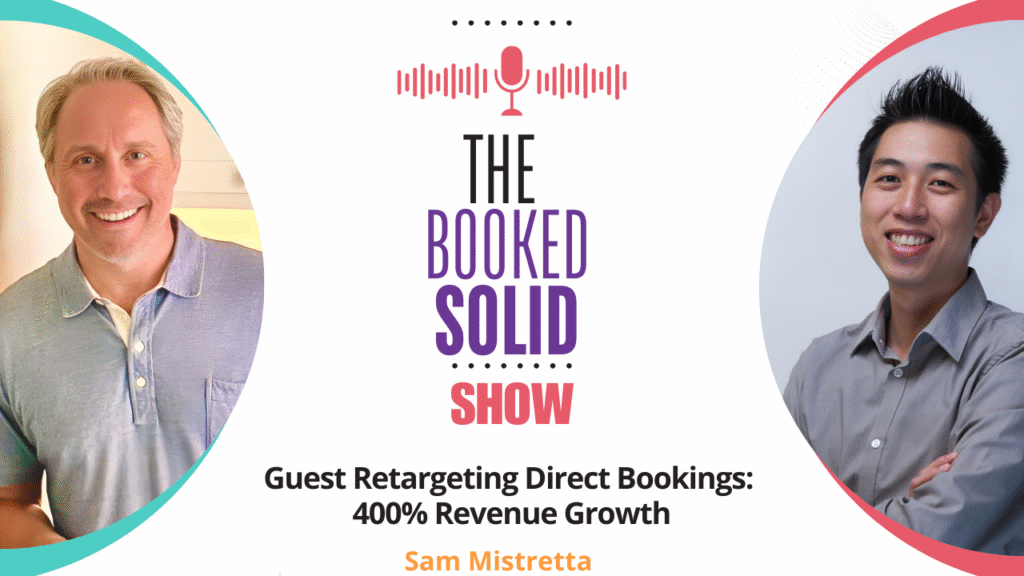
In this episode of Booked Solid, Sam Mistretta returns to share what he’s learned after 18 months in the trenches helping hosts drive repeat bookings through text and email marketing. Sam built a system that grew his own direct booking revenue by 400%, and his company, Go STR Marketing, now helps hosts achieve an average 650% ROI on their guest retargeting campaigns.
We break down why authentic, personal communication outperforms corporate branding, why coupon codes aren’t the magic bullet you think they are, and the one rental agreement strategy that’s still flying under Airbnb’s radar. Whether you’re a new host or managing dozens of properties, this conversation will shift how you think about guest relationships and building a direct booking business that compounds over time.
Summary and Highlights
🎙️ Meet Sam Mistretta
Sam Mistretta is the founder of Go STR Marketing, a company that helps short-term rental hosts bring past guests back through strategic text and email campaigns.
His journey began in 2022 when he left his corporate IT career to focus full-time on the short-term rental business he and his wife had built. With 18 properties and roughly 1,000 past guest contacts sitting in his PMS, Sam knew the easiest revenue was waiting in his existing database. When he couldn’t find an affordable solution to market to those guests, he built one himself.
The result? A 400% increase in direct booking revenue within the first year.
Word spread through his mastermind group, STR Secrets, and Go STR Marketing was born. Today, his team helps hosts achieve an average ROI of 650% while consistently beating hospitality industry benchmarks by over 700%.
🌊 The Airbnb Shift Every Host Needs to Understand
The short-term rental landscape has changed dramatically. Lead times are shrinking. Competition is fiercer. And Airbnb has made sweeping policy changes that directly impact your bottom line.
Sam and Gil walked through the major shifts:
The new fee structure moves hosts from paying roughly 3% to now covering 15-15.5% in commissions. For a $200 nightly booking, that translates to a 12.9% reduction in earnings overnight if you don’t adjust your pricing.
Airbnb’s communication changes now mask phone numbers, limiting your ability to contact guests to just two days after checkout. Chargeback policies now push disputed payments back onto hosts. And the platform continues tightening control over how you interact with guests.
Sam put it bluntly: if you’re sleeping on these changes and not adjusting your strategy, you’re going to make less money this year than last—even if your booking volume stays the same.
🏠 Why Authenticity Wins in Guest Marketing
One of the most valuable insights from Sam’s data involves branding. Some hosts want to project a large, corporate image. Others sign off with their first name and a headshot. The data shows which approach actually converts.
Personal, authentic campaigns consistently outperform corporate-style messaging.
Signing off with your name, including a photo, and sharing why you became a host creates connection. Guests who had a great stay want to feel like they have someone on the inside—not a faceless booking entity.
Gil confirmed seeing the same pattern on the website side. Properties with genuine host bios and photos show longer dwell times and lower bounce rates. Even larger property managers with 50+ doors see better results when they introduce their team and tell their story. It’s not about size. It’s about making guests feel like they’re booking with real people who care.
💡 The Coupon Code Reality Check
Many hosts obsess over crafting the perfect discount offer. Sam’s data reveals something surprising: the majority of re-bookers don’t use coupon codes at all.
When guests had a great experience, they don’t need a discount to come back. They book because they trust you. They feel like they’ve got a connection. The coupon becomes secondary to the relationship.
This doesn’t mean coupons are useless—they still work well for acquisition through influencers or local partnerships. But for repeat guest marketing, the emphasis should be on maintaining that authentic connection rather than leading with discounts.
📈 Direct Bookings Compound Over Time
Both Sam and Gil emphasized a fundamental truth: direct booking success doesn’t happen overnight. It builds momentum over time.
Sam compared it to investing in the S&P 500. It’s not sexy at first. You won’t see instant results. But three or four years later, you’ll look back and realize you built something substantial.
This stands in contrast to the Airbnb dopamine cycle—chasing the next booking notification, constantly adjusting rates to fill gaps. Direct booking strategy requires patience, consistency, and a long-term view. You’re building an email list. You’re refining your messaging. You’re learning what resonates with your audience.
The hosts who invest in this approach now will be far better positioned than those scrambling to react when the next policy change hits. For those just getting started, building your email collection strategy should be a priority from day one.
🔧 Tactical Advice: The Rental Agreement Strategy
Sam shared a specific tactic that remains compliant with Airbnb’s current policies: automated rental agreements.
After a guest books through Airbnb, you can send an automated rental agreement through your PMS that collects their phone number and email. Sam was initially skeptical—another thing for guests to click seemed like friction. But out of roughly 2,000 bookings, only two guests pushed back.
The key is disclosure. Make sure your listing mentions that a rental agreement will be required. And if you plan to reach out to guests off-platform, Sam recommends waiting at least 15 days after their departure. Why? The post-stay review survey expires at the 14-day mark, reducing the risk of any policy enforcement.
📱 Why Your Website Matters for Co-Hosting Growth
The conversation took an interesting turn when Sam shared a story about a client named Mike Munson. Mike had three verbal commitments from property owners ready to switch management companies. But when it came time to sign, they ghosted him.
The problem? His website barely existed. These potential clients searched him online and couldn’t verify his legitimacy. Mike ended up having to FedEx his corporation documents to prove he was a real business.
Your direct booking website isn’t just for guests. It’s your business card for potential property owners. If you’re building a co-hosting operation, your site needs pages that showcase your management services, your portfolio, your team, and how you take care of both guests and homeowners. PMS-provided websites often can’t accommodate these needs—another reason purpose-built platforms matter.
📚 Rapid Fire Highlights with Sam Mistretta
Book recommendation: 1 Million Followers by Brendan Kane. Sam isn’t chasing a massive following, but the book helped him understand the science behind social media engagement and how platforms work.
Mindset advice for someone starting something new: “One in a row counts. Just take action.” Don’t get paralyzed by what-ifs. Wealthy people make decisions quickly, trust their intuition, and adjust course when needed.
One tactical tip for direct bookings: Use automated rental agreements in your PMS to collect guest contact information. It’s currently approved by Airbnb and remains one of the most effective ways to build your marketing list.
🔗 Connect with Sam Mistretta
- Website: www.GoSTRmarketing.com
- Instagram: @samuelmistrpm
Special offer for Booked Solid listeners: Sign up for an annual subscription and get a free 13th month with promo code CRAFTEDSTAYS at checkout.
🎧 Listen to the Full Episode
Sam’s insights go deeper than we could cover here. If you want to understand how text and email marketing actually drives repeat bookings—and why the data shows authentic communication beats corporate messaging—listen to the full conversation.
Ready to build a direct booking website that actually converts? Start your free trial at CraftedStays.co and take control of your guest relationships.
Transcription
Sam: What we’ve seen is that the campaigns that actually tend to do better are the more authentic, the more mom and pop, the more, you know, like signing off as the host first name or something like that. Um, even giving ’em a last name, right? So it’s like being that personal, giving a headshot, right?
Sam: Signing off, being more authentic, not coming off as. Large entity or something like that. People want authentic experiences. And so if they had a good time at a place and they felt like they were taken care of, uh, you know, this whole thing started as just one person offering their home to another. And so, no matter how big your team is, I think that, you know, authentic experience and approaching connection has really, I’ve seen the data show that they perform better in their rebooking efforts.
Sam: To come visit with him again.
Gil: Before we bring on my guest, I wanted to talk just a little bit about something that I’ve been hearing a lot from Host. I keep on hearing the same thing. I know my website isn’t converting, but I can’t afford $8,000 on an agency to rebuild it. Here’s the thing, you’re letting all these marketing strategies, you’re driving traffic and you’re putting it all to work.
Gil: But if your site isn’t really built to convert. You’re basically lighting your energy and money on fire, and even if you could afford an agency build, every time you want to test something or make a change, you’re having to pay them again. You can’t iterate, you can’t test, and you really can improve on things.
Gil: You don’t need a custom $10,000 website to get the conversion rates that really matter. You just need the right platform. That’s why I build CraftedStays. It’s purpose built for short-term rentals and designed from the ground up to help you drive more direct bookings. You can finally turn that traffic into bookings and you can keep on testing and improving.
Gil: As you learn, you can make changes all on the platform. You don’t need to learn something new. So if you need some help or you wanna get started, go ahead and go to CraftedStays.co and start your free trial. Now let’s bring on our guests and dive deep into hospitality and marketing.
Gil: Hey folks. Welcome back to the Booked Solid Show, the podcast where we bring in top operators to discuss hospitality, operations, and digital marketing. Uh, today’s show is gonna be special because we have Sam Mistretta. He was on episode number four with us very, very early on. He’s the founder of Go STR Marketing.
Gil: I invited him onto the show to have us walk through what he’s cha, what he’s seen change over the last. 18 months since he’s been on the show, how he sees the industry changing, how he’s changing his tactics internally, what he’s learned along the way. So I’m really thrilled to bring him back and really share his knowledge.
Gil: Uh, his firm go, STR marketing, really specialize on how to bring repeat bookers back into booking again with you. So he does SMS campaigns and email campaigns as well too. So he has a wealth of knowledge specifically around retargeting past guests. So without further ado, let’s bring him in.
Gil : Sam, welcome back to the show.
Sam : Thanks for having me, Gil. It has been a whirlwind of a time since we last spoke. It seems like it was yesterday, though.
Gil : Yeah. Yeah. It seems like it was yesterday, but it also seems like it was a long, long time ago. I forgot what episode number you were, but you were. In the low double digits, if not single digits. Um, and it’s, so it’s been, it’s been quite a while and a lot has evolved since, um, both on both sides. Um, um, maybe to kind of like help folks that haven’t listened to the first episode, definitely.
Gil : If you haven’t listened to that first episode, definitely listen to that one. Um, but do you mind, Sam, giving folks an introduction on who Sam is and kinda what you do?
Sam : Yeah. Yeah. Awesome. So I’ll keep it as short as possible. It’s a long story, but, um, have a history in, um. Uh, corporate it in 2000, uh, 22. I left my W2 and decided to focus solely on our short-term rental business that my wife and I built. Um, we’d been building that for about. Year and a half, two years, I guess, at that point.
Sam : And so, um, after that I focused 100% on my STR business and said, man, we needed to grow this business, but we didn’t want to go out and acquire more properties. And so what could we do with what we had? And so after two years, we had about a thousand, um, contacts in our, uh, PMS that we, that we’d served as, as guests.
Sam : And so, um. We had about, I think, 18 properties at that time. So I said, you know what? Not a big deal. I’m just gonna go out and find a software, um, to add to my tech stack that can market to all of my guests and lead them back to my direct booking site. And because I knew that I wanted to, that I wanted to. That, that was the easiest money to make, right? In any business, it’s always doing business with the people that already do business with you. It costs less, you know, time to acquire them and it costs less money to acquire them as well. So, um, figured not a big deal. I go out and find something to throw on top of the tech stack.
Sam : Well, I couldn’t find it. The only things that I’ve found were things that could either, um. Teach you how to do this, and I didn’t have the time. Okay? Or it cost tens of thousands of dollars and so neither of those fit. And so anyways, I built a solution and after a year of implementing that solution, um.
Sam : To direct guests back to my direct booking site via text and email. Um, we saw a 400% increase in our direct booking revenue. And so folks in my mastermind that I was a part of, STR Secrets started asking how I was doing that. I told them they. Wanted to be beta group testers. And so I did that. They had a similar impact and so that is how go STR marketing was born.
Sam : And, um, yeah, since then we’ve been able to add a few more, uh, really one more key product that helps STR businesses increase revenue. Um, but that’s where I am now with GO STR marketing and, um, we’re loving it.
Gil : Yeah. I, I, I just looked it up. We’re episode number four, so that was very early on. I, I, that I, I, I, I remember it was very early. I didn’t realize it was like almost in the infancy of us running this podcast. So it’s, it’s been a long while. Um. And a lot has also changed in the industry since we last had a recording together.
Gil : We, we’ve had many chances to talk since then, but what have you seen change in the overall industry over the last year and a half?
Sam : a lot changed over the last year and a half and, um. escalated in the last, like six months if you really think about it, at least from the Airbnb perspective. Right. Uh, but kind of zooming out, um, over the last four years, um, we have seen, um, it, it, it’s interesting, um, at least from a go STR marketing perspective, from clients’ interest in like direct booking, um, you know, interest.
Sam : It’s really interesting how, um. Folks are busy during their busy season, and so everybody is just trying to keep up with the demand. Uh, you have a few folks that are kind of visionaries and, and kind of see the fact that, um, they wanna market to their guests, um, after the busy season. Uh, but really on the, uh, kind of slow seasons, uh, that’s whenever folks are really kind of interested in. know, driving direct bookings. Uh, we’ve seen a, uh, a real increase in the interest in direct bookings, especially over the past, really a few months with the Airbnb policy changes and fee structures and stuff like that. But, um, you know, overall, um, the market, I think any market is, uh, it, it ain’t quite what it used to be a couple of years ago.
Sam : Right. And so, um. We’re having to reinvent ourselves as hosts and just stay sharp because you can’t just, you know, throw something out there and, and put a pillow in it and, and count on it being booked. You know, 90% of the time
Gil : Yeah, a lot has changed. Um, I think when I first started hosting, it was during the. Early pan pandemic days. And that was, those were the easy days. I would say. It was easy to kind of fill your calendars, super easy, uh, at least compared to now. And I think that’s people are traveling differently. Like they’re not cooped up in a house and where they really want to thrive and go, go out and, and, and go on vacations as, as much or be in like silo location, uh, vacations.
Gil : Um, but there’s also a lot more international travel now. There’s a, there’s also a lot more competition now. So from a market perspective, I, I definitely think it’s not as easy as it was to kind of bring in the revenues as it was back in 20 20, 20, 21, 22. Um, but you’re right at, at, in the last six months, Airbnb has made a ton of changes where folks are now starting to think, oh, shoot, I have a lot of eggs in this one basket.
Gil : I need to really diversify. I need to really figure out like, how do I shield myself because. There’s a lot of danger, and I’ve been hearing these changes really ly impact the hosting experience as well too. So I don’t have this all written down, but if I recall some of the changes, they changed the, um, chargeback policy.
Gil : So Airbnb now, if there’s ever a chargeback, they’re pushing that charge back on you. So if they’re not able to collect, they’re gonna take that, they’re gonna take that deposit out of, out of your payout. They changed their, um, more recently they changed the way that they did phone numbers. So they’re now masking phone numbers and they’re using an anonymous phone number and it has to go through them.
Gil : What that also means is that that phone number is only active for the duration of the stay. I think a couple days prior to the stay and only two days after the stay. So if you don’t have, if you find something that’s broken, you’re no longer able to contact that guest directly anymore. Um. I think that they’re rolling that out only for a small set of users to kind of beta test that out.
Gil : Um, and then the change that’s coming up and I think, I think by the time the show airs it’s probably gonna be out is the whole fee structure change, where they’re changing it from a three, three something percent change to 15, 15 and a half percent change for the commissions that we pay them. So that’s a huge change.
Gil : And I forget there’s like one or two other changes that happened earlier this year. Um, that really just impacted our hosting experience and also like the guest experience as well too.
Sam : Yeah, exactly. You know, not to mentioning, uh, not, excuse me, uh, not to mention, um, one of the things that we’ve seen too, uh, is lead time shrinking. I just, whenever you were talking about that as well.
Gil : Yeah.
Sam : And so I think the economy has really impacted that. And so folks are now going to be, um, seeming to be very, very cost conscious, right?
Sam : And so for a small business owner like yourself, like myself, you know, whether it be a host, definitely co-hosting companies to just, um. Add another 15% of cost to their, um, business, uh, at the drop of a hat. That’s a big deal. And so, um, yeah, I’ve talked to a lot of folks about what they’re gonna do with what the pricing increases, where they’re gonna, you know, increase their, their rates, you know, maybe not.
Sam : Anyways, it’s, it’s a very interesting, um, conversation now. And so, um, if you zoom out and think about. Everything that has to, you know, all the repercussions of all these policy changes and this and that, it’s really this one OTA. Right? And it’s, you know, the 800 pound gorilla, OTA. Um, but I tell a lot of folks, uh, that, that are interested in, you know, developing their direct booking strategy is, this is almost like an insurance policy, right?
Sam : Can’t really bank on what other people are gonna make the rule. This is like, you know, if, if anyone’s ever worked in a, in a corporate environment, right? Like this is basically, you know, you’re working for another global enterprise, right? This is being pushed down to you. Well, um, it doesn’t have to be that way.
Sam : And so, um, you need to diversify, you need to do that, you know, in, in a way that’s smart and makes sense for your business.
Gil : Yeah, I, I just remembered the, the other policy changes, they changed their communication policy as well too, earlier this year where they were saying like, oh, you can’t. Collect payments outside, you can’t communicate to them outside of ours. And there’s a lot of ambiguity on like what you can and cannot do there.
Gil : Um, and then they also rolled out experiences as well too. And where they’re now saying, you gotta open up your home for experiences that we wanna offer to, I guess. And you have no say in, in who you’re letting through the door. Um, I think this is like, I always think back at. E-commerce. And then that’s because I, I have a big, big background in, in e-commerce and retail, and this is very, very similar to what we felt in by Amazon.
Gil : Amazon basically has a stranglehold on a lot of, a lot of manufacturers, a lot of product makers out there. And they have pushed down a lot of changes over the years where everybody’s really scared of them. Um, and so. That there was this big rise in, I think they call it like rebels against, I forget what the name of it is called, but like Shopify and a few other big companies like started to have big campaigns where they’re saying like, no, you don’t have to be in the stranglehold of Amazon.
Gil : You can go independent. And so we saw in e-commerce, this big rise of D two C brands that really create their own brand, create their own experience. Started marketing on social media really delivered a good product. And those are brands that are really thriving today. They’re, they have, they’re not really beholden by, by Amazon.
Gil : They’re able to thrive there, and they’re still selling on those platforms. They’re not completely removed from it. Um, but they have a, a whole strategy outside of just being on the platform.
Sam : Yeah, exactly. And, and if you take a micro, you know, uh, uh, view of this, if you look at all of the big juggernaut digital marketplaces, right? Amazon, Uber, Airbnb, you think about it. They’re just kind of, they’re the broker, right? They don’t own anything. And so they depend on, um, you know, the distributors, right?
Sam : The, the products. And so this happened in, if you think about it, this happened in Uber First. Okay? So they, they, and just like Airbnb, uh, but it actually took effect in Uber first before Airbnb. But, okay, what do we want? We need drivers. Okay for Uber. So we’re going to be very friendly to these drivers and we’re going to build up our inventory.
Sam : So our customers now have all that we can meet the demand. And so they met the demand, it caught on. Now comes Lyft. Okay. Wow. Well, what do we need to do now? Now we need to become super friendly to the consumer. Okay, well, great. Well, how do we come? Become super friendly to the consumer Well. We don’t want to lose any money on out of our pocket.
Sam : So what do we do? We pinch the supplier, which is the drivers, which are the homeowners, right? Which are the hosts. So every large, I mean, it’s, if you think about it like that, unfortunately it’s a story as old as Amazon
Gil : Yep.
Sam : but if you think about it, right? I mean, um, but. You know, we, we’ve gotta do something about that.
Sam : And to your point, there are other folks out there, other companies that have done this successfully. And so if anybody can do it, if any group of people can do this, it’s STR operators, host and co-host. ’cause we’re pretty, we’re pretty savvy folks and we’re, we’re pretty gritty.
Gil : Yeah, I mean the unfortunate fact for Uber drivers is that. You really don’t have many options. Like, it’s like taxis are independent, taxis are not coming back. Um, that, that’s just, there’s just, there’s just, it’s just too much of a commodity at that point. Um, getting from one place to another is, is, is a huge commodity.
Gil : So for Uber and Lyft there, like, you can decide to drive with one versus the other there, but outside of that, there’s no way for you to be independent. Like, actually I take that back there. I, I had heard stories of people that. Really deliver good experiences. And whenever someone needs a ride, they’re calling them, but it’s more of like a personal limousine service type of thing.
Gil : But that’s super, super rare. Um, whereas in our, our industry, you have these really gorgeous properties. You’re driven delivering great service. It’s hospitality at the end of the day. And those brands that really. Deliver beyond just the star ratings. They deliver a really exceptional experience that makes you want to come back and makes you wanna feel like, oh, if I’m gonna spend time and energy and money on a vacation, I had a good time here.
Gil : They took care of me. The place was clean. It had all the amenities that we wanted. Our kids love the place like as, as a parent of two Youngs, like if there’s a low stress way for me to. Take the kids and spend some time somewhere and know that it’s smooth, like that’s like one, one thing that I don’t have to worry about.
Gil : There’s a lot of things that you have to worry about as, as a parent when you’re traveling. So like if you have a great stay, you tend to want to go back.
Sam : Exactly.
Gil : Yeah, so, so Sam, so there’s all these changes that have been happening kind of externally. Um, either we talked about the market changes and how people travel.
Gil : The travel has changed, the lead times has decreased. There’s all these changes in regulations policy, and what Airbnb is doing. VRBO has actually started to pick up a little bit of that too. So it’s starting to be a little infectious on the other OTAs, but kind of like how has. The strategy within Go STR marketing changed has, are you guys still rooted on really strong foundations where like, oh, we actually, it’s not much has changed because we’ve built this on strong foundations, or has there been small tweaks and changes along the way that you found that works more effectively now than than ever before?
Sam : Yeah, so, um, great question. And so I think with, with every. Uh, with every day we’re learning more and more because we do so much, the data’s so rich with, with what we have, right? So we have the ability to, um, capture data within the, the campaign itself. So, um, the open rates, the interaction. Um, with the text and the email, uh, we have timestamps of email opens, timestamps of direct booking, website clicks, and then we also have, um, access into the PMS.
Sam : And so we can see timestamp of the bookings. And so it’s really cool. We can see, um, we can see the, the, the kinda the, the guest journey. Right? And so Gail, as, as you and I were talking before the show, we’re going to be able to see the, um. The journey, uh, with, uh, you know, through the, through the website as well.
Sam : So, um, we are, we’re gaining a lot more insight with that. And so, um, some of the changes that we’ve seen, uh, with some of the more successful campaigns, as I realize marketing is misspelled right here on the. The thing, I must have missed a T. But, um, anyway, one of the things that, uh, a few things that we’ve seen change in, in, and have been more successful for some of our, uh, clients is that, um.
Sam : There are some folks that want to, I guess, give, give the image and, and the presentation of a large company, right? We are the name brand, and so they come at this with the company name. Um, we have the ability to, um, you know, put, uh, you know, personal photos, head shots, you know, like, um, different things like that.
Sam : Um, some folks have just decided to go to, to look more of a, a larger brand. Um, what we’ve seen. Is that those, uh, do well, but the campaigns that actually tend to do better are the more authentic, the more mom and pop, the more you’re like signing off as the host first name or something like that. Um, hell even giving ’em a last name, right?
Sam : So it’s like being that personal, giving a headshot, right? Uh, signing off, being more authentic, not coming off as this. Large entity or something like that. Um, people want authentic experiences and so if they had a good time at a place and they felt like they were taken care of, uh, you know, if this whole thing, you know, uh, it started is just one person offering their home to another.
Sam : And so no matter how big your team is, I think that, you know, authentic experience and approach and connection, um, has really, I’ve seen. The data show that they perform better in their rebooking efforts to to come visit with ’em again.
Gil : Yeah, I, I want to double, double, double down on that one. Even on our side, on the direct booking side, when we start, first started launching our websites, we didn’t have this section of like, about me or who we are as hosts, and we start. Started running tests kind of early on. Um, in our, in our journey and for some of our templates, we started adding this about meat section there where we ask a property manager or a host to input their host bio and then a picture of themselves.
Gil : And we’ve also tested. And reviewed hosts that weren’t maybe comfortable putting their pictures. So they’ll put a property image rather than themselves. And we’re comparing the differences there and, um, what we call like dwell time, like how long is someone staying on the page or recording the dwell time and the drop off rate.
Gil : How, how, how often are people leaving within a short duration there? And we found that. Folks that have an image on there and a bio that is not generic, but it actually speaks to like why they became a host, who they are, what they like, how they think about hospitality. Those host that include that in the bottom of their homepage.
Gil : Actually has a longer dwell time and a lower bounce rate. So people are actually clicking through to search for properties. People are actually clicking through to the property pages themselves and seeking more information. And we always thought that this was like a, kinda like sim, similar to what you said is, is it was only for small hosts, but we noticed that some of our larger property managers.
Gil : We have like certain templates are specific for a smaller portfolio versus a larger portfolio and kind of what, whatever’s in between. Um, and we started off not having this host section on the templates for some of our larger property managers. And we found that like they would start to create about me pages and then they would do something similar there.
Gil : And the property managers that had that about me section that had. The founders on there, but also had maybe who was doing customer facing support, who was doing operations within the company and showing faces there. That actually made it much more relatable. Even when you have 50, a hundred, 150 doors there, like those about me pages are very impactful because then you don’t feel like, oh, I’m just renting from a huge Acosta size property management company that doesn’t care about me.
Gil : I’ve stayed at Acosta before. I, the last experience I had was not a good one. I don’t know who I talked to and I had issues with it and it didn’t feel very personable at all.
Sam : Yeah. Toe detached, right?
Gil : it’s super detached. It’s super detached, and I and I, I look at some of our larger property managers that have couple hundred doors and I see they’re about me pages and I see how they present themselves and I see kind of like what the ratings are on the OTAs.
Gil : And those are the ones that really care about hospitality. And they’re not afraid to say like, oh. This is who I am, this is my team. This is who supporting you in your journey there. And that really comes across and it really builds that trust there. So like I’m totally not surprised that like you signing off those emails with a personal name, it, we’re seeing the exact same thing on the website side of things.
Sam : Oh yeah. Um, we have, uh, one of our emails is why I became a short-term rental host, right? And so that is consistently one of the, uh, um, highest o uh, emails with the open rate, you know, the highest open rate emails, so across wherever. Um. Interesting too. You say that about, um, making your, um, making your website more personable.
Sam : Personable, right. Uh, your, your, your people behind this. Right. Um, I know we’re talking about guest rebooking, but, um, kind of pivoting to, to, um, we help co-hosting companies increase, um, their co-hosting portfolio right. By targeting, um. owners and also realtors to, you know, take over management from a VE casa that’s like just, you know, poorly managed.
Sam : Um, or, and, and the bad thing about it is like people don’t know what great looks like ’cause they’re so used to bad and they have nothing to compare it to anyway. Um. We help these folks, uh, increase their portfolio tremendously by adding more co-hosted properties. And one of the things, uh, Mike, uh, Munson, in fact, he’s a client of ours and he had, um, some great conversations.
Sam : He had two or three folks give them a verbal yes, they wanted to switch over and have him do management for them. But the problem was whenever it came time for them to sign the contract, they’d ghost him. They didn’t know what it is. Didn’t know what it’s, he followed the, you know, everything felt great and everything.
Sam : And so anyways, we started talking about it. Well, his website wasn’t, it was, it was barely a website. It was poor. So these folks didn’t see. They didn’t believe him. Like honestly, because he reached out to him outta the blue. They thought it was a scam. How’d you find my number? Um, whatever. You sound great.
Sam : Um, but what’s the first thing someone does whenever you don’t know who someone else is? Well, you look ’em up on Google, right? Had a tough time. It wasn’t clear. It wasn’t easy to read. And so turns out, um, after he spoke to this third lead that he’s now, um. Signing with, uh, because he had to FedEx, he didn’t have to, but he chose to literally FedEx his corporation documents and everything over to this lady, um, to prove, um, that, that he was an actual business.
Sam : But, um, people look at your stuff, like people, that’s the first thing you do to gain credibility, um, about your business. So whether it’s, you know, getting more co-host deals or getting more, you know, lead, uh, guests buy in, um, that’s huge.
Gil : Yeah, you, you make a really good point. Um, I find that there’s really two reasons why people have been really flocking to build their websites. One is like, oh shoot, I have my eggs in this Airbnb basket. They’re, they have a stranglehold on me. I need to build my own engine there. Um, and kinda like kind of branching off that just a little bit is like, because of that, they’re taking a pretty sizable portion of their commissions there, so they’re looking to generate more revenue by going direct.
Gil : So those are two primary reasons, but outside of that, there’s also this kind of third one where. Um, folks have been going down co-hosting and they’re realizing, oh, shoot, the PMS website that I have really doesn’t talk about my management services. I can’t. And, and some PMSs you can’t create new pages, you can’t talk about them, so you really can’t show you that you’re a legitimate business.
Gil : It just basically has all your properties all on one page there. And that’s kind of like how it is for a lot of the PMSs. So when they come to us, they’re like. One, one of the questions I get asked very, very often, I probably should have, should have it as a q, is, can you create me a management page and what does a good management page look like?
Gil : And so we usually send them some of our, our samples or some of the other ones that people create on our website and like what the structure of it looks like. But you’re absolutely right, like your direct booking site isn’t just geared towards if you’re a property manager, isn’t just geared towards. Who wants to travel there, but it also is your business card where you can start to market yourself and what people are looking for.
Gil : What homeowners are looking for is one, like you said, are you a trustworthy, legitimate business? What your portfolio looks like. Does that align with my property? Is it at the caliber that I wanted to be in? Um, how you take care of the guest. What are the things that you talk about? You might talk about cleanliness, you might talk about customer service.
Gil : You might talk about your, just your hospitality there, and you as a homeowner, you wanna know that your home is being well rented out there. But also on kinda like the fourth thing is how do you service the homeowner themselves? Do you provide me reports at the end of the month? How does cleaning work?
Gil : How does maintenance work? Like those types of things. Are part of creating a really good website overall and probably even your management page there. So like any of our listeners here, if you are a manager, if you are a property manager and you are still on a PMS website, see if your pm MS website can add these elements in there.
Gil : Or if not, you can take a look at us and see if we can help you with that. But make sure that you have those components in there to make sure that when you’re talking to a homeowner and. You’re down to the fourth and fifth conversation there that they’re not gonna jump because they find that, oh, this is probably not a legitimate business.
Gil : Or do I trust this person to manage my home? Because that home for a lot of ’em is a big asset. It’s probably sometimes some of the biggest assets there. I know a lot of folks that have bigger and better vacation homes than they do their primary. Um, so they’re banking on it. Um, and they wanna make sure that like you take care of them.
Sam : Yeah, absolutely.
Gil : Um, so you mentioned that there’s, there’s things that I, I think, like one thing that I I I took from what you mentioned earlier was over the last year, you’re starting to really look at the data more and figure out what are the open rates, what are the people clicking on? What has, what messages appear more?
Gil : My, my thinking is that like. This is all data that’s informing how do you run better campaigns When you’re onboarding a new client, how do you change the messaging? Which are the ones that you need to spend more time with the client to figure out like, oh, I wanna make sure that I understand why you got into hosting, because that is one of our highest leverage emails there.
Gil : Like, if we don’t get that right then. We, we, we aren’t able to tell the story. That can really drive more conversion out there. Is that, is that right on your side? Like do you look at the data pretty intently to help inform how you onboard and kinda how you service your customers?
Sam : Yeah. Uh, yes. And one of the things that I, I find a lot of new clients, uh, coming on are, are really, uh, focus on a lot is the coupons, right? So we have about half a dozen coupons. It, um, throughout the whole year, and you choose the aggressiveness of the coupon. It’s like a multiple choice answer, right? So, um, and we give you some different options, you know, whether it’s, uh, you wanna be very aggressive.
Sam : Um, IE like, um, 10% coupon. If you book two or more nights, moderately aggressive, 10% off your next day. If you book seven or more nights, or you know. Not aggressive at all, 10% off if you book like 14 or more nights. I’m just making those up, right. Anyways there there’s a combination of those and so a lot of people spend a lot of time focusing on that, and what we’ve found is that the majority of re bookers do not use those coupons.
Sam : They don’t value the coupons as much as you’d think they were. Okay? So after the first year of me doing this, I thought my stuff didn’t work. Because I didn’t see barely any coupons being redeemed in, in my PMS. And, um, I saw a few bookings come in in my direct site, but I didn’t see all of them coming back on my direct booking site.
Sam : And so what that data has shown us is that if you make a good, authentic, you know, connection and your guests like your product. And you make it easy for them to do business, they’re just gonna do business with you again. Like they, they have the feeling like, you know, like they got a guy, like they got a guy on the inside.
Sam : Like, I, you know, I don’t, I don’t deal with Airbnb anymore. Right. I got a, I got a personal connection, right? And so, um. The coupons. And we know that because we can see the timestamp of the guest journeys, right? All the way from email open to booking. Uh, the next thing we’ve seen is that, um, and this is interesting, and so, um, the more data we get that the more we can kind of diagnose this.
Sam : Um, and I’ve got a few ideas as to why we’re seeing this is, um, not all re bookings are 100% direct. On your direct booking site. And so, um, you know, I I think one of the things that, that, uh, you’ve gotta just realize is that, look, Airbnb is all over TV and their ad spend is, and VRBO too in booking.com, right?
Sam : I mean, they have, this is a multi-billion dollar ad industry, right? So people are just gonna feel more comfortable, whether that be based on demographic, whether that be based on maybe in a Facebook group. Um, there could be a direct booking scam going on. And so, you know, one of the members of the Facebook group may have become victimized, and so now it’s, you know, they’re putting a flag in the ground and blasting it out.
Sam : Don’t book with anybody direct in this market. It’s all a scam, right? You never know about that. Um, regardless, you’re getting out there, you’re rebooking, you’re, you’re giving a good product. You have a good property, you have great hospitality. People are coming back wherever they book. But, um, what’s gonna be very interesting in the next probably six to eight, six to 12 months probably, is to see how this fee change is gonna, um, drive guests to either save you a few more bucks and go book direct or, you know, stay loyal to,
Gil : Yeah. Yeah. Yeah. It’s, it’s very interesting. I, I, I. I hadn’t ever made the ex distinction between coupon codes. It’s actually a very interesting one. I’ve heard really good successes of coupon codes, being able to identify attribution, meaning like if you promote yourself somewhere and you can then use a coupon codes to kind of like almost reverse engineer where that person came from there.
Gil : But kind of hearing you talk about things, those scenarios where I heard it work really well where. It’s in the scenario where someone doesn’t know about your business, they found you through likely an influencer or social media there, and they saw the coupon code. So a lot of times if you’re working with an influencer, you use some coupon code, then you give them X percent off that they can share with their audience.
Gil : That gives them a, a discount. And I’ve heard that that works extremely well to identify attribution, um, way better than using like UTM tags and so on. But. When you were speaking and talking about how that isn’t always effective because in your case you don’t actually see the coupon code, coupon codes being used. I think the difference is really around, you kind of subtly mentioned this, the audience there is different, in your case, you’re talking to a known audience, someone that you’ve, you’ve. Already serviced. At one point, you, you’ve already delivered them a really good experience. You’ve already had them stay with you.
Gil : So you have that connection with them. It’s not about finding the cheapest rate. It’s really like, how do I make sure that I have a really good vacation again, because I had a good one last time when I stayed at this place. So like the, the motive is very different. Whereas in social media, you might be influenced by someone and you’re like, oh, they’re, they have a, they have a direct link.
Gil : I’m gonna use their link to get in there. They haven’t received nurture campaigns from you. They haven’t gotten a trickle of emails over the last year. Um, so they’re only finding you from the ether from someone else. Um, so they’re following that link there. Um, so I can, I can see why coupon codes are effective when you’re using, um, other people to send you leads where it’s not effective when you’ve already built a loyal following to folks.
Sam : Right. Exactly. And, you know, some do get used, but, but typically, um, and you know, I, I, I haven’t worked with a, with an influencer. Um, I don’t know if you have Gil or, or I, I guess you, you’ve talked to folks that have, and that seems to be,
Gil : I, I, we, we have, um, we also work with, um, some local folks too. So in one of our cabins, in, um, in Gatlinburg, um, in, in, in the Smokies, we are next to one of the largest stadiums. We’re, we’re like a three minute drive, a like 10 minute walk to this huge, huge competition sports stadium for like a lot of high school sports.
Gil : Um, so you have a lot of people that fly in there. Um, and we found out that there was a local service that will basically match people that need to travel for competitions with. It stays. And so we’re now registered on there. And so we get a lot of leads from this. Um, and that’s how, that’s how I know that these folks came from there because we have like a very unique coupon code that gives ’em a, a discount off.
Gil : And that gets used all the time. Um, that gets used a ton. Um, but again, they’re being sent to us from someone else. We don’t have that relationship with them. We’re not nurturing them. Um, so I can see why it’s used. There, but not as, not, not when you’re, you’re rebooking someone.
Sam : Yeah. Yeah. Yeah, exactly. And, and, um, but man, whatever you do and, you know, um, whatever to, you know, whether you get someone else to, to market for you or you do it yourself, um, the data is there, it works, right? Um, put yourself out there. Um, even in one booking, you can recoup the cost. Uh. Of, of your time.
Sam : Sometimes, uh, it depends on how much time you put into it, right?
Gil : Yeah. Yeah. And I, I, I would say like, I would urge folks to like, get started, start collecting emails, start nurturing folks there, um, and just like start to invest into it because it, it takes a little bit while for you to kind of build that momentum there. Like, I, I, I would imagine Sam, on, on your side, like when you onboard a, a client there.
Gil : You start to see their direct bookings kind of ramp up over time when they get more and more, like their mailing list gets a lot larger there. It’s a lot easier to do marketing when you have. A bunch of emails from folks that you’ve stayed with already, but when you’re starting off in the very beginning, you might not see kind of that impact in that first year there.
Gil : It’s really when that, that second year you start to see that momentum really build up, unless you, there’s also other, like, other tactics there. Like I was on a call on our last podcast where the property manager. Went from 1% direct bookings last year, and they’re at 30% direct booking this year. They spent a ton of energy on social media, on influencers.
Gil : They have really gorgeous properties and they’ve been able to ramp that up. And they’re not leveraging the email side of things. So like I can imagine like if they combine the two of them together, they can get to that 50, 60% direct booking rate. Really, really quickly. It, it makes such a big impact. And they have a, they have a, a pretty sizable, like if they have a, a dozen or two properties, there, not a, not a huge set, um, but something that’s very attainable for a lot of folks.
Sam : Oh, and that’s the easy, like that’s the cheapest thing. I talk to folks all the time, like, direct marketing is the least expensive return on your ad dollar spent,
Gil : It is.
Sam : you know? And, um, emails are good, right? Um, what we, what we, another thing we found is that. Email only marketing campaigns take longer time to, to really recoup that investment.
Sam : Um, email and text, that’s a lot quicker. Okay? Because we live in a, we live in a text world, right? You need to shoot a text to get people’s attention to look at the email with value in it. Um, that’s why we’re able to smash, you know, industry benchmarks, uh, is because. Of that. And similar to what you were talking about, um, it takes a little bit of time.
Sam : Yes. Um, text and email does happen quicker. It does take time to evolve. It’s a numbers game, right? The more it’s just sales, right? The more numbers you have, it’s a numbers game. Um, I tell folks we see it’s very similar to, um, launching a new property. Okay? The first year’s gonna be good. It always gets better the years after that.
Sam : It’s a big snowball, right? Because you’re just gaining momentum. You’re gaining momentum. And so, um,
Gil : And you’re learning along the way, like you’re, you’re figuring out what your messaging looks like. Um, your, your email list are bigger. Those are things that I think that’s the one thing that I, like I say over and over again. Direct bookings is one of those things that compounds over time. It’s not like Airbnb where you’re chasing the next transaction there.
Gil : You’re not having to, like on Airbnb, you’re, you get a, a dopamine hit every time you get that next booking there. Um. You’re always chasing it. You’re always looking like, oh, I can reduce my rate to fill in this next, this next booking or this weekend, or whatever it may be. But in direct bookings, it’s a very different strategy.
Gil : It’s about how do you do things consistently in the long run that builds over time. You start to build your email list, you start getting better at marketing, you start getting better at messaging your, your customers. You start to just, you just kind of build things over time and all those things just start to feed into each other.
Gil : It’s a very different way of, of, of filling your calendars.
Sam : Oh, especially now, right? So let’s just kind of compare direct bookings, driving direct bookings to like a stock, right? Or putting your money on the s and p 500, whatever. Like it’s the slow, it’s the slow way to grow. It’s not gonna be, you know, uh, sexy all at first. But then you look back and three or four years you’re like, wow, like I invested in that.
Sam : Whereas, you know, the Airbnb bookings. Probably at the time of this, uh, podcast, you’re now, but if you don’t, if you, if you sleep on this, your business will become instantly at least five to 15% less profitable if you don’t raise your prices on Airbnb.
Gil : Mm-hmm.
Sam : the th sad thing about it is a lot of folks aren’t gonna realize that, and they’re gonna be getting, you know, starstruck by those dopamine hits.
Sam : And you’re getting booked and you’re getting booked and it’s great. And you look, you know, 6, 8, 12 months down the line and you’re like, wow, how’d I make less money this year than I did last year looking on my bookings? Yeah. Well, they’re worth less, man.
Gil : Yeah. Yeah. It’s gonna make, I’m interested. I, I haven’t, um. I haven’t dived in and, and made the changes to kind of reflect the, the new policy changes there. It’s gonna make really our analysis a lot different because we’re not comparing ADRs from last year to this year quite the same. If we have to raise our rates, um, to keep the same kind of end end result, what the guest guest pays and what we, what we get back.
Gil : It’s, you can’t compare ADRs year after year as easily now.
Sam : No, no. ’cause the data in Price Lab is gonna slowly float up to be different as well, right after a few months. So, you know, a lot of folks, like we’ve been studying this pretty, uh, deeply. You know, this is the beginning of October, right? Um, and talking with our bookkeepers, having team meetings, and a lot of folks are saying, oh, well, not a big deal.
Sam : I just throw 15% on it and let it be Well, it’s not that, especially if you’re co-hosting. So, um, please, please, like, look into this due diligence because I think that’s gonna be, um, a big distract, a big distraction when if you do. Nothing. And you start getting all these bookings, well, that’s great for right now, but you’re gonna be, is, is that what you got in the business for?
Sam : To work harder and get paid less? Right. Whatever your business is at, it’s not a one size fits all change. ’cause there’s a lot of other factors that have to do with that. Right. Okay. So for cohosts, are you taking your, uh, management fee on the gross cleaning plus uh, accommodation? And then, you know, Airbnb’s, you know, you’re getting the, the owners are getting, you know, their rev, uh, their pay after that or whether you’re taking your commission after.
Sam : The Airbnb pay. And so, um, we are probably, we are on gross right now and I think we’re gonna be switching to net and be increasing the price. And so what you also have to think about is, okay, how’s that gonna change for our VRBO bookings as well and how’s that gonna change in my co-host agreement? And so it’s a ripple effect, uh, if you’re a cohost.
Sam : And so. It’s different for everybody and different strategies, different markets, things like that. But I’m telling you, if you just sleep on it, you’re gonna lose in the end of the day.
Gil : Yeah, you can’t, you can’t, you can’t, you can’t keep it the same. Like you’re just gonna lose that, that, that, that delta difference between the fi the five, 15 and a half and the 3% previously like that. That’s, that’s insane. That’s a huge dip there. Um, but I can’t imagine like the rewriting all your agreements to be in line with how, how that is.
Gil : And then getting your ag, getting your homeowners to agree on that. Or maybe, maybe you have it as take it. This is, this is, this is the change.
Sam : Right. Yeah, exactly. So, um, you know, it’s a communication thing with the owners, you know, hopefully before this happens. Um, so, you know, just look into it. I would urge listeners,
Gil : Yeah. Awesome. Sam, we usually end the show with three questions. You may have answered these three already. It may have changed since then. Um. But what’s a new, new book recommendation for me? I, I’m always looking for a good book. What’s been a good read for you?
Sam : Um, I would say, let me look right here really quick. I’m gonna give that to you. Maybe you can edit this out. Um, let’s second. Um, for me, it’s been 1 million followers.
Gil : Which, who’s, who writes that one?
Sam : That’s, uh, by Brendan Kane. It’s really a little bit more about understanding, um, social media. And so, um, I don’t want to have 1 million followers. I don’t want to be a talking head, right. I don’t, but it helps me understand the, a little bit of the science behind. Instagram, Facebook. Right? I don’t, I don’t have, I am not that special person.
Sam : That is a, you know, but anyway, it just helps, uh, me understand a little bit better. So if you’re interested in learning the best way the foundations to increase your following rate and do that stuff, I would, uh, yeah.
Gil : Nice. I’ve been, um, really into, um, person of, in interest in, because I was at that Wealth Con and um, that you and I were at previously and when the speakers was Coach Bird and he talked about how to. How to leverage yourself as a person of interest. So that’s been a topic that’s very interesting to me to see, like, how can you use your knowledge and your influence to help shape the industry there?
Gil : And hopefully you give good value that people may wanna work with you. Um, but that concept is super interesting to me. So like that, that’s actually a very relatable book. Um, so I’ll have take a look at that one. Did you, um, did you listen to it on Audible? Did you get the Kindle version, the hard copy version?
Gil : Which ones, which ones should be the best, uh, medium for this one?
Sam : For the 1 million followers.
Gil : Yeah.
Sam : Um, I just did a audible, you know, so it’s, it’s, you know, audible, maybe 1.2. It’ll get you there,
Gil : Yeah, I’m, uh, I’m definitely a speed things up. I try to, at times two x, it’s, it’s fast. It’s fast. Um, it depends on the book. It also depends on the narrator, because sometimes the narrator, they speak faster than others. Like if I were to narrate a book, I tend to speak a bit faster. Um, I’ve had people tell, ask me to slow down, um, but I cannot listen to myself do x that that’d be just way too fast. Um, awesome. Second question, what’s one piece of mindset advice that you would give to someone that’s starting something completely new?
Sam : One in a row counts. Just take action.
Gil : Hmm.
Sam : Don’t get wrapped around the axle. What if, what if, what if? Finds out? Find out. What if, um, wealthy people make D decisions quickly and if they made the wrong decision, they change it ’cause they trust their intuition and they move forward.
Gil : Yeah. I’ve been, I’m, I’ve been hearing them more and more, um, especially around. The folks that have built the most momentum over the last few years. That’s the, that’s the one advice is just like, just dive right in. Yeah. Yeah. It’s, it’s, it’s a really good advice because even times now, like where the company has grown so much and I felt like I took action, I took a lot of action building this company, leaving my W2, hiring the best engineers I’ve had a chance to work with, like.
Gil : There was a lot of that, and I think sometimes you almost need that reminder because you get in the groove of things. Now the company is stable, the team is healthy, we got things moving. Everything feels really good, and you kind of feel like you almost get, need to get reminded that even though you acted on that at one point.
Gil : So I think, I think that’s, that’s a worthwhile advice. Even if you, if you’re a season go-getter.
Sam : Yeah. Oh, a hundred percent. And phase two is, you know, what got you here and what’s gonna get you there, right. But regardless, it’s action at some point. So it is.
Gil : yeah. I like that. I like that. Awesome. Sam, last question. What’s one tactical advice that you would give to someone that’s either trying to get started in direct bookings or trying to amplify the direct book?
Sam : rental agreements, automated rental agreements in your PMS at this time, they are technically. Approved by Airbnb. So in order to collect guest phone numbers and emails, I would send, and we have unrest. We send an automated rental agreement out after they book through Airbnb. At first, whenever I heard of this strategy.
Sam : I was staunchly opposed. I don’t want to, it’s just another thing to click and people to get pissed off for and they already booked. And out of probably 2000 bookings, we’ve probably had two people push back on it. Um, you can check it out. We have it in some of our marketing collateral. Uh, the act, the actual Airbnb, um, link.
Sam : I ha I’ve had, um, my VAs that are actually previously, um. Um, leaders at Airbnb that we’ve, you know, hired from Airbnb, um, they’ve, um, approved that as well. So, um, it’s just an additional way if we have the, you know, if you can’t talk to folks outside of, um, outside of the platform, if you can’t, you know, give them your actual phone number or whatever, get that in your rental agreement.
Sam : Um, you can also put in there some other things like, um, you know, but the thing is you have to disclose that on the listing.
Gil : Hmm. Yep. Do you disclose that you re, you can reach out to them also on the listing because of that?
Sam : um, no, I just, um, well, another thing, another thing I do, no, uh, short answer is no. The next actionable advice I would give you is if you are gonna reach out to people off platform, um, may try 15 days after they last book with you after they depart. Reason being, if Airbnb is going to, um, really police this policy of soliciting communication and direct booking off of platform, uh, what’s the most scalable way they can police this?
Sam : It’s probably gonna be on your post, on the guests post stay, um, review. Survey. So wait at least 15 days because at this point that, um, that survey expires at the 14 day mark. So those are
Gil : that’s true. Yeah, that’s true. Yeah. I don’t think they do do, do this right now where they’re asking like, did someone. The host solicit YouTube to repo back with them, um, on the review. And they the after, after you’re right, after the 14 day after the review policy. They don’t like have to guess, worry about the, the last day they’re focused on like, oh, how do I get them to rebook again?
Gil : So they’re not gonna reach back out to that guest past the 15 days. So yeah, that’s good advice. Awesome. Sam, it was a huge pleasure having you on again, again, for our listeners here, if you haven’t had a chance to listen to episode four. On our podcast. Go ahead and listen. It was a really good one because we dove really deep into what Sam does, what he does for his clients, how he’s able to get the click-through rates, how he’s able to help folks convert at much higher pace.
Gil : Um, so definitely if you wanna know the nitty gries on how Sam service work, listen to episode number four. We didn’t spend a whole lot of time on that today. Today was more on really what has the, the industry changed over time, what you, what you folks have learned through the last year and a half, um, and kind of like where things are going.
Gil : So I appreciate Sam, you sharing all that with us.
Sam : Absolutely man. Uh, it’s been fun to see crafted stage growth as well, man, anytime somebody asks me, um, about a, um, you know, direct booking site that uh, they can do themselves, you know, that kind of fits certain, uh, high points. Uh, man, they have been extremely happy with you, Gil. So, um, thanks for serving my clients.
Gil : It’s, it’s been a lot of fun and I, I am super excited with all the different changes. We didn’t talk about AI very much on, on, I don’t think we actually mentioned it all at all, but I’m just seeing like this big wave of how hospitality and how people are discovering properties and how that’s all changing there.
Gil : So just. Being able to make sure that we’re staying in tune with where the industry is going and making sure that our websites are evolving along with the industry. Like I’m super excited with all the customers that may have signed us, signed up with us maybe at our infancy almost two years ago, and what they’re able to now do with the same website.
Gil : Like I’m, I’m just super, I’m, I’m super excited what the next generation is gonna look like.
Sam : Yeah, well tell you what, how about in a couple years, um, we do another one and it’s how AI has changed our hospitality business.
Gil : Oh my. I, I don’t think we had to wait that long for that one.
Sam : I know, right?
Gil : Yeah. Awesome. Sam, again, it was a huge pleasure to have you on. I hope you have folks, if you, as we’re recording this, Sam had his birthday yesterday, so happy birthday, Sam. Happy belated birthday. Um, folks give, uh, Sam a very belated birthday because I know by the time this one airs, uh, time will has passed.
Gil : But I hope you had a good one.
Sam : Yeah, I did. So thanks so much, Gil.
Gil : awesome. Yeah. Bye.
