
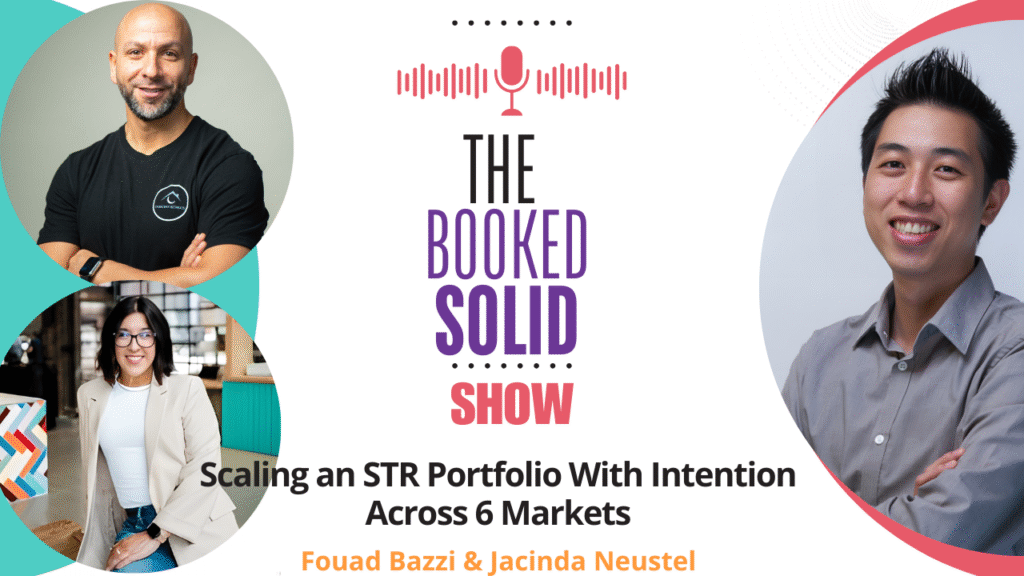
“You gotta make it or make it. These are your two options.”
What happens when a 20-year corporate banker with a vision meets a solo operator managing 30 properties by herself — cleaning, messaging guests, and fixing maintenance issues with no team? In this episode of Booked Solid, Fouad Bazzi and Jacinda Neustel share how they combined their very different strengths to build a property management company spanning 82 properties across six markets. They talk about why saying yes to everything nearly broke them, how hiring for core values changed their team, and why the Entrepreneurial Operating System (EOS) became the backbone of their operations.
Whether you’re managing two doors or two hundred, this conversation is packed with perspective on growing with intention — not just growing for the sake of it.
Summary and Highlights
👤 Meet Fouad Bazzi
Fouad Bazzi spent nearly two decades at Comerica Bank, working across retail, treasury management, and commercial banking — including 11 years in correspondent banking supporting community banks. After leaving the corporate world, he made the jump into entrepreneurship and hospitality. Fouad is the founder of The Owner Hosts, where he focuses on helping property owners run smarter, more profitable short-term rentals through strong systems, pricing strategy, and guest experience. He brings a unique mix of financial discipline and real-world operator experience, and he’s passionate about building sustainable, well-run businesses in the short-term rental space.
👤 Meet Jacinda Neustel
Jacinda Neustel got her start in short-term rentals out of pure necessity — she couldn’t afford her rent one month and listed her spare room on Airbnb. That one decision snowballed into managing over 30 listings by herself, first through midterm rentals for travel nurses, then rental arbitrage, and eventually co-hosting. She physically relocated from Fort Wayne, Indiana to Arizona to force herself to delegate and stop being the one answering every emergency call. She’s the published author of The Airbnb Queen: How I Built My Short-Term Rental Empire and now co-manages over 82 properties alongside Fouad.
🤝 How a Mentorship Became a Partnership
One of the most refreshing parts of this episode is the origin story. Fouad and Jacinda didn’t meet through some polished networking event and shake hands on a deal. It started with mentorship. Jacinda wanted to break into the luxury rental space, and Fouad was already there — analyzing properties with his sons, hosting launches, and building a brand around high-end hospitality.
For a full year, they “dated” as business partners. They trialed hosting a property together to see how each other handled real problems — upset owners, maintenance emergencies, integrity under pressure. Jacinda admits she initially resisted the partnership entirely. She wanted a hundred percent of her own pie. But over time, she realized something critical: a portion of a much bigger pie was worth more than full ownership of a smaller one.
Fouad’s take was equally grounded. He wasn’t looking for a partner at first either. He saw someone with incredible grit and operational ability who, with the right mentorship and systems in place, could go further than either of them could alone.
Their advice for anyone considering a partnership? It’s not about full agreement — it’s about full alignment. Know your lane. Give your opinion, then pull back. Trust and communication make it work, not constant consensus.
📉 Why They Went From 96 Properties to 82 (On Purpose)
At their peak, Fouad and Jacinda managed 96 properties. And they’ll be the first to tell you — not all of that growth was good growth. In the early days, they said yes to everything. If someone was willing to pay, they took the property on.
That changed after a particularly frustrating experience with a portfolio in San Diego. Despite flagging issues during the property tour — overgrown landscaping, mismatched sleeping capacity, a rooftop deck with ocean views but zero chairs — the owners were unwilling to invest. Guest complaints piled up. Review scores suffered.
The lesson was clear: not all revenue is good revenue. So they started trimming. They got honest about which properties fit their brand standards and which ones dragged the portfolio down. That intentional pruning also transformed how they onboard new owners. Now they ask direct questions upfront: What’s your break-even number? Can we realistically meet it? And if a property would perform better as a midterm rental, they say so.
For hosts and property managers looking to build a portfolio they’re proud of, Fouad and Jacinda’s experience is a powerful reminder: growth without intention is just more work.
🧠 Implementing EOS: From Reactive to Proactive
One of the biggest operational shifts Fouad and Jacinda made was adopting the Entrepreneurial Operating System (EOS), popularized by Gino Wickman’s book Traction. They use Ninety.io to run it across their global team — three VAs in Bolivia and two in Egypt — and the transformation has been significant.
Before EOS, their team was reactive. VAs sat waiting for guest messages. Now, every team member has a specialized role. One handles revenue management full-time, living inside Key Data and PriceLabs. Another manages vendor relationships. A third focuses on maintenance. Everyone has a scorecard with weekly targets, and Monday meetings are no longer top-down status updates — they’re interactive accountability sessions where the team reports on their own metrics.
Fouad’s analogy from the book is worth repeating here. Think of a cup. If you fill it first with big rocks — the priorities that actually move the needle — the pebbles and sand (the smaller daily tasks) will find their way into the gaps naturally. But if you fill the cup with sand first, the rocks won’t fit. EOS helps you identify and protect those rocks.
For operators who think EOS requires a $10,000-per-quarter integrator, Fouad’s message is encouraging: self-implement. Even at 60 or 70 percent accuracy, it’s better than not having it at all. Use AI, read the book, or let the Ninety.io software walk you through it.
🧑🤝🧑 Hiring for Core Values, Not Résumés
Building a team across multiple continents sounds daunting. But Fouad and Jacinda took a refreshingly simple approach: hire for core values and train the skill.
Out of their five current team members, none had short-term rental experience when they joined. They went through roughly ten candidates to find these five. The key filters weren’t industry knowledge — they were character traits. Trustworthiness. Work ethic. A “yes, I can” attitude. Willingness to learn.
Their Bolivian team members work Eastern time, which eliminates the timezone challenges of hiring overseas. Many of their ground-level vendors speak Spanish, and having Spanish-speaking VAs has made vendor coordination seamless. Their Egyptian team members bring strong analytical skills and proactive thinking.
Referrals from their broader network — not just STR contacts — delivered the best hires. They also worked with a headhunting agency, which opened the door to the Bolivian market.
The takeaway for anyone looking to scale their operations? Stop looking for people who already know the industry. Look for people who align with your values and show them how to do the work.
🏨 Hospitality First, Always
When Gil asked what ultimately drives direct bookings and repeat guests, the answer came down to two things: hospitality and product quality.
Guest experience isn’t just about clean sheets and fast Wi-Fi. It’s about how guests feel when something goes wrong. Jacinda put it simply: not everything will go perfectly every stay, but how you handle it — how the guest feels you’re taking care of them — that’s what determines whether they come back.
The conversation included a real-world example from Gil’s own experience as a guest with AvantStay. A missing play structure, scratched-up dishes, and dismissive customer service left a lasting negative impression. That’s the kind of experience that kills repeat bookings — and it’s exactly what Fouad and Jacinda work to prevent across their portfolio.
For hosts thinking about building trust through their direct booking websites, this is a good reminder: your brand is only as strong as the experience behind it.
🎯 Living and Scaling With Intentionality
Fouad’s session at the STR Hospitality Summit in Denver — called Hospitality Your Way — captures the philosophy that drives their entire operation. It’s not about copying someone else’s playbook. It’s about designing your own.
He’s blunt about the state of STR advice online: too many people are coaching and building courses while operating at a negative cash flow. His advice? Only take guidance from people who are actually doing what you want to do — and have the receipts to prove it.
The financial goals for their company are specific: a bare minimum of $100,000 in monthly profit and $11.3 million in gross booking revenue. But those numbers exist alongside lifestyle goals. They want to impact lives — their team’s, their families’, their guests’. One of their VAs in Bolivia is an anesthesiologist who received a pay raise by joining their team. Another team member in Egypt just secured his dream apartment.
That’s what intentional scaling looks like. It’s not just about doors — it’s about building something that matters.
🔥 Rapid Fire With Fouad & Jacinda
📚 Book Recommendations:
Jacinda recommends Traction by Gino Wickman — the book that introduced EOS and transformed how she approaches operations. Fouad picks two: Unreasonable Hospitality by Will Guidara and Start With Why by Simon Sinek.
💡 Mindset Advice for Someone Starting Something New:
Fouad: “Only take advice from people that are doing exactly what you want to do. Your parents love you, your spouse loves you — but if they’re not doing it, find someone who is.”
Jacinda: “You gotta make it or make it. What was I gonna do, let my house go into foreclosure? These are your two options. One way or another, you’re gonna figure it out.”
🎯 One Tactical Tip for Direct Bookings:
Fouad’s team converted their digital guidebooks into QR codes placed inside every property. Guests scan the code and enter their email to access the guidebook. That email goes straight into their database for future email marketing campaigns and direct outreach.
Jacinda calls past guests directly at the end of their review window. She asks for a review, but while she has them on the phone, she tells them about other properties in their portfolio across multiple markets. It’s a personal, off-platform touchpoint that opens the door to repeat direct bookings.
🔗 Connect With Fouad & Jacinda
Fouad Bazzi:
- Instagram: @fouad_airbnb
- LinkedIn: Fouad Bazzi
- Website: fouadbazzi.com
Jacinda Neustel:
- Instagram: @the.airbnb.queen
- Facebook: Jacinda Neustel
- Website: thequeensbnbs.com
- Book: The Airbnb Queen on Amazon
🎧 Fouad is currently looking to help 10 operators set their goals and objectives for 2026. Reach out to him on Instagram if you’re ready to scale with intention.
🎧 Listen to the Full Episode
This conversation barely scratches the surface. Fouad and Jacinda go deeper into partnership dynamics, VA management, revenue strategy, and building a company culture that impacts lives far beyond the bottom line.
🎙️ Listen to the full Booked Solid episode wherever you get your podcasts.
Ready to build a direct booking brand that reflects the quality of your hospitality? Visit CraftedStays.co and start your free trial today. Your website should work as hard as you do.
Transcription
Fouad: Take advice from somebody that you know is doing exactly what you want to do, and, and that’s, you know, the care and the love from everybody else, but take the advice from people that, that are doing it
Jacinda: with receipts who want to see the receipts. Yeah. Mine is more mindset of just, some people ask me, how did, how did you do all that?
Jacinda: And you know, when you come across this hiccup or that hiccup, how did you overcome it and stuff. And like, you gotta make it or make it, what was I gonna do? Let my house go under? You know, foreclosure and stuff like that. Like, no, I wasn’t gonna let that happen. You gotta make it or make it these, these are your two options.
Jacinda: So one way or another you’re gonna figure it out. And kind of having that slightly abrasive mentality of just you, you’re not losing. So find the way to make it what happen.
Gil: Before we bring on my guest, I wanted to talk just a little bit about something that I’ve been hearing a lot from Host. I keep on hearing the same thing. I know my website isn’t converting, but I can’t afford $8,000 on a agency to rebuild it. Here’s the thing, you’re letting all these marketing strategies, you’re driving traffic and you’re putting it all to work.
Gil: But if your site isn’t really built to convert. You’re basically lighting your energy and money on fire, and even if you could afford an agency build, every time you want to test something or make a change, you’re having to pay them again. You can’t iterate, you can’t test, and you really can improve on things.
Gil: You don’t need a custom $10,000 website to get the conversion rates that really matter. You just need the right platform. That’s why I build CraftedStays. It’s purpose built for short term rentals and designed from the ground up to help you drive more direct bookings. You can finally turn that traffic into bookings and you can keep on testing and improving.
Gil: As you learn, you can make changes all on the platform. You don’t need to learn something new. So if you need some help or you wanna get started, go ahead and go to CraftedStays.co and start your free trial. Now let’s bring on our guests and dive deep into hospitality and marketing.
Gil: Hey folks. Welcome back to the Booked Solid show. The show we bring in top operators to discuss hospitality, operations and direct bookings.
Gil: On today’s show, I have my good friend Fouad. I met him at the STR Hospitality Summit. I also have his partner, Jacinda. Together, they are property managers with a portfolio of 82 properties across six different markets. Um, they came together after collaborating together for many, many, actually many years.
Gil: Um, and, and today’s show, they talked about how they came from two different perspective, two different skill sets, and how they’re able to come together and really amplify their strengths together and how they’re able to grow. So on the show, we talk about structure, growth, and a lot of intentionality there.
Gil: So without further ado, let’s bring ’em both in.
Gil: Hey, Fouad. Hey Jacinda. Welcome to the show.
Fouad: Hey, hey. Thanks for having us.
Jacinda: Thanks for having us, Gil. Thanks for having us. Appreciate you.
Gil: Yeah, this is the first time on the show. I have actually, this is the first time, maybe the first or second time that we had two guests on the show, so it’s super special for me. Um, I’ve been on the receiving end where I have two hosts on the show, and I am the solo guest, and I find it to be a very fun show because then you get to see differing opinions across, across the board.
Gil: So I I, I’m enjoying to, I’m, I look forward to today’s show. Uh, maybe to kinda get us started, uh, I would love an intro from each of you, uh, maybe Fouad, if you don’t mind introducing yourself first.
Fouad: Sure. Yeah. My name is Fouad Bazzi. Gil and I, we met in, boy, I mean, we met probably via social media a couple years ago, but we’ve, we met in person in Denver at the. Um, at the, summit, the, the hospitality host summit. And, you know, we really had a chance to kick it off there, talk, kind of talking about businesses and goals and, you know, what we were trying to do, and I think Gil and I are very similar.
Fouad: You know, we’re, we’re, we’re very similar in that we came from a different world, right? We came from a world of, you know, I came from a banking career you came from, from an entrepreneurial like startup career. And then we kind of landed here in the short term rental mix. Um, for me, I got into the space, you know, after 20 years in banking because we were looking for all kinds of tax breaks.
Fouad: We started buying short term rentals for the loopholes. And then, you know, then, then we kind of got really good at this thing called management. And people kind of started saying, but we were only managing for ourselves. And people were saying, Hey, will you do what you do?
Fouad: What you do it for me? And I really didn’t have any interest in it, but I met this really awesome person, Jacinda, while we were in Phoenix one day. And she had been doing it at a pretty high level. And so, you know, we can kind of get into how our stories merged together one day, but, but I’ll pass it over to Jacinda at this point, to to introduce herself.
Jacinda: Yeah, I got started in short-term rentals, all because I couldn’t afford my rent one month. And someone was like, Hey, you should, you should just rent all your extra room on Airbnb. And I was like, no thanks, but gave it a shot. When you need money, you need money. And yeah, honestly, it kind of escalated from there.
Jacinda: So primarily I was into more or less like midterm rentals for travel nurses. And then I got into arbitrage, and then I started like co-hosting for other people. It, it, it started, transitioning from being the crazy girl that had strangers come stay with her to being like an actual viable business plan.
Jacinda: Then when it was kind of transitioning out of the, uh, travel nurse midterm kind of market, and it was transitioning to more short term, I knew that I needed to get a mentor to teach me how to, how do you do if I have 30 listings? How do you do 30 turnovers in a weekend? I’m not ready for that. And so that’s exactly what I meant Fouad.
Gil: how long have you guys been working together now?
Fouad: now it’s been 13 or 14 months now. So what happened is when we met, you know, we met and you know. I think we both had gaps, right? For me, wanting to, to actually get into management, it wasn’t something I really wanted to do, but I had a great team. We had a lot of capacity to do it. We had great systems, great team, had multiple VAs and all these things built out just for my, my small, you know, little eight, eight house portfolio.
Fouad: And Jacinda had 40 or so, 45 maybe, uh, properties she was managing, but had no team, had no, you know, like nothing. She was a solo as solopreneur as it gets. And so it was like, okay, well how do we, how do we bring these two worlds together? I’ve already got the team that can help you handle your world. And, um, you’ve got the desire to run a day-to-day operation.
Fouad: Um, and so, you know, my, I’ve always been a growth guy. I’ve always been focused on the vision and how do we go get more and scale and all of that. So we put our worlds together about 14 months ago now. And, um, you know, here we are and I’d say we’re at, we got up to 96 properties at one, at one point. We’re down to 82 today.
Fouad: Um, that’s growing here over the next two weeks. And, uh, yeah, now it’s, you know, 2026 for us is all about like, you know, growing with intention, meaning we’re only gonna, we’re not gonna say yes to everything. It’s gonna be the right properties, and it’s gonna be about taking what we currently have and optimizing it, right?
Fouad: So, there might be some, some, some attrition by decision. We may want to get rid of some of those properties, but also, like, what systems are we using? And I, you know, we, we, we already started getting rid of some softwares and adding some other ones in. So we really wanna make sure that we’re, we’re just, we’re, we’re, we’re as efficient as we possibly can.
Fouad: There’s enough revenue in the door. You know, I always say, you know, for the company that tried to get really lean before there’s enough fat, you’re not really growing. You know, you’re just, you’re just hoping to stay alive. You know, for us, there’s enough fat there now. So it’s like, great. Now, now we can lean it up a little bit, you know?
Gil: Yeah. Yeah. If, do you remember kind of that first interaction, like I’m, I’m really interested in kind of like how you folks met. I’m guessing you met at some like public space where like there at some type of meetup or conference there, you guys meet up, found out there’s this gap there and to take that leap and say, oh, I actually want to take this further and, and maybe we can work together.
Gil: Like, what was that like for the two of you and when do you know like, oh, this person is someone that I want to spend much more time with and could be a big unlock for me? Like how did you get each other’s cues? To know that there’s that fit there, or maybe that fit came over many, many different conversations.
Jacinda: I’ll take, do you want me to take that one?
Fouad: you want me to take that one? Yeah, I do.
Jacinda: So, uh, it started out as much more of a mentorship. So like, Hey, I’m having this problem. Can you advise me? And stuff like that. And he was in like high-end luxury rentals, which is where I wanted to go. Like I was very much into these accommodation stays and they’re fun, but we make a couple hundred bucks a month off of ’em rather than luxury stays you make, you make some good money off of those ones.
Jacinda: Um, and so I was really wanting to get in that market so. He was so gracious, like he invited to me one of his property launches, and I got to see how cool it was and all the things that go into it and how to analyze a property. And he took me around with him and his sons were there one day and we just went to go look at properties that they were looking to potentially purchase and like hear how his brain would analyze it.
Jacinda: And he’d show me how he’d analyze the numbers and stuff too. And, and honestly I’ll be, I’ll be really honest, I had no intention of getting a business partner. He, he had pitched it a year prior to us actually having the real conversation and I, I was a call it ego or, or not, not mature enough, but I was like, no, I wanna, I wanna be my own business owner and I don’t wanna have anyone to tell me what to, and I don’t wanna share it and I want it to be mine.
Jacinda: And like, oh, okay, well I got a hundred percent of all that work and responsibility then all the time. And so it, it. Over the course of time, I finally matured and was like, oh man, it would be so nice to have a partner to get to share this burden with, but also bounce ideas off of and like, man, I can work so hard, but my pie will only be this big.
Jacinda: How big will our pie be together? And I’d rather have a portion of that than a hundred percent of a smaller pie kind of thing. So.
Fouad: So I’ll, and I’ll add to that is, you know, having a business partner, by the way, and I’m sure Jacinda would, would say this is I probably drive her crazy more often than I actually make it easy, right? And, but, but, so it’s not about cupcakes and rainbows and, and sunshine all the time, just because you have a partner.
Fouad: And it’s not about full agreement. It’s about full alignment in where we’re going. And what I think is the beauty in that is that we always get to challenge each other. We always get to say, you know, are we doing the right things? But then it’s really important to say, okay, where’s my lane? Where does my lane start?
Fouad: Where does it end? And then I’ve given my opinion, pull back. That’s enough, right? Like, so now, you know, like we use a PMS that I don’t like. But I don’t care because she likes it and the team likes it, and it’s not important that I like it. You know what I mean? And so, so I, I know where to, you know, and I, and that was a, a very learned thing for me as well.
Fouad: Um, so I think that’s really important to know as a business partner isn’t just there to always agree with you. A business partner is there to, you know, iron sharp, sharpens iron, uh, just like in football. And, and, and I think we do, we do. I think that’s probably where we do a really good job.
Gil: So it sounds like Fouad, like you knew early, earlier on. Then Jacinda actually realized that like, oh, there’s actually a good potential partnership there. What was going through your head when you first met Jacinda and you’re like, oh, this is someone I actually wanna work with. Like what was that trigger on your side?
Fouad: Yeah, early on, I don’t know that it was about that. I think early on it was really more about, man, she’s a killer and she, if, if, if, if, if she had a mentor and if I could add a little bit of value to her, I think sky’s the limit for her, you know? And that, that was kind of where my head was at, was how can I add value just to her as a human, as a person, as an operator, but which she was doing really well at.
Fouad: Um, so it wasn’t really, you know, because at the time I had zero desire to scale a management company. I just really did it. I just wanted to own more real estate. That was, that was the focus at the time. And so, um, so I think from there it just kind of morphed into, well, okay, I’ve got this, all this, um, you know, unsolicited demand coming to me from a lot of people, a lot of masterminds and, and, and other networks and, and, and groups that I belong to saying, Hey, manage my properties.
Fouad: We love your approach. We love what you do. And I’m like, I don’t love doing that and I don’t want to do any of that. And so I kept saying no, actually for a couple years to, to those inquiries. Uh, but then when I had the, you know, is Jacinda and I continued to get to know each other and. Um, just kind of saw who she was as a human, as an operator and, and what she was doing and just really understanding.
Fouad: And this is where kind of, you know, Traction, you know, EOS, EOS is Entrepreneurial Operating System, really having a clear understanding of that whole philosophy and understanding. There really are visionaries and there, there are really are integrators. I really just, you know, and, and this goes back to my corporate days, even when I was an employee, I was a growth guy.
Fouad: I was always on business development. That was always where my head was at, was how do we do more, I hate political red lines. I don’t wanna follow the rules. I don’t like, like compliance. I don’t care about any of that. I want growth, right? Like, how do we grow the numbers? How do we hit the, the growth goals?
Fouad: Um, now we’ve had a team around me that, that kind of, kind of checked all those other boxes. Um, and, and similarly, you know, for Jacinda, I think, you know, it was a great integrator. I could see it in her from day one and she was really, really good at what she was doing. But I think. Kind of some of that scale stuff, some of the, Hey, it works today, but what happens when the, when the belt gets too tight, and how do you expand and, and are we building something that’s, that’s scalable?
Gil: Yeah, I, I’ll, I’ll, I’ll do a slight tangent for a little bit like. Starting CraftedStays. When I first started this, it was very much my, myself and the team that I hired in there, and I hired a bunch of engineers that I have had a chance to work with over the last 15 years. But having that other partner there, like for me, even to this day, I’ll, I’ll, I admit it to our listeners and our customers here.
Gil: Like, I don’t enjoy marketing. I don’t enjoy that side of the business. I like building product, I love understanding people’s needs. I under, I love working with the engineering to, to figure out like how do we, like, create new offerings that help serve our customers better. What I don’t like is like going on the megaphone and talking about how great we are and all those different things.
Gil: And I’ve been hunting probably for the last year and a half for that marketer, that person that I want to bring into the company that like I can bounce ideas off of. They’re thinking about like their, their wheels are turning when we start talking about product, product stuff, about how we get that out there.
Gil: So like. Anytime I see like a really well partnership, I always, I’m always interested in like the origin story of like how that came to be, because I’m hoping that serendipity will find its way to me one day and I’ll find that other person out there and hopefully I talk about it enough on this podcast.
Gil: Like, if someone kind of fits that bill and wants to reach out, they can do so as well too. But yeah, I, I, I always admire like really strong partnerships because I see a lot of times there are partnerships that start for a little while and they seem good and then they kind of fall apart. And it sounds like there are certain fundamentals of things that are put in place that makes partnerships more successful because partnerships, it’s hard.
Gil: I can even say that even with my partnership with my wife, like not every day we agree with each other on every single thing. Um, but kinda like Fouad to what you mentioned earlier, I think one of the biggest d like one of the biggest things that contribute to my wife and I working so well together is really that alignment.
Gil: Like we agree on things. I am now, I’m now at a point where like we will, there are gonna be 40, 50% of the things that we just don’t agree on. And that’s okay. Like, I don’t have to win arguments. I don’t have to be Right. Hopefully she doesn’t feel like she has to be right all the time either. But like, it’s not, it’s not about like always trying to like get each, like get what you want out of things.
Gil: Um, and being able to rely on that other person and just say, okay, you got this. Or, we’ll, like, we don’t have to resolve these things. Like wife, my wife and I, we, we, we’ll we will talk about the same topic. And I’m like, okay, this is one of those topics like we’re just never gonna agree on. And that’s, that’s okay with me.
Gil: Um, so I, I just don’t wanna say like, it’s, it’s, it’s amazing to hear kind of like how your partnership was almost seeded and kind of progressed along the way. And now that you’re in it in the last 14 months, how you two have been able to rely on each other and respect each other and, uh, and align with each other that made you guys successful.
Gil: And then on top of that. I think one of the best partnerships are ones that there’s actually pretty big differences in the way that you look at the world and the things that you’re really good at. Um, like I know that if I’m bringing a partner here, I don’t need someone that’s a product visionary. I don’t need a product person.
Gil: I don’t need a customer success person. I don’t need someone that obsesses over those types of things because I already bring enough energy in that area. I need someone that is, that has a different skill set and a different lens.
Jacinda: That’s what I really appreciate about, uh, Fouad was like, I, I’m really good at working hard, but I can work hard in the wrong direction ’cause I don’t do the visionary part very well and he. Is a lot of really great ideas. It’s just the execution part that like, that’s my skillset. Let you tell me where to go and I’ll get us there kind of thing.
Jacinda: Um, and also something that I wanna talk about in our journey. I appreciate that. Look, I do think that business partnerships are a lot like marriages. It’s just as painful to get divorced if we’re gonna ever split our business. And so with that same analogy, we got to date for like a year, I wanna say, before we merged.
Jacinda: Um, and so we trialed out hosting a property together. And so then we really got to see like, ’cause don’t get me wrong, like at the beginning when you’re talking about merging or anything like that, it’s just like dating. You put on your best face, Hey, things are gonna be great, all the things. And so we got to see each other when, hey, when this pro problem happens with the property or the owner or whatever, like how, how do you react in those kind of scenarios?
Jacinda: Where does your integrity, um, lie and stuff like that. And so we got to, we got to see that before we actually got married, merged all the things and stuff like
Fouad: Yeah, and, and you both talked about marriage and I think just like it, it’s trust and communication, right? And so we have an immense amount of trust for each other no matter what. Like I know that she’s not gonna steal from the company. I know she’s not going to deliberately sabotage the company. I know she cares about humans.
Fouad: That matters. All of those things matter. When you have all of those qualities, then, you know, like, look, it’s like, you know, we, we both might wanna go to the same restaurant, but you want to go in a red car and I wanna go in a blue car, and that’s cool. And like, let’s go, let’s just meet there then instead at the, at the restaurant in your own cars and take whatever roads you want to get there and, and all that.
Fouad: I think. You know, all of that really, really matters is just, just being open to those differences and, um, yeah, it’s great. It’s fantastic guys. When you, when you, when you’re able to have a partner that, that fulfills all of those things, just, just the trust and loyalty part, then you can just sit back and say, okay, cool.
Fouad: I don’t care how you do it. I, I really don’t care. As long as we agree on the goal. Cool, let’s go.
Gil: Yeah. So you, you’ve grown your portfolio quite a bit. Um, I think you mentioned you went to like 96 doors. Is that, is I, I don’t remember the exact number, but like 90 something and then you’re now starting to pull back on them and you’re scaling up still. What, what is kind of, what were you trying to recalibrate kind of in that up and then the down and back up again?
Fouad: again. Yeah. I mean, you know, we got to 96 and frankly, you know, for lack of a better phrase, we were kind of whores. I mean, we, we just said yes to everything. You know, as somebody who’s gonna pay us, we were just gonna take it. And, and so, um, you know, what we’ve done is we’ve just gotten really intentional and understanding about like, not, not, not all.
Fouad: You know, not all growth is good. And, and you know, I know that from my consulting days also is, you know, revenue is not always good revenue. Um, you know, we had a, we had a particular portfolio properties in San Diego that we were managing and, you know, really loved this couple. They were dynamic, they were amazing people and, um, know them very well.
Fouad: Great reputation in the real estate space. Um, and then when I went out there to San Diego and toured their properties, I kind of called out like, Hey, this thing is gonna be a problem. Your landscaping here is gonna be an issue, and you know, this one thing might be a problem. And, you know, we say we can sleep 10 people here, but we’ve got a dinner table for six and we’ve got.
Fouad: You know, sofas in the family room that only have six seats and you know, like, how are we gonna, you know, what, what, what are we really gonna do here? And oh, by the way, you got a rooftop deck and the rooftop deck has ocean views, but we got no chairs up there. Like, what do we wanna do about that? And you know, so all these things that we called out and, you know, guest after guests, we had, we had issues, we had complaints about the landscaping and overgrown weeds and, you know, literally like three feet tall weeds.
Fouad: And, well, we’re still waiting on our permits for our ADU. And it’s like, cool, can you just cut the weeds? Like, can we do anything about that? You know, can we just make it, um, um, you know, enjoyable to sit outside in the backyard and can we throw some chairs up? And, and it just, you know, the, the, the, the, the unwillingness to invest in the right things that made, you know, because look, at the end of the day, I get it, real estate investments are real estate investments, but hospitality is also hospitality.
Fouad: And, you know, um, you know, you’re, you’re always, I always say, you’re, you’re one, one star review away from not being able to host at that property anymore. And so, uh, so for us it was, it was just understanding that this was a portfolio we had to get away from. And so we started getting, getting, uh, you know, honest with ourselves about what we wanted and who we wanted to work with.
Fouad: Said no to some things, you know, turned some things away, got rid of some things. And I think 2026 we’ll see a little bit more attrition now that we’re getting more dialed into our fixed costs versus our variable costs and understanding what is gonna drive the needle towards our, our ultimate revenue goals.
Fouad: Um, and, and, uh, yeah, we’re off to a pretty good start in our growth so far this year. So that’s that.
Gil: Yeah, I, I hear the story quite, quite often with, with property managers where kind of in the beginning they’ll take whatever, whatever portfolio or whatever properties that, that kind of come the way. And, and at some point there’s this realization that like, oh, there’s a set of properties that have done really well.
Gil: The owners are really good, they’re investing into their properties, and they fit the por right portfolio, they fit into my brand. And then there’s this other camp of properties that just don’t fit very well. And maybe we took them on very early on and they’re trying to realize like, oh, actually. I’d rather be sculpting our portfolio more like these, and almost like one, you’re trimming the fat and you’re really making sure that the properties that you have are ones that you want to keep, that you feel proud of having in your portfolio.
Gil: But also it changes the way that you talk to prospects. New homeowners out there. I, I bet. Right. Right now, your onboarding process, now, the questions that you ask, the expectations that you set are very different than they were many years back. Is that, and, and I’m assuming here, but let me know that’s.
Fouad: that’s a hundred bro. That’s a hundred percent right. I mean, we, we are, we’re super transparent about what we can and can’t do. Um, you know, one of. Things that we’ve gotten really good at, I think has, has been really helpful is just saying, Hey, what’s your break even number every month?
Fouad: Right? Like, we just ask, we just ask owners that right up front, what is your break even number? Can we meet that? And hey, by the way, I think we can in all of the months, except for, you know, July, October and November, it’s gonna be tough to meet that number just as an FYI. So we’re not gonna distribute, you may not want to distribute too much profit out to yourself those months.
Fouad: So, you know, the months leading up to that. So you, you know, we’re just, we’ve become really, really good at understanding that. And the other thing is understanding who the guests are that are gonna be coming through, right? So we have one in Rockwall, Texas that we, that we manage right now. And we just increase the, the number of, of minimum nights stay there because we think that one’s just gonna be a much better midterm rental.
Fouad: Right. And we’re very honest with the owners about it. We just don’t think this is gonna be a good short term rental. You guys have had a hard time, you know, self managing it for a while for a reason. Now we are as well. And so I think this is gonna be kind of the, the best world for it. So we might go a month with no revenue, but then hopefully we get a three month tenant, right?
Fouad: So, you know, just understanding where, what the right things are at the right times, uh, in the right markets. So any, anything I missed there, Jay, or
Jacinda: Yeah, I think just transparency of like, Hey, this, I used to, when I was getting started, I, you know, of course I wanted the business and I was optimistic. That’s how I got to where I was. Um, but not being blindly optimistic, so like, Hey, okay, let’s talk, let’s be real about what the expectations are and stuff like that.
Jacinda: I think we’ve gotten really clear on that so that everyone has the same expectations and we’re not painting rainbows and
Gil: Yeah, I, I, I bet like in, in those conversations, you, you talk about the outcomes that you’re able to produce for your homeowners, but now you’re layering in like, these are the realistic numbers. We’ve done an analysis on your portfolio or your properties, and this is what I see us getting to is this kind of where you expect as well too, and really setting that very early on so that.
Gil: They don’t go six months into it. They’re like, actually, I, I actually thought about a different number. You’re not, you’re not being surprised. But also it also opens up the conversation of like, okay, if we wanted to be at this number, do we need to do more with the property and what the expectations are there?
Fouad: for sure.
Gil: What’s, uh, what’s been, and I, I would love the individual kind of take on this, what’s been one of the biggest learnings kind of growing that portfolio from year eight or just into your, your 40 back then to the collective 90 something or 80 something properties now. What was, what’s been like the biggest learning that you’ve both have gone through?
Fouad: You go first, Jay.
Jacinda: uh, delegation. It, uh, especially like in Fort Wayne. Where I started out, I think I was able to maintenance and housekeep for like 30 listings myself for a while. And then one time I got a guest that called me and was like, there’s a dirty fork stuck to my nightstand. And I was like, I’m gonna call housekeeping right now.
Jacinda: And it was me like, okay, I gotta, I’m clearly not doing a great job anymore. And so learning to, okay, I need to delegate that out. And same with maintenance. And it was, it was so difficult for me. To theoretically sit on my hands while we have an emergency going on, because I, I, I cannot be the one that keeps going out to do these things.
Jacinda: I have to build relationships with, with vendors and stuff like that to be able to call them so they can go do that. So I can work on the business, not in the business anymore. And I physically had to move away to Arizona, which is where Fouad and I at. I had to physically move away so that I could not go take those emergency calls anymore.
Jacinda: And it was so painful. And that was exactly why I didn’t, didn’t have a team either, virtual team, um, to help with guest communication and coordinating all that. And it was just. Honestly, like I was kinda like, yeah, this is paying my bills, but like, how long do I wanna do this? ’cause now I can’t, I can’t go out on the lake ’cause I have to be with my phone and I can’t go out and, you know, spend time with my family sometimes because we have checkouts today or whatever.
Jacinda: And it’s just really sucking the life out of my life. And, uh, so I delegation even with our team too. ’cause, ’cause for the longest time I was like, well no one can answer guest communication like I do. But then when I got to such a capacity, I wasn’t even doing a good job anymore. So, uh, yeah. Now I see that our team, they have the time in this space for it and they do a much better job.
Jacinda: And then that way when things hit my desk, when it’s the big problems, I have the capacity to handle it. ’cause I’m not handling the whole whole thing anymore.
Gil: I, I would love, uh, a, a contrast to what it is today. We haven’t, we didn’t dive deep into kind of your day to day now. So before there was a lot of elbow grease. You’re the ones out the floor. You’re the one cleaning, you’re the one doing guest comms. Like all of that was on your shoulders, and that’s.
Gil: I don’t know how you did it. 30 doors with that is insane. Kudos. What I, I, I can, I now understand why you, so you see so much potential, there’s just so much grit in that. Um, and in kind of in contrast now, like what does your day to day look like, look like now? And kinda like what helped you get to that outside of maybe some, some mentoring.
Gil: Like what are some of the, the biggest things that you shifted, um, tactically that helped you get to where you are today?
Jacinda: Um, well, the biggest, biggest difference of contrast, I guess is like, I, I don’t, my phone is on silent now. I never could ever put my phone on silent before and like, just all the notifications and all the thing, like now I, I get to do podcasts and it wouldn’t, it used to stress me out ’cause I’m like, oh my gosh, this guest messages and I need to get back to him and stuff like that.
Jacinda: Um, but honestly, the, the biggest push, I, I don’t think I would’ve gotten a whole team for quite some time. It was my business partner. He was like, look, this is our line. I’m, I’m gonna hold it for us. And so I really appreciate that. Uh, he does force me to do things that are uncomfortable, that are for the betterment of our company.
Jacinda: Like, look, you can keep doing it yourself, but it’s gonna be to our detriment. So you, you gotta, you gotta start letting people help you.
Fouad: Yeah. And I, I’ll take that a step further. I mean, not, not, not this part of the question. ’cause I, you know, certainly she, you know, she knows more about what’s changed in her life, um, than I do. But, but I think, you know, as we’ve, as we’ve grown, what I’ve learned, um. When you get into this industry, everybody talks about automate and delegate and then hire a bunch of VAs, right?
Fouad: But nobody actually talks about what that means. Like when you hire VAs, like, okay, cool, you got 13 properties. You, you gotta, you know, they’re working 50% of the time, the other 50% of the time you got one or two VAs and they just kind of sit around and wait for work to be reactive. And that’s really, that was where our world was early on was we had, we had a lot of reactive, uh, habits.
Fouad: Um, I think what we’ve done is we’ve done, uh, uh, you, you know, where we’ve elevated is we’ve gotten very proactive in almost everything that we do now. Um, and so, you know, we, we’ve, we’ve specialized all of our VAs have specialized. So one of our guys has done a ton of training in revenue management and he’s out of Egypt.
Fouad: So he handles, he’s living in Key Data, PriceLabs, he’s pricing strategy. We’ve built a course for him in ChatGPT. That is it. Perfect. No. Um, but you know what, show me a pricing revenue strategy. That is perfect. Right? Because, you know, even for the people that say we hire, we, we outsource revenue management.
Fouad: You, you know, how many times they, they fire and hire and fire and hire and fire and hire and um, and all these things. So we have a real, what I, what I believe in very thoroughly is that, or very deeply, is that we, we’ve done a hell of a job training this guy. He understands the philosophy of how do we, how do we, um, shift pricing from season to season, from weekday to weekend and holiday to non-holiday and all these things.
Fouad: And we have all these tools. We’ve given him all the resources he needs. We have a general admin, we have a vendor specific. So she, she manages the vendors. And then, um, we have a gentleman that is maintenance, uh, related. Now they can all dabble a little bit in all of these by the way, but we, especially, we, we have leaders in each category, right?
Fouad: Um, and then, and, and what that’s driven is we use Ninety.io a software that implements EOS for you. And so our Monday morning, our, our, that’s when we have everybody. We have three in Bolivia, three VAs in Bolivia to in Bolivia, to in Egypt. And so. Our Monday mornings have gone from us just talking at them, to them be this, this is now a very, uh, high level conversation where everybody’s on their scorecard, everybody understands what they’re assigned to, and everybody’s talking about what they, what they did.
Fouad: Right? Hey, I, here’s my weekly goal on this, and I did it. Here’s my weekly goal on that, and I did it. And then it’s the next person. Then it’s the next person. And so we’ve become so much more interactive and understanding of who’s doing what now. So I, you know, we’ve be, we’ve just become proactive and I think that’s really important when you shift to reactive, to proactive in the space.
Fouad: Um, it does, it, you, you know, you’ve gotta play some offense, you know, and, and I think we’ve done that.
Gil: Yeah, it sounds like a lot of, lot of tactics from, or strategy even from Traction and EOS and really putting that as a fundamental thing of, and I, I, I think we’re going through some of a, something similar at CraftedStays where in the very beginning we’re looking at the high level metrics now, and now we’re down to like, okay, we need to pay much closer attention to our monthly recurring revenue, our churn, our CSAT scores, and kind of transitioning that process where a lot of that onus was on me.
Gil: I, I bet, like in the very beginning, that onus was on you, those metrics that you cared about of revenue, uh, your, your financials that was on you as the founder, and over time, you’ve now transitioned where there’s actually ownership at the bottom level where the folks actually operating. The business is the one that’s owning that metric and they’re trying to figure out, okay, how do I, where do I make changes?
Gil: And they have a lot more autonomy to do so because of that.
Jacinda: And
Fouad: do. Yeah, absolutely right. They, they are talking about booking revenue weekly. We have one of ’em that’s even managing, uh, reviews for us, right? So she tell us, you know, she’ll tell us how many of our reviews are not five star, how many this week did not even, you know, how many checked out but didn’t review us.
Fouad: And then in those review periods expired. And that’s really important to know all of these things. And so there is, there’s total buy-in, there’s total awareness. Uh, you know, the last thing that you want is you want it to, you don’t want a team, um, that’s sitting there thinking that you’re making hundreds and hundreds and hundreds of thousands of dollars in profit, um, doing nothing and while you’re asking them to do all of these things and, and fight all these tasks, right?
Fouad: And so I think it was really important for them to, to understand that and. You know, look, and, and the one thing I’ll say about EOS because I’m a strong believer in implementing it in your business is, you know, the, if you go research it and you find all these integrators that wanna charge you $10,000 a quarter to come in and help you, and I think that there’s, by the way, there’s a ton of value in that.
Fouad: So, not to poopoo the idea of actually hiring an integrator, if you’re at that point where you can afford it, I do think you should bring in an expert. But just because you can’t afford that, don’t allow that to be the hurdle. You can self implement EOS, even if it’s 60% accurate or 70% accurate, it’s better than not having it at all.
Fouad: And you can implement it using AI, you can implement it by reading the book, you can implement it by just buying the software in Ninety.io and it’ll walk you through a lot of this. But I strongly recommend it. You know, even just doing it on your own, implementing it on your own, um, you just, I, I, I, if the goal is scale and go larger, you’ve gotta do it.
Fouad: And, and a lot of times it’s because. You know what I find in, in all, in all the companies that I’ve consulted, you know what I always find is you’ve got somebody that says, well, I’ve got this goal on, on the money side, the finance side, but then here’s my lifestyle goal, right? And it’s like they don’t match up.
Fouad: And it’s like, so, you know, I wanna make a million dollars, but I only wanna manage four properties. Like, okay, that’s not gonna work. It’s just not gonna work, right? So either you need to change the number of properties, you need to change the lifestyle, or you need to change the number of the goal, the revenue goal.
Fouad: And, and, and they’re both okay? ’cause this is your own goal, but you’ve gotta get in full alignment and understand the end. And then you gotta reverse engineer everything, right?
Jacinda: Also to pair off the EOS I really appreciated that. Like in short term rentals and hospitality, so much of it is opinion based. If your guest is upset with you, and some of ’em are crazy, I think you guys know, some of them are outrageous and you know, vendors, if they’re ever unhappy with how things are going, owners, you know, don’t get me wrong, it’s a lot of people’s feelings.
Jacinda: And so what I love with, with, um, scorecards and EOS and stuff like that is you have factual numbers to see how am I actually doing? If you take the emotion out of it, how are we actually doing? What needs some work? What are we kicking ass at? Where, where do we lie in all of this?
Fouad: Yeah. And then also by the way, and like, and we just talked to ’em about it this past Monday, is don’t be scared of the scorecard. You know, don’t be scared of showing up. One of ’em was, was, was afraid that. You know, she had a red box on there because she hadn’t, you know, she hadn’t hit her weekly target and it was like, Hey, this isn’t, this isn’t a scare tactic.
Fouad: That’s not what the scorecard is about. A scorecard is about identifying what’s real and what’s not, right? What, what, you know, do we have the right goals? Or do we have the right habits? Or are we just, are we just out of line with our expectations? Like what, what real ha what real trends can we find here where we can just tweak some things and really understand where we, what we do well, you know, and, and where we need to optimize.
Fouad: That’s all it’s about. So, you know, it’s funny because early on it was just, you know, I I, they were starting to feel some pressure and some burden, which I loved because to your point, Gil, yeah. It’s ownership. When you care, when you show up and you’re like, crap, man, my box is red and that, that really is weighing on me.
Fouad: Well, good. It should, you know what I mean? But not for, not for the scary reasons. It should just in the sense of like, we have something we gotta talk about guys. How do we identify that? What have we identified and what have we gotta improve? Like, that’s all, that’s the only thing that it should bring up.
Fouad: That’s a conversation that needs to lead.
Gil: Yeah. For, for our listeners here that might not be as familiar with EOS or maybe new to EOS, what’s some of the core principles within EOS? If you were to kinda like summarize what EOS is and some of the things that you should be thinking about and why it’s important, like how would you kind of capture
Fouad: Yeah, so, so, so, so ultimately, if I had to summarize it in one word, busy is, busy is not always productive, right? And so what the Entrepreneurial Operating System does is it allows you to focus on the main things. And so it says, you know, you’re gonna have a million ideas. A guy like me, I’ve got ideas all day long, you have a million ideas.
Fouad: But then you always have to, you have to measure that against your capacity. And your capacity is all derived by what you know, what is, what do you first, first of all, 60% of what we do is just working with guests alone. So that’s 60, 60 to 70% of our capacity is eaten up right there, which limits how many new ideas we could implement.
Fouad: And so, you know, rather than suppressing my creativity, rather than suppressing good ideas and saying, well, I sh I, I had to stop thinking that way. No, it’s, what you do is you take good ideas that are not for today, but they’re for the future. And you put ’em on your issues board. The issues is one of the boards in EOS and you say, this is for later.
Fouad: We’re not gonna talk about it now, but it’s here and we’re gonna talk about it when the time comes. And every 90 days we’re gonna look at that issues board and say, do we want to take anything off of that issues board and bring it into li real life and start setting some weekly goals around it for 90 days and building it and making it live.
Fouad: Um, you know, and so I think that’s, that’s a big part of it. So for me, you know, I can give you an example. You know, my rocks, well, let me start. I can talk about rocks and what those are, right? So if you have a cup and you want to fill this cup, you know, um, it’s got a little bit of coffee in it guys, so ignore the coffee.
Fouad: But, um, but what you do is it, you know, on a day-to-day basis, you have your big rocks. These are the things that move the needle. These are the things you have to do. And so let’s say you have three big rocks that fit in the cup. And if you, and if you fill the cup first with those three rocks, well then you’re gonna have all the things, the little things that come into play on a daily basis, right?
Fouad: And call those pebbles or sand. And if you put pebbles or sand in between the rocks, they’d find their way in and they’d fill the cup out, right? But if you fill the cup first with all that little stuff that doesn’t really move the needle, and you fill it first with pebbles and sand, you’re not gonna have room to put rocks on top of it.
Fouad: The rocks are gonna fall out of the cup. And so what it is, is it allows you to focus on the main things first, and then allow all those other things to just kind of fall into place. And, and so we’ve, you know. What, you know, because of that, we’ve gotten very intentional about who’s doing what, how often are we doing it, uh, you know, and, and, and what’s the point of doing it?
Fouad: Right. Is there an actual goal or are we just saying, Hey, hey, go, go waste your time and do this since you have extra time. Right. And so, so we, we’ve just been able to, to use everybody and get the best value out of all of our team members because of this.
Gil: That, that, that’s really good. You mentioned hiring your team and your team is kind of spread across the entire globe As you think about hiring, how did you find those people? And you know that these are folks that are gonna thrive really well because hiring is, it’s a hard thing. If you don’t do it right, you’re gonna go through a lot of turnover.
Gil: I think that happens quite a bit in our industry where you may hire VAs or folks to kinda help you on the company and you find out, oh, it didn’t work out. Um, what was kind of like your secret sauce on how you approach hiring?
Fouad: I’ll take this if you’re okay with it, Jay. I, you know, I always say, you know, in the short term rental industry, we’re not saving anybody’s life. You know, that’s, that. The good news is, you know, nothing that we’re doing is so, um, so specialized or so unique that we need to go hire experts and specialists.
Fouad: Um, for us it was about what are our core values? Who are we, what do we want to be around? Who are the people we want to be around? And we found people that fit those core values and then we trained them, you know, so actually I think out of the five that we have, I don’t think any of ’em had any short-term rental experience at all.
Fouad: Right. We had, we had, when, when we first merged, when we first came together, we had two VAs in the Philippines that were short term rental historians, but just quite frankly, they, they really weren’t a good fit from a core values perspective. When we asked ’em to do more and optimize their time in their efforts, we, we would catch ’em sleeping on the job, sometimes, literally sleeping on the job.
Fouad: And, um, and, and, and, you know, shirt off. We would, Microsoft Teams them. And, and it just, it, it just, it just didn’t feel like a team oriented thing. It was just like, I’m doing work. Pay me on Friday. I’m doing work. Pay me on Friday. That’s just what it felt like. So we, we set out to find people that fit our core values and we could train them and we did.
Fouad: We have, um, and, and they’re all fantastic. So having three in Bolivia works really well because they’re all on the Eastern time zone. So they’re not across the world. They’re right here. They speak Spanish, which is fantastic because the majority of our vendors on, on the ground in all of the six, the whatever six or nine markets are now that we’re in, um, all of our vendors all speak.
Fouad: Uh, or the majority of them speak Spanish, so that’s fantastic. The two in Egypt, uh, they’re uh, they’re very analytical. They’re very proactive. Uh, they’re, they’re, yes, yes, I can. Attitudes they’re not, you know, and, um, I think that’s it. I mean, I don’t know if I missed anything there, Jay, but I think it’s that simple.
Jacinda: Yeah, I think that was my biggest takeaway, uh, this last year. Like it took us a whole year to build this team. It took some time and I, I bet we went through 10 people to get these five. Um, but it, it really. sped up the process when we decided, oh, hey, I think I’d rather hire for core value and we’ll teach the skill rather than hire for skill and then try to keep, teach a core value.
Jacinda: ’cause that doesn’t happen.
Gil: Yeah. Where did you, did you end up going through an agency to find the right folks? Did you have some sort of connection into those markets where you found like, oh, this is one person that can lead us to the next hire? Like what was your kind of, your approach on like the, the headhunting process?
Jacinda: Yes. So honestly, referrals are the best of the best. So whatever your network of people is, even just other business owners, doesn’t have to be short-term rental specific. Um, referrals is a hundred percent. Um, the way to go, first and foremost, we, we were looking for, as we were trying to find more, uh, applicants and stuff like that, we did try out a head hunting agency, which found, um, that’s how we started, uh, the market in Bolivia and stuff like that.
Jacinda: So that, that turned out really well.
Gil: what I’m hearing is two things. One is hospitality, making sure that you’re taking care of your guests, that you’re, you’re really thinking about the entire experience. And then two is your product, the properties themselves, the listing themselves, and making sure they’re at the quality that will attract people to even try out in the first place.
Gil: And those two is the combination of how you get folks to even want to book directly with you or, or repeat book with you. It’s really those focus on those two. I don’t know if it’s metrics or core principles, but that’s what you focus on
Fouad: Yeah. A thousand percent. Yes. I mean, I think you hit it on the head. I don’t, I don’t, I don’t need to speak too much to, to duplicate that, but I think that’s absolutely right.
Gil: Yeah. Fouad, just as you’ve kind of grown now, it, it sounds like you’re. Um, kind of getting rid of properties that may not fit your portfolio. Um, you’re starting to ramp up. What does, what does the next phase look like for you? Where do you, what do you wanna get to? Um, and a lot of times I hear that like, no, it’s not like infinitely scale to X number of properties indefinitely.
Gil: It’s like finding that core sweet spot where there’s this happy marriage between how big I want the portfolio to get, but also like how does that fit into my lifestyles? Like what does, what does the next two years look like for the both of you?
Fouad: I, I mean, I’ll take that if you don’t mind, Jay. So, I, I mean, really, really directly. We want a bare minimum of a hundred thousand dollars of of profit to the company every single month. We want to get to a gross booking revenue of $11.3 million. And that’s very targeted and with reason. Um, and then we just want to continue to have fun and, and give back.
Fouad: One of our, one of our, um, one of our VAs was a, what was his job in Bolivia? What was
Jacinda: Oh, he’s an anesthesiologist.
Fouad: He an anesthesiologist. And we, and by joining our team, he got a pay raise. You know what I mean? We took this guy we improved their lives. And, you know, our, our team member in Egypt just got the, his dream apartment, about three weeks ago.
Fouad: So we want to continue to impact lives. We’re impacting our team’s lives, we’re impacting our family’s lives, we’re impacting our guests lives. And, and so we’re, we love the work we do, and I don’t ever wanna get away from that. But the very intention, the financial intention is stated. The lifestyle intention is stated.
Fouad: And now we just get to pick the owners that we wanna work with. And we get to, you know, even our, even our housekeeping teams, we, we’ve impacted their lives because we give them so many properties at a time, and they’re usually husband and wife partnerships and we get to really change their businesses, right?
Fouad: So we’re very relationship driven in everything that we do. Is that.
Gil: Is anything you wanna add on that one?
Jacinda: I love that, uh, Fouad talks about like, look, big picture, life is short. So like, we’re really transparent with our team of like, look, you have a role. Yes, but if there’s a specific task that you really hate doing, that you dread doing every day, like, I don’t want you to come to work every day and hate your life.
Jacinda: And if Fouad exemplifies that in, in his daily life, and also then we’ll make sure that I’m holding it with mine. Like, don’t get me wrong, the reason why we all got where we’re at today is because we’re, we’re good with delayed gratification. Look, I can eat it today so that it’s better tomorrow. However, you do need to find the satisfaction of today.
Jacinda: Like you can’t keep holding off until that one day kind of thing. So I do appreciate that. Uh, Fouad made sure that we add to our core values of like. Be authentically yourself. For real. Be honest about if you like this and if you don’t like this, and we’ll find a way to, maybe, it doesn’t have to be on your plate, it’s gotta get done, but maybe you’re not the one that has to do it.
Gil: I remember before when, when we met in, in Denver, it was at the STR Hospitality Summit there, and you were the MC there. So I saw quite a bit of you face time, but I think the most memorable part of, yeah, the most memorable part was actually your session that you, you you created, um, you had a work, you had a, a piece in the workbook as well too.
Gil: I don’t remember the exact title of it. Don’t, and, and you don’t have to correct me on it, but I, I, what I took out of it was really living a life with intentionality. Like really, like what do you want to shape your life to be and really starting there and not. Like not trying to figure out like, how do you fit, like really starting out, like mapping out really high level, like what the vision of the life is first, and then figuring out what are the pieces that you wanna bring into that.
Gil: That’s what I took from it.
Fouad: It, it, that’s, that’s exactly right. It was called Hospitality Your Way, but it was about your life, right. I mean, it was ultimately that I think in this industry, I think there are a lot of really good, uh, you know, I think there’s, there are a lot of really good, operators in this industry. But I also think there’s a lot of really bad advice in this industry and, you know, I’ll just, I’ll just call it what it is.
Fouad: I just think there’s a lot of people that haven’t operated and made, you know, I think they’ve gone too deep and they’re, they’re operating at a negative cash flow in this industry. And so they think it’d be okay to go make money by coaching and guru-ing on Instagram. And the truth of it is, um, you know. A lot of that stuff is just not okay.
Fouad: It’s just not okay to go give bad advice, not scalable advice. Um, and so what I, what I wanted, the, the message that I always want to do is, it doesn’t matter what John Doe says on Instagram about his hospitality company or what I tell you, I think mine is, and the way we do things and the way Gil does things and the way that that person, what do you want?
Fouad: What life do you want? Because if you try to create the life I tell you to create, it’s honestly just a job that’s a prison. And so you might as well just go get a job that pays you without having to operate a company. Because operating company, by the way, it’s not easy. And you know who eats last is the owners.
Fouad: Um, everybody else has to get paid first. And, and so there are months where owners don’t get paid because we’re reinvesting and we’re doing all these other things, but there’s a vision, there’s a mission, and we’re going and that, and that’s the direction. And there’s no veering off of that, right? Once you start a company.
Fouad: And so it’s not for everybody. It’s not good advice to, uh, to just go tell people to start arbitraging a bunch of units if they know nothing about arbitrage and they know nothing about the market and they know nothing about hospitality because of how quickly rents can change and how quickly travel can get shut down as COVID showed us, right?
Fouad: And all these other things. So I just think it’s really important that, um, people drive with intentionality and not with dollars. And, and once you do that, you really start to figure out, okay, well I can make money doing what I love. And so like, it’s not one of those like cliches like, Hey, uh, you know, just do your passion and you’re gonna love your life.
Fouad: No, because sometimes that doesn’t pay either. And so you really, that’s why I say like, you, you have to set your goals, both your lifestyle and your financial. And they have to match be. And if they don’t match, like if you, if you say, I want $10 million, but I want one pizza store, dude, good luck. Like, you’re not gonna make $10 million if you have one pizza store.
Fouad: Now, if you start a thing like Domino’s Pizza, you can make $10 million, right? Like if you have a thousand pizza stores, cool, now we can talk about $10 million. But if you want one pizza store, you’re not gonna make 10 million. But if you want 10 million, you need a thousand pizza stores. So which one has to give, which one has to change?
Fouad: Like, what do we have to do to reconcile these? And, and I just think that’s really important. You know, that’s really, really important is, um, don’t take, you know, learn, but apply and, and apply you what you want. So anyways.
Gil: Yeah. Yeah, I like that. And I, it empathize with, with, with me as a, as an entrepreneur, like I, CraftedStays is probably the third company that I wanted to start, and I’ve always like being part of like six other startups. I always wanted to start something on my own, and it wasn’t because I wanted to be like stinking rich and, and, and, and do the exit.
Gil: It just like, it was for me, it was like proving myself that I can start a company and apply all the things I’ve learned from all the great founders I’ve had a chance to work with. And. I’m a believer in, if you are val, if you’re creating value in the world in the right way, you are applying your skill sets, your passion, your drive towards that, like the money will follow eventually.
Gil: Um, and really making sure that there’s alignment there. Like I knew that like eventually we wanna move out of the city and move somewhere else and like, I can do that working for someone else. I can do that doing another startup. But there’s also another path that I found a lot more excitement out of.
Gil: And I took a big risk of doing this and I don’t regret it whatsoever, but like there was a, a check of like, is this worth it? But I knew like if I didn’t take this path, I would kick myself forever. Like I would. It’s, it’s that there’s a saying of like, when you look at yourself at the deathbed, like, are you proud of who you are?
Gil: It was that type of like thinking there that kind of led me down. It
Fouad: Yep. Yep. Love that.
Gil: Awesome. Well, we usually end the show with three questions. Um, you’re welcome to answer them together or answer them separate. Um, uh, the first question first, what’s a good book recommendation? I have a good sense of what Fouad would, would probably recommend.
Gil: I mean, I’m interested in whether or not that he’ll recommend something else.
Jacinda: I think we have the same one. I think it’s the same one that we have is Traction by Eric. Uh, Eric Wickman is the guy that, uh, or Gino, sorry, Gino Wickman is the guy that wrote Traction, which does EOS and the Ninety.io and all the things. So that was, that was the thing that really opened my eyes of like, oh my gosh, I work really hard, but like in a thousand directions, and I don’t know really where we’re going.
Jacinda: So I love that for what sets us in the right direction. And then I get to just build where we go there.
Fouad: huge. I, I actually wrote, uh, I have two books and, and I, I didn’t pick that one. Um, but, but,
Jacinda: So close.
Fouad: um, Unreasonable Hospitality is one. Obviously we’re in the hospitality space, but, but beyond that, it does talk a lot about how to treat humans, and I’m big on that. I think it’s really important to be a good human, um, that I love Unreasonable Hospitality. And, and the other one is Start With Why. Um, because when you do that, when you do that, you’ll really be able to kind of really start to think about the end game and, and, and where am I going and why am I doing it?
Gil: Yeah, I, I absolutely love, like, Start With Why. That’s actually one of my favorite books. Like, if, if there’s actually two books I would recommend it’s Start With Why and Rich Dad Poor Dad. Those are like the two books that like changed my perspective in life. Um, yeah, and it’s actually surprising, like Simon Sinek, he wrote that book like probably over a decade now.
Gil: I, I, I feel like, and he’s still pretty active in the scene, like the content that he produces is still very spot on, very authentic. I, I, he’s one that I enjoy following and, and just keeping up with.
Fouad: Yeah, no
Gil: love the, uh, second question. Um, given that we have a lot of entrepreneurs listening to the show, what’s one piece of mindset advice that you would give to someone that’s starting something completely new?
Fouad: Only take advice from people that are doing what you want to do. Your parents love you. Your spouse loves you, everybody loves you. But if they’re not, if you hate their life and they’re not, they don’t know, oh, it’s a terrible time to buy real estate. Really? How much real estate do you own? None. Oh, okay.
Fouad: Like, you know, then I need somebody else to give me advice because somebody’s buying real estate right now. Right. And so take advice from somebody that you know is doing exactly what you want to do, and, and that’s that, that, you know, the care and the love from everybody else, but take the advice from people that, that are doing it.
Jacinda: With receipts, we wanna see the receipts kind of thing. Yep, yep, yep. Um, mine is more mindset, um, of just. Some people ask me, how did, how did you do all that? And, you know, when you come across this hiccup or that hiccup, how did you overcome it and stuff. I’m like, you gotta make it or make it. What was I gonna do?
Jacinda: Let my house go under, you know, uh, foreclosure and stuff like that. Like, no, I wasn’t gonna let that happen. You gotta make it or make it this. These are your two options. So one way or another you’re gonna figure it out. And kind of having that, uh, slightly abrasive, uh, mentality of just, you’re, you’re not losing.
Jacinda: So find the way to make it what happen.
Gil: Yeah. Awesome. Last question for folks either trying to get started in direct bookings or amplify the direct bookings, what’s one piece of tactical advice that you would give to them that they can apply today?
Fouad: one of the things we just did is we took our, guidebooks out of like PDF email or, you know, or whatever format we use to give it in. We’ve printed, we’ve turned them into QR codes and we’ve put them. In all of our homes. And so now when a guest wants the guidebook, they scan the QR code, they can only access by email address.
Fouad: So now we have them, we have them in our database, and so now we’re building up that email database. And so for us, it’s, it’s definitely going to drive as we begin to really lean into email marketing and direct marketing to our past guests. Um, that one little tactic could really build your, list because let’s, let’s be honest, if you ever go to make a sale, if you scale big enough to make a sale in your management portfolio, one of the things that drives the valuation is how many email addresses come with your, with your company.
Gil: Mm-hmm. Mm-hmm.
Jacinda: That’s a good
Gil: You said anything on your side?
Jacinda: Um, mainly like, um, so for a while, uh, we were seeing that not all of our guests were like leaving us reviews afterwards and stuff like that. And so then as we saw that, that window kind of start to end, be towards the end of the window, that we’d actually start calling them and say, Hey, you know, you were such a great guest.
Jacinda: We made sure to leave you a five star review. You know, ask them for a review back, of course. But while we have ’em on the phone, like, Hey, you know, we have properties in X amount of market. So we’re, we’re communicating with them off platform in that, that exact moment we have that personal touch with them, bring it up.
Jacinda: Then this is, you know, we’re not violating any Airbnb policies by mentioning it on platform and stuff like that. Like, I, I definitely used to be more of a people pleaser, just, oh, I don’t wanna bother them and I don’t wanna feel salesy or whatever. Like, just tell ’em about it, tell ’em about it. Hopefully they can come back and, and take, take the opportunities that are given to you to, to promote yourself.
Jacinda: ’cause if they enjoyed their stay, make sure that they’re staying with you again so they don’t have a bad, bad time at somebody else’s.
Gil: Yeah, I mean, kind of going back to what we were saying earlier about like the hospitality and the product, if you’ve given them a good time, they enjoy the stay, they enjoyed where they spend their vacation, then they’re gonna be traveling much more. And if you have that quality that’s across the board, across multiple properties, they’re, they’re very likely to, to go with you the next time they visit the same area or find out that, oh, actually that’s an area that actually I’ve been wanting to go to and to know that like we’re taking care of.
Gil: That’s, that means a lot, like it’s stressful traveling, especially if you have family and kids and all the things you think about. We’re traveling and do you have all the things you need? But if there is a property that is above and beyond and you know that when you get there, everything is there. It’s been thoughtfully like played out, like.
Gil: That gives me a lot of confidence as, as a parent to say, okay, we wanna stress free vacation. Like, okay, we had a good stay with this property management last time. Let’s go back to them.
Jacinda: Yeah. It doesn’t mean that everything’s always gonna go perfect, but how you treat them, how, how they feel you are taken care of for them, that that matters.
Gil: Yeah. Like, we had a stay at, we went to Tahoe. We were, we were based in San Francisco, uh, in the Bay Area. And we went to to, to Tahoe and we stayed at, at, at AvantStay. And they’re supposed to be decently nice. And we stayed with ’em a little while ago, but this recent time we stayed with them and the listing description didn’t actually match the property themselves.
Gil: All the dishes and pods were all scratched up like we were, we read the reviews, we ended up knowing that, and we had to bring our own pots and pans in there. And it was a property that was like, nice and we thought the kids would like it. And it was an outdoor play structure out there that we would enjoy.
Gil: And that’s why we, we picked that place. It had a little playground. We had, we had what, six kids with us. Under the age of seven, like that was gonna be a hit. We got there, that whole structure was missing, and the whole time I messaged them, they acted like it was no problem. It’s not an amenity that they cared about.
Gil: We ended up, we booked direct with them, and it just left a really nasty taste in our mouth, like, we’re probably not gonna go with them again. Like, we, we made it work, but it’s, it wasn’t like a, a place where like, oh, that, that, that, that host took care of me.
Jacinda: Mm. Like you mattered as a human, as a guest for them.
Gil: Yeah.
Jacinda: Yeah.
Gil: Awesome. Fouad, Jacinda, it was really good to have you both on here. It was good to see the different perspectives, how you both came into this partnership with very different angles and kind of how you met in the middle, somewhere in the middle. Um, and both learned from each other quite a bit it sounds like.
Gil: Um, so thank you both of you for sharing that whole experience.
Fouad: Thank you.
Jacinda: Thanks for having us.
Gil: All right. Bye.